What, me a topper???

Roger_Barnett

Participating member
Well, um, yes, I reckon, today... But it was better than removing the tree.

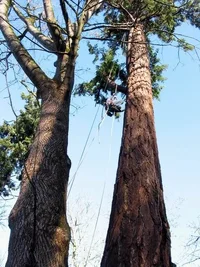
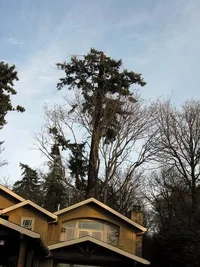
Subject tree- appz 400 yrs old, 5.5 feet dbh, old growth Douglas fir, 125 feet to last live branch, then 15 feet of snag, another appx 60 feet broken out years ago, 22 inch at the breakout.

Scott Baker had climbed and Resistographed it, it has a slight lean away from the new awesome mountain style house, the folks love it and want to keep it. (The Mercer Island city arborist thought it should come down.)

It was a darn dicey climb!!

I may post more pics, but several are up over at arboristsite.com, where over 100 kb pics work. thread is "Roger the "topper" strikes again
 

Attachments

  • 2821-Prince old growth for oo7w.webp
    2821-Prince old growth for oo7w.webp
    92.2 KB · Views: 151
Glad to see you didn't fell it - trees that age and over take on a new management philosophy because of their ecological importance. Maybe you are familiar with the book already, but I'd urge others to check it out when faced with managing veteran trees:

- Veteran Trees: A guide to good management - Helen Read - Veteran Tree Initiative & English Nature - ISBN 1 85716 474 1.

- web page

It deals mainly with ancient tree of species and habitats found in the UK, but is very well presented and can be used as a guide. Enjoy!
 
This brings up an interesting question

For most trees we deal with, if a client insists that their tree is too tall, and it either needs to be topped or taken down, is it then better to top it? We had a customer that claimed her tree MUST be topped. What do you do?

love
nick
 
Re: This brings up an interesting question

Nick,the answer is simple; first try to talk your customer out of such nonsense (i.e letting her know all the reasons why a topped tree is more dangerous than one that hasn't been),if that fails,you have only two choices; [1]you can go your merry way after explaining that you don't top healthy trees, or, [2]you can flush your integrity down the toilet and kneel at the altar of the almighty dollar. (by this I mean go ahead and top or "drop crotch" the tree). Either way, the choice can only be made by you. I've heard just about every excuse for doing shoddy work, and they're just that- excuses.You have to ask yourself Nick, did you get into this business because you love trees,or because you love money?
 
Re: This brings up an interesting question

My first attempt failed, I forgot to disable Norton Internet Security. :( I'll try again-
Lovey,
I have walked from many jobs because the customer insisted on work that would destroy the tree. I offer my opinions on why topping is unacceptable, and back it up with copies of articles that I keep in my truck. If the customer still insists on destroying the trees, I give them a (high) price for complete removal. If they insist on destroying their trees, I leave them for the hacks.
 
Re: This brings up an interesting question

Jason,
are you equating drop crotching with topping? given a client who is determined to top a tree, talking them into drop crotching seems better than nothing. I can see the argument of walking away from the job in hopes that the client gets a message, but there is still a good chance they will hire a jackleg to top the tree. if I can get in there and reduce the height without leaving giant stubs, haven't i accomplished something?

keith
 
Re: This brings up an interesting question

Keith,
We are obviously talking about the lesser of two evils, but who are we kidding? How many times have you climbed to the top of a drop crotched Bigleaf maple and seen a bunch of lovely 45% cuts to a nice sized lateral? You look at those cuts, and nine times out of ten the have a column of rot running right down the center. Moreover, you often have just as many suckers as you would from a topping cut, not to mention the now vigorous lateral that has outgrown its scaffold branch (which is now 85% hollow). It would be a little different of the customer wanted the height reduced by six inches or a foot, but most people who are afraid of tall trees want their height reduced drastically. Drop crotching is definitely not as bad for the tree as topping, but you would be hard pressed to convince me that it's GOOD for the tree (except for maybe those isolated cases presented by Dr. claus Mattheck). I'm sorry if I came off high and mighty in my last reply, but lets face it;the argument that doing work that may compromise the integrity of the tree will prevent work from being done(by some anonymous hack)that will definitely compromise the integrity of the tree is an argument that doesn't hold a lot of water for me. Imagine that you're talking to a guy who sells pot to kids, and he says "at least I'm not selling them crack" or "If I don't sell it somebody else will." I'm not saying that topping trees is the same as selling drugs to kids, but the way people try and justify doing things they know are wrong are remarkably similar.
 
Re: This brings up an interesting question

This all depends upon justification for the work. The original post was talking about the justification because of age. Some old trees are important ecological sanctuarys as well their ability to cheat death and being impressive to our psyche - why end its life when it can be helped? These simple facts are normally complicated because of aesthetics & safety issues.

If the tree has lost its top and is surviving, it can be artificially aided by us by judicial pruning on a regular basis to help prevent heavy regrowth from breaking out and causing an injury to people, property and the tree's amenity. The resulting wounds and decay are beneficial to wildlife.

This is not to be confused with topping or reduction work in an urban environment without justification, and topping should not be confused with ornamental pollarding.

Little of what we do pruning wise is good for the tree. We aren't trying to help the tree - we are compromising the tree for our benefit:

-Increased safety
- Increased light
- Decreasing pavement cracks

All this whilst trying to maintain tree health, safety and amenity within an acceptable level, again for our benefit. If we don't prune the trees to the best of our knowledge, they will suffer a premature death through our hands as an unacceptable risk, or through disease.

So, by that reasoning, we need to retain urban trees to support wildlife, decrease pollution and soften the psycological effects of hard landscapes, for OUR benefit. Both individual Urban & wildland trees may also have sentimental value, that jsutifies their retention in the eyes of the client (In the UK one local authority trys hard to retain a tree that took the crash of Mark Bolan that killed him, because memebers of the public (his fans) identify it as a link to him!), and ecological value that justifies their retention.

You cannot generalise - it depends upon each indidvidual specimen, its genetic capability to withstand certain types of pruning, and the justification for the pruning based upon the needs of the client, the needs of the tree and that of the surrounding environment (amenity/ecology).

From my point of view, if the tree has not yet reached a static mass/dynamic mass ratio of 1:1, then it should be treated (pruned) in such a way as to maintain its natural form, as promoted by most arborists and organisations. If the client wants it down and it won't be missed in the overall landscape effect, fine. If they want it down and little else is around of that stature, or want it topped or reduced for aesthetics, not so fine (I do believe that we are only custodians of the future landscape, and therefore shouldn't be allowed unreasonable behaviour that would take away something to be shared by many others).

If the tree has passed beyond this ratio into senility, then the rule book changes. It all depends upon sentimental or ecological reasons for keeping a tree alive, or both.

The last word on reducing height: Senile trees of low height and large girth are better able to withstand high wind loads, are of ecological importance (that includes us) and impress our psyche with what seems to be the ability to live forever. So what if that means it doesn't look like a typical tree - it doesn't mean all trees should look like that. If we neglected all urban trees to ecological warfare, nature would take our garden away from us. To keep all trees safe, we would have to reduce and pollard them. I wouldn't want a city full of pollarded trees - the system would be reversed and a normal tree would be the exception! We need to appreciate the wonder of old & ancient trees, and identify individuals suitable for this role in the future!

There are no right and wrong answers, only honourable intentions. Variety is the spice of life!

 
Re: This brings up an interesting question

Paollo, I too like the post. A reffreshing change from the kneejerk responce of the trypical "tree advocate". I see us as managers of the clients property, we need to have some long term veiws as to the work being done.

I think the mindset that what we do has no/negative benefit for the tree does not take the long term into concideration. And does a disservice to the industry.

Proper tree management can greatly increase the usefull life of a tree in a landscape.

The most obviouse is to help it conform with the landscape over time so that butcher is not needed later in life for structural clearance.

management of individual subsystems to conform with growth of the rest of the tree seems to be overlooked by portions of the industry, but will have lasting results on the health of the individual plant and its neighbors.

This consists of pruning for single leaders, reducing weak codoms, stunting the vitality of fast growing limbs, ensuring that low limbs will not coaless and cause decline in the central canopy.

I would love to change this perrenial discussion from most prunning does harm, to the good that proper pruning decisions can do compared with the harm that thoughtless, production based work can do. Step away from the dogmatic ranting and define what is bad beyond topping.

Lets start with sprouts; inner canopy is not suckering. Sprouts are fast growning suculent growth, where smapp slow growing twigs are the trees second line of photosynthesis in hot times when the outer canopy flags to conserve water. They also support local bark tissue and the requirments of local wood. Thinning larger clumps is not bad but stripping them all out is, wound closure in thinned areas is much faster then areas that ere stripped out.

The link Stumper provides discusses raising canopy; is it realy better for the tree to leave every low limb on if some of them will conflict with structure or lines of sight in the future, which will result in either lionstailing or large wounds at the trunk? Many of these limbs have no branch protection zone and pith conjoining with the trunk, these wounds do not compartmentalize well. I understand the benefit the tree gets from low foliage, but would management practices that reduce/remove large branches while maintaining small branches on the trunk?

Sorry if this was more disjointed the usual. I've been doing other things for the past few hours while pecking at theis.
 

New threads New posts

Back
Top Bottom