Depends on species, cut size, % 0ff, condition, vigor, etc.
"Topping" means different things to different people. And "roundovers" may or may not be "topping". Not all proper pruning cuts are made at the collar. As Shigo noted, often there is no collar!
Good video, but no description of sustainable crown reduction was given. Maybe Mark and Melissa could shoot the next one in a tree, demonstrating proper reduction cuts made at growth points.

Let's assume we are all familiar with the main two arguments brought up to discredit topping, that
topping leaves a tree vulnerable to infection and that the regrowth from topping cuts is weakly attached compared to the original limbs.
One of the things that is less acknowledged is that when you remove most of the leaves from a tree, you rob it of its ability to create energy.
The tree needs to dig into its savings to replenish that as fast as it can. A tree with lots of reserves may overcome the obstacle. Trees with lesser reserves may die or have insufficient reserves to fight disease.
Another thing even less considered is that the fine twig ends of limbs are like whips, designed to dissipate wind energy. You rib trees of their ability to respond to wind the way they designed themselves to.
In some cases, mainly in retrenchment scenarios, apparent topping is a viable strategy. And some trees are tough enough to adapt to pollarding.
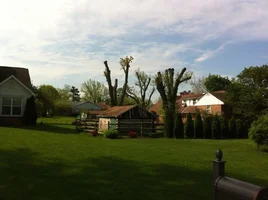
Other thing that topping does? Makes a beautiful tree butt ugly.
I took a photo of this "butt ugly" property while I was passing by... What were they thinking?! Sad thing is - I see this all the time. This is in Reading, PA.