What am I missing here?

Matias

Been here much more than a while
Location
Butte County
1000000715.jpg1000000720.jpg
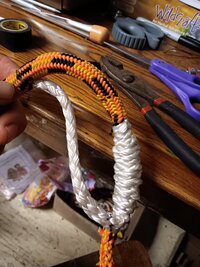
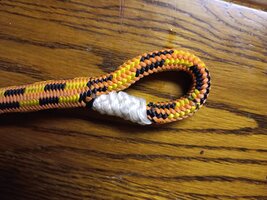
So, I have never not completed a double braid splice and it seems my beginners luck streak has ended. I have had this happen twice in a row with this piece of blaze I'm trying to splice. The core is bunched up and it is lumpy in the bury, and it really won't go in anymore. Both times, the crossover wouldn't go at all past mark T to get to the eye mark.

What am I missing here? Is there some special instructions for XTC24?
 
You able to back out the core and try again? The bunching occasionally happens to me when I dont keep enough tension on the core during the bury.
I tried but it didn't seem to wanna give. I jerked it pretty hard to get it where it is now, so it's pretty well jammed. I cut it off, as I don't want it to have the size eye it would have if it only buried to the crossover. I made the crossover at the mark I usually would, but it didn't suck in to cover those 8 strands worth of cover. Which happened the previous time as well. I just did some stable braid 9/16, and it was like splicing silk rope.
 
That crossover is tricky, and if it’s not super clean it will be a bear to “beary”

When you made the crossover did you yard pretty good on both ends to get it sucked in real tight?

Do others use an MA system to help with the bury?
 
Haven't had time for patient dissection.

It's very tight in general for sure.

I clamped the cover tail to be able to put my body weight into making the crossover. It still wouldn't go a single strand width past "mark T", 8 strands towards the end from mark 1.

It's that crossover that really has me stumped.
 
Lots of possibilities. A picked stand is probably what’s hanging you up.
I’ll often add a few inches to the end of the line BEFORE doing a thing and make a heavy mark where the line should end for all my measurements.
On the core burry I’ll pre taper and leave the tail long without trimming it on the exit. This gives me something to pull on if I think there might be a snag.
Stitching the cross over is your friend, just a few passes without a knot and this can be pulled out as the cross over buries if desired.

A long prussic made from throwline around the cross over on the cover side tensioned pulling against the know upstream to keep tension on the core really helps.
 
I used to have that same issue when I first started out. Since then I have found a couple of tricks that don't seem to get much attention in the splicing directions that seem to prevent this from happening. For the steps described below, I'm using the Samson Splicing Manual marking, steps and terminology:

Step 5 tapered cover Figure B. "Leave the tapered cover tail out". Note the tail of the tapered cover that sticks out? Mine always seems to get sucked into the core and disappears. You then don't have a piece of the tapered cover to pull on to get the crossover tight. While the tapered cover is still exposed, I tie/sew a short piece of whipping thread about midway along the taper (where you still have most of the cover strands), and leave the tails of the thread long enough that the thread tails can't get sucked inside the core.

Step 7 "The crossover should be tightened until it is approximately equal to the diameter of the rope." To do this, first pull out enough of the core (not the core tail) so that you can pull the core tail and the tapered cover tail in opposite directions to really tighten up the crossover (really tight). Before pulling these in opposite directions to tighten the crossover, your tapered cover tail will likely get sucked inside the core. You can pull on the whipping thread to coax the cover tail back out of the core to where you can grab the cover tail. Then pull the tapered cover tail and the tapered core tail in opposite directions. This enables you to get the crossover really tight. Cross stitch the crossover while it's really tight to keep it that way. You can then milk the cover tail into the core until the core and cover are smooth and tight. You can remove the whipping twine before you milk the tapered cover tail back into the core, or just leave it on the tapered cover and cut off the excess twine. You can also then milk the tapered core tail back into the cover.

Step 8 "If bunching occurs . . . ". This is an important step. For some ropes you need to do this, and some you don't. Pay attention to the area that's going to become the eye. You want to make sure this doesn't bunch up anywhere. One way that seems to reduce this bunching is how you bury the exposed core. Don't just milk the cover. You need to keep tension on both sides of the eye while pulling on the eye. You also need toperiodically "snap" the eye while burying the cover to keep things tight. By keeping both sides of the loop tight as you pull the loop and milk the cover it seems to make it much easier to do the bury.

By using these tricks I haven't had an issue with the type of bunching you show in the photos--and I've done a lot of splices on lots of different Class I double braid ropes. I hope this helps you too.

I also agree with Evo. A picked strand can also really mess things up. To do "Step 6--Reinserting the core into the cover" I use a wire fid (made out of 0.030" welding wire) for this step. Readily available, very inexpensive and easy to make. To check and see if you've caught any strands, after inserting your wire fid from point Z to mark T, pull/milk the core back and forth. It should move easily. If not, you've caught a strand. If that's the case, it's easy to just pull the wire fid back out and try again. This is way, way easier with a wire fid than a tubular fid. If you're using a tubular fid, getting the fid through that section between Mark X and Point Z is (IMO) horribly difficult. With a wire fid it's a piece of cake.
 
Last edited:
Ditto on the thought that you've snagged a core strand somewhere. Or sometimes I just pull everything apart and start over. And watch the "sidedness" of your buries (see videos) - what side the FID goes in and comes out - if that isn't set up right you'll get things twisted and have trouble later on.
In step 5 above I just use one of those snap keep fresh fastener thingys on the cover to not let it slip into the core completely till I've stopped flailing around with things. I like the idea of a prussik type small diameter cord to yank on the cover and core before you do your bury. Maybe have a look at a splicing video for Courant Squir - different lind of core but the yanking is the same to get the crossover really tight.
I still like watching Eric splice Blue Moon - I found it about the same to splice as Blaze.
And in step 8 above I find it really important to keep tension on the eye as you're pulling and doing your bury - I use a biner with a flatter end cuz it's easier on my hands.
Milking cover for final bury with a prussik is now standard with me. On some really tight eye splices I find rather than yankin too much. I just tie a rope off over a pipe between joists or on a lim, get into a harness and give the splice a final yank or two to get it where I'm happy. Or some guys do the final bury with a harness while standing - whatever - body weight helps.

 
Ditto on the thought that you've snagged a core strand somewhere. Or sometimes I just pull everything apart and start over. And watch the "sidedness" of your buries (see videos) - what side the FID goes in and comes out - if that isn't set up right you'll get things twisted and have trouble later on.
In step 5 above I just use one of those snap keep fresh fastener thingys on the cover to not let it slip into the core completely till I've stopped flailing around with things. I like the idea of a prussik type small diameter cord to yank on the cover and core before you do your bury. Maybe have a look at a splicing video for Courant Squir - different lind of core but the yanking is the same to get the crossover really tight.
I still like watching Eric splice Blue Moon - I found it about the same to splice as Blaze.
And in step 8 above I find it really important to keep tension on the eye as you're pulling and doing your bury - I use a biner with a flatter end cuz it's easier on my hands.
Milking cover for final bury with a prussik is now standard with me. On some really tight eye splices I find rather than yankin too much. I just tie a rope off over a pipe between joists or on a lim, get into a harness and give the splice a final yank or two to get it where I'm happy. Or some guys do the final bury with a harness while standing - whatever - body weight helps.

The Step 5 using a clip, snap, whatever you want/have works. I sometimes use such a thing instead of the thread. I usually prefer the thread because it's so light weight--nothing to flop around or accidentally fall off at the wrong time. Use whatever you want to keep the tapered cover tail accessible. Being able to grab it and pull hard is the key.
 
I will get to dissecting it this evening and we'll see if there's a snagged strand, but I am 99% certain that's not the case. I learned that wire fid trick from Eric's videos, but I had the vortex video bookmarked for double braid and forgot about the blue moon video, which is practically the same rope. I wanna splice an eye on my squir, so I will be checking that video put as well.

I definitely don't ever lose my cover or core. I never thought of a quick stitch to hold the crossover in place; that's really clever. I have been using vice grips for lots of tail and crossover clamping, but threads sound easy enough and much lighter weight.

Like I said, I am good at applying adequate force in the various ways that have been mentioned, so I'm just gonna make some tiny adjustments to my strand counts maybe, and will try again this evening after dissecting the last eye. The first failed attempt will serve like a sort of butt splice on the other end of the rope. I whipped it and put a couple of stitches in.
 
When stitching or getting ready to, I will pull the cover tail out of the exit, tape it and spike it. This makes sure it won’t self bury until I’m ready for it.

I have a set of these, that I tossed in my splicing gear. So many good uses for them, work great for prying strands, plucking stands and using as a spike. https://beanfarm.com/products/probes-prohook-sexing-probes-3-pc?_pos=16&_sid=dc96e5702&_ss=r
Back in reptile land these are used for sexing snakes, which have two inverted penis’s up their vent towards their tails. You lube up and count how many scales deep the probe goes. Deeper for males and just a few scales max for females. Now you know….
 
When stitching or getting ready to, I will pull the cover tail out of the exit, tape it and spike it. This makes sure it won’t self bury until I’m ready for it.

I have a set of these, that I tossed in my splicing gear. So many good uses for them, work great for prying strands, plucking stands and using as a spike. https://beanfarm.com/products/probes-prohook-sexing-probes-3-pc?_pos=16&_sid=dc96e5702&_ss=r
Back in reptile land these are used for sexing snakes, which have two inverted penis’s up their vent towards their tails. You lube up and count how many scales deep the probe goes. Deeper for males and just a few scales max for females. Now you know….
TMI...
 
  • Haha
Reactions: evo
Another thing I've tried is using sailmakers needles in an "X" thru the crossover once it's pulled tight to keep it from moving. I don't usually do this anymore because my splicing has settled down to where I keep the crossover tight enough with pulling from both ends and frankly I kept sticking myself, but thought I'd throw it out there if somebody wanter to try it to see if it helps.

 

New threads New posts

Kask Stihl NORTHEASTERN Arborists Wesspur TreeStuff.com Teufelberger Westminster X-Rigging Teufelberger
Back
Top Bottom