Wedges or Rope?

FWIW: I often use both rope & wedges. As others have posted; they both have their place. In fact, the only time I don't use a rope is when the tree has a favorable lean and there is zero chance the tree will get hung-up in another tree. I've found, the hard way, that setting a line in hung-up tree is difficult and hazardous. IMO … It's way easier and SAFER to have a line in a tree and not need it than to need a line in a tree and not have it. A safety-line in a tree is not just for pulling a tree over. In addition to a pull-line for a heavy side-leaner, I'll often set a hold-line perpendicular to the lay to help keep the tree away from a target. For a heavy back-leaner, sometimes wedges will not overcome the lean, so a rope is necessary to pull tree to the lay. The mechanical advantage of a pull-line is always greater than a wedge. However, wedges are better to prevent pinching a bar, especially in a compromised stem — even when using a pull-rope.
Just my 2¢ … GREAT THREAD!
 
Yeah it was weird, it also required a height limit. One that came back quite short which I discovered, called the agent and some how they changed it to 150’. It was called assisted felling or something like that then went on to detail ‘pull rope’ and ‘wedges’, and ‘no felling within city limits’
Sounds like they were applying a logging standard for some odd reason. The height limit and terminology is similar.

Tony
 
If by "safer" you mean giving yourself the best chance of getting a back-leaner/side-leaner to hit its intended lay then its a tagline 99 % of the time. This is going under the assumption that your crew members and yourself know how to properly pull on a tagline...
This is an excellent point. I would call what Rico stated not as safer but more efficient.

“Safer” to me implies that a hazard has been reduced, mitigated, and or eliminated. Often times this is just the other side of the coin with efficiency.

Those differences in definition and the end goal are why these types of questions cannot be answered in definitives.

It is why good experience is always the trump card.

Tony
 
I think the type of trees and their size would be a significant factor. Many of the trees here in the east coast are decurrent and tent to be smaller in height and girth, given that most trees of size were logged out already. So in Maryland where you come from, I suppose a rope would be the go to. In most cases you can remote set a line with a throw line with either an isolated branch/trunk pull or a base tie. All this assuming residential work rather than logging. I did come across some older, forest grown white pines that I thought would be easier to fell with a wedge than in most cases.

Wedges are great tandem with lines in some situations and good for trees in non-critical settings with residential work.

Also, how you pull on the line matters. Hand pulling, truckers hitch, come-alongs, side pull lines on truckers hitches and come-alongs, winches, tractors, vehicles, all make a difference based on location, traction, fixed tie in options, targets, lean, and puller safety.
 
Worked with a logging feller in a residential scenario a few weeks ago, every tree that didn't have a favorable lean and was in range of homes or lines got a rope.
Both is safest if I had to pick one I'd take a rope if it's something I'm worried about not going where it needs to on it's own especially if it's dead. I've had a few beetle kill pines that were straight just lift straight up hammering wedges and fall over cut was good, one was just a post.
 
I strive for wedges 100% of the time. Reality is maybe 70/30, Lots of info can be gleaned just by hand setting a wedge in loosely, longer the better. If it sits up the tree is sitting back, if it tips down its getting ready to go..
If its sitting back, the wedge is already there, ready for a few taps.. Cut a little, wedge a little.. repeat. Check the hinge and if it's where you want it, tell the guys to pull. Slow and methodical, and helps prevent rushing though things.
 
For me the rope goes on if the tree is compromised; leaning hard the wrong way; or I am winching a hung up tree out of others. Anything solid and somewhat upright I won't bother getting out a rope. But then, where I work and what I am doing most often has zero chance of damaging property if something should go amiss. I have been wedging and jacking trees for a lot of years and feel very comfortable about where the tree is going to end up.
Most of what I do entails getting the tree down. Where it will go all depends on where I can drop it so it will not get hung up, or hung up further than it is. I get to pick the spot. Most leaners will be dropped in somewhat the direction they are leaning. A real benefit to this type of work, and I don't have to recover the tree or clean it up. It stays where it fell or pushed to the side if it is on a road or right-of-way. On the other hand, I sometimes have to climb and take them down a piece at a time. That kind of sucks at my age, but it comes with the territory.
 
Would be a good time to view some youtube with improper tag lining and lost/popped hinges from over wedging back lean. Just as reminder. Good to refresh the concept that wedging is not lifting except in the simplest case of a purely straight balanced tree. Even then it's levering. It alters the stress strain near the hinge which starts out in varied states from lean and balance.

IMO it is good not to rely on an assumed level of hinge capability.

Well written thread:)
 
I disagree that wedges are guides. The hinge and gravity are guides.

The wedge and rope get the tree's center of gravity past the hinge enough for gravity to continue to exert enough force to bend the hinge until the hinge fails.


Ropes are easier to use an very thick hinge. Wedging a thick hinge is harder.
 
i think,
The compressed part of the hinge is the actual common shared pivot as bench mark to all other force points measurements.
Try to see (in sound, solid, monolith unit) as if tree on hinge is weightless framework;
>>except for a cannon ball of weight called CoG, within framework perimeter
>>but not necessarily on the framework
>> i call it: CoG of horiz metal donut would be the hole rule, force as a ghost presence model here. Added inputs of rope/wedge must be on framework tho/ not ghost.
The distance and angle of the inputs: CoG, rope, wedge distances to shared pivot as leverages
>> battle thru framework to force directions values of the inputs.
.
i prefer work the rope, wedge as anti-sitback safety sometimes.
Rope in higher leveraged position, but wedge is in a more rigid position
>> wedge face does also stays as a pure perpendicular input to tree base tho too
>> wedging is more sawyer distraction and tools at base.
Rope is less rigid input and position, but then can be used to flex wood to same spring, and also brace rear of tree if traced down back spine.
.
Each force direction is of very large importance.
In E=mcSQUARED, it is dynamic velocity as the real game changer potential in contrast to the static force parts of CoG, wedge, rope.
So, i think in terms of falling(slower, more art and evac time)
>> vs. throwing(thinner hinge allowing faster movement) triggers by quick release
>> or sudden rope, wedge to weaker hinge so that force of motion (cSQUARED) as then a ruling force direction of even enough to punch thru 'distractions'.
My concern is directions of added inputs when side lean.
>> added force inputs to faced direction 'arm wrestle' hinge to thicker/stronger/earlier fold
>> vs. added forces across face against side lean that only manage side lean until rope/wedge relieves, then potentially impact back with side lean as a pulse of force.
If speed is invoked it can cSQUARED can trump side lean some.
The less speed invoked, the more static elements can reveal until committed speed achieved. Specifically crafting of hinge taper : anti-left, anti-right or anti-anti(neutral).
>> Triad of anti's as the pull more powerfully as challenged, pulled against, than if just there.
>> This triad assumes all hinges tapered, so binary of left or right choice
>> then too as other half of overlaying binary against assumption to add the non
>> to cover all instances, always treating Zer0 as a VALUE of balance, not just simple place holder (triad/ trinary view/model has ying-yang roots "Tao of Physics" -Fritjof Capra).
Added rope/wedge only usher against side lean until relieved, unless speed invoked to carry thru or imbue forces into hinge that can usher against side lean to close/tearoff.
In general, in good wood, i think all force forward to force better hinge, accentuated with taper , anti side force efforts wasted to this modeled view. But look to slower fall control is how I go.
.
If use part of wedge/rope force against side lean , hinge less strong than if all force forward. Speed of throw during rope/wedge active can carry that direction thru less reliant on hinge build.
.
Slow fall w/o so much 'throw'/speed; depends more on hinge, w/lower cSQUARED factor.
In either scenario unclean/stalling is bad, allowing changes and impacts smooth, clean motion does not.
Closing face side(s) (L,R,neutral/ full across triad again only later and to front) give another change, powered by speed of slap and face rigidities AND give sudden pivot(al) change to the works to then recalc leverages from the new common/shared point of pivot. Like bouncing a rubber ball off wall or ground, the more speed force in, the higher force returned.
.
i view falling into lean as most direct, hardest hit, so side lean with Tapered Hinge control must be less as softer hit downward. For part of leveraged potential expressed and bound sideways, not fully down now. So 2 reasons not to fell directly into lean force: less ground concussion and PRACTICE. Doc Shigo showed harsh rainfall could upset sea of soil mychor etc. So, bucket truck and felling are not innocuous compressions either on that scale.
.
Backleaner to me more of a draw CoG uphill over the pivot to TDC, to then more splash down to fall side. This is more true the steeper backlean, hinge can only be worked so much and dependant on species and condition.
.
In neutral taper side lean works anti / Dent's offside harder, taper affords to do home more AND support angle maintained more as tree flows forward. When appreciable side leans handled w/ neutral hinge taper squarely to face, i kinda assume is faster throw style of less evac time.
.
i face to direction of fall, not face over steering to serve to fail point between side force and facing directions as seen Tim Ard shows.

 
Last edited:
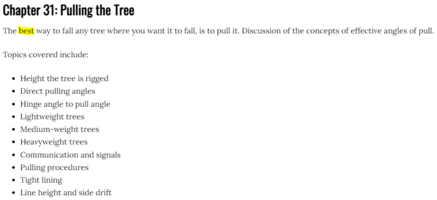
From : The Fundamentals of General Tree Work - G.F. Beranek

View attachment 88490

Someone's idea. One could say the BEST way would to be build a wall on each side of the stem so it has to go between them when it falls. There comes a point where BEST must be overruled on favor of practical and reasonable.
I just finished a week long project of clearing a basswood stand. As we know basswood tend to grow in clumps radiating outward in all directions. I pulled with a rope on two of the 31 trees I took down. All 31 fell exactly where I wanted them to fall.
 
I certainly don't disagree with your stance of using just what is needed for the situation at hand,r but to imply that Gerry Beranek is just another 'someone' is not fully understanding his qualifications and why what he says carries so much weight.
I wasn't knocking Gerry at all. I have his book, in the orig. hard cover. I was merely pointing out that what one person thinks is the best way does not fit for everyone else. Nor is it the best way at all. There are better ways, but time and reasonability preclude that you choose your best way for the situation.
I have much respect for Gerry, but he is just another point of view, albeit with a knowledgeable view.
 
I have much respect for Gerry, but he is just another point of view, albeit with a knowledgeable view.

Oh no! Blaspheme against the tree Bible!

But seriously, based on what I have seen of his work I don't think Beranak would would disagree with this:
There are better ways, but time and reasonability preclude that you choose your best way for the situation.
Nor actually do I suspect he would disagree with this:
he is just another point of view, albeit with a knowledgeable view.

What I think he has done is provide as comprehensive a discussion of the factors and options as he was able at the time to help people make reasonable decisions based on the situations they come upon to mitigate risks and work efficiently and safely.

If the original poster has not read Fundamentals, he would certainly benefit from doing so.
 

New threads New posts

Kask Stihl NORTHEASTERN Arborists Wesspur TreeStuff.com Teufelberger Westminster X-Rigging Teufelberger
Back
Top Bottom