
Bendroctanus
Carpal tunnel level member
- Location
- Springfield
Hear, hear!You would be hard pressed to find 2 men who know more about the HH than @DSMc and @Richard Mumford-yoyoman, and we should count ourselves lucky to have them here at the Buzz.

Follow along with the video below to see how to install our site as a web app on your home screen.
Note: This feature may not be available in some browsers.
Hear, hear!You would be hard pressed to find 2 men who know more about the HH than @DSMc and @Richard Mumford-yoyoman, and we should count ourselves lucky to have them here at the Buzz.

The angle can be a difficulty.I MRS'ed out today.
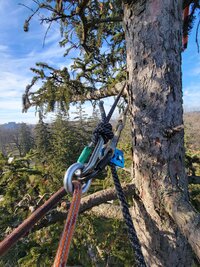
I could have flipped my HH biner over, for less conflict. It wasn't an issue when the 2 sides of the system were on my bridge at outward angles, however, as I descended, the ring and termination biner came together. As I descended more, they conflicted more. A big-hole bowline (tied off) on the ring would have worked a treat.
I was using @DSMc 'S Fixe pulley on DMM bridge ring add-on.
View attachment 91375

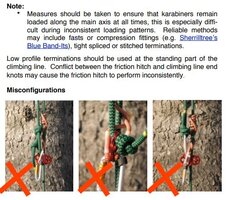
That's the second edition, but the first one - or at least an older one - also warns about interference of knot and hitch on page 7:Here is the most current Hitch Climbers' Guide to the Canopy showing that a termination knot (page 15) is not liked by their legal team. Does anyone have older archived versions of the Hitch Climber's Guide to the Canopy they can share?

Same!An anchor hitch would not interfere as much as a fisherman's knot.
Mirror imaged anchor hitches could be used on a pear shaped biner that goes to the saddle and would also capture the Hitch Climber in place.
Spliced eyes can and do move around easily and can side load a biner.
I've always trusted the anchor hitch over spliced eyes. Plus you don't have to buy them and can easily switch ends of the main climbing rope.

As much as I love an anchor bend, I haven't paid for a splice in many moonsAn anchor hitch would not interfere as much as a fisherman's knot.
Mirror imaged anchor hitches could be used on a pear shaped biner that goes to the saddle and would also capture the Hitch Climber in place.
Spliced eyes can and do move around easily and can side load a biner.
I've always trusted the anchor hitch over spliced eyes. Plus you don't have to buy them and can easily switch ends of the main climbing rope.
Cant help but notice that all the photos in the hitch climber guide show the termination knots being attached to the upper hole of the HC pulley. I thought it was a no-brainer to use the center hole when running a termination knot on a HC setup?That's the second edition, but the first one - or at least an older one - also warns about interference of knot and hitch on page 7:
View attachment 91381
Hadn't considered that point, but you're right, I do that automatically, as though there were no other obvious correct way in that setup. Nobody ever showed me that. I don't think I have ever seen anyone mention it in a video either.Cant
Cant help but notice that all the photos in the hitch climber guide show the termination knots being attached to the upper hole of the HC pulley. I thought it was a no-brainer to use the center hole when running a termination knot on a HC setup?
I've always used that middle hole. Aside from the manual, that middle hole connection is all I see when I looked.Cant
Cant help but notice that all the photos in the hitch climber guide show the termination knots being attached to the upper hole of the HC pulley. I thought it was a no-brainer to use the center hole when running a termination knot on a HC setup?

This right here solves 99.7% of all problems. I understand that it's not the fastest possible solution, but some smart people have told me that slow is smooth, and smooth is fast.It’s always good to give a all systems check before taking a big swing, shifting weight from one device to the other before change overs, as well as before making saw cuts.
About the same level of most modern contraceptives…. Excluding well placed ice cubes of course.This right here solves 99.7% of all problems. I understand that it's not the fastest possible solution, but some smart people have told me that slow is smooth, and smooth is fast.

You can use another hitch on the non-spliced end of your line with a foot or so of tail before a stopper. It might sound a bit clunky, but it’s actually very clean as far as the potential of interference with your main hitch. Even a thimble prusik works a treat.Hello All,
My normal tool for climbing both SRS and MRS is the HitchHiker XF.
If I want to traverse to another limb, I will often use the other end of my line. I will make all the necessary throwbag/grappling hook moves to get situated and secured. My tool of choice for the other end of the line is a HitchClimber Pulley and hitch of choice. I will then ease out my XF TIP while easing in my HC setup. It's one of my favorite parts of climbing...traversing my way through the canopy.
So...that leads me to my question. As I'm working with the "other end" of my rope, there is no spliced or sewn eye. I keep reading that it is not recommended to work with a HitchClimber Pulley with a termination knot, as it (the knot) can disrupt the effectiveness of the hitch/prusik.
My thought was that maybe a Figure 8 up the line, and out of the way of the HitchClimber and hitch would be a reasonable solution. I would like to know your thoughts/solutions when a spliced or sewn eye is not available to you, but your available tool is a HitchClimber Pulley?
Thank you.
David
I struggle to see how the stopper knot in the middle frame can interfere with the friction hitch as it is well below it. What is the problem with that configuration?That's the second edition, but the first one - or at least an older one - also warns about interference of knot and hitch on page 7:
View attachment 91381


