warp speed bridge autopsy

robinia

Participating member
Location
Ontario, Canada
I recently replaced a warp speed bridge on one of my saddles. I was starting to get concerned about it as it had been in service for at least 2-3 years, occasional usage. I honestly can't remember how old it was.
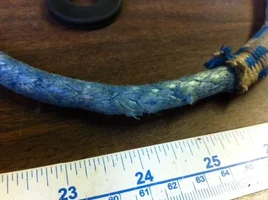
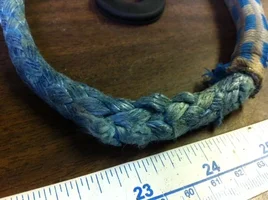
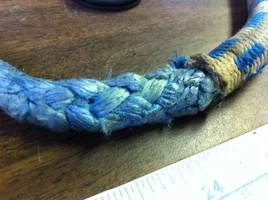
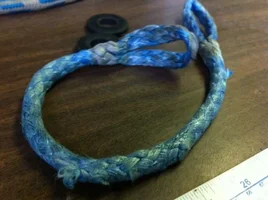
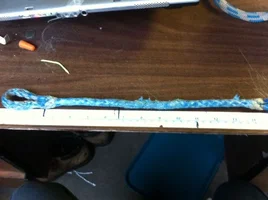
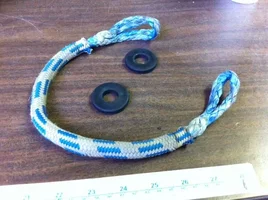
I pulled off the cover to inspect the load bearing core and it looked like you would expect- fairly compressed, a bit ratty looking, but otherwise fine. (see photos)
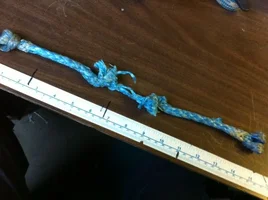
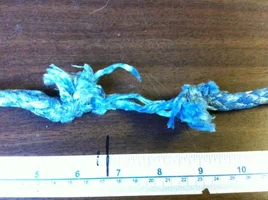
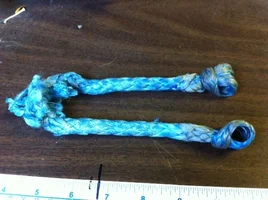
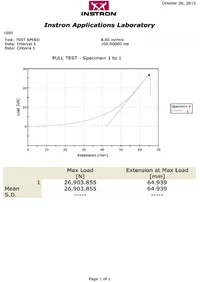
I then had the old one broken to see what the actual residual strength was.
Pleasantly surprising results: 6,047 lbf compared to the new, unused rating of 9,000 lbf.
However that is a 30% decrease over that time. Probably caught it pretty much right on time.
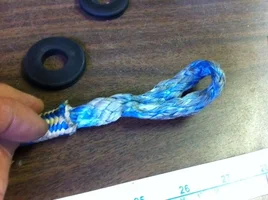
image (20).webp image (21).webp image (22).webp image (23).webp image (24).webp image (25).webp image (26).webp image (27).webp image (28).webp
Looks like there was lots of meat still there after all, and people can draw their own conclusions - I'm only posting this for information.
If you don't trust the gear anymore, switch it out!
 

Attachments
  • image (19).webp
    image (19).webp
    54.8 KB · Views: 12
Last edited:
Thanks for posting. I've always wanted to know what my old gear would break at, it's good to see an example like this.

I cut a bridge off of a coworkers cougar saddle this spring, same basic style not sure what materials. I'm confident it was at least 6 years old, compressed down to about a millimeter thick in the eye area and crumbly like chalk. It had to of been sooooooo close to failure! I wish I would have had that one tested or at least taken pictures.
 
You have any idea what type splicing method is used?looks like buried and weaved,i took mine apart,i just can't believe how short the entire splice is. Awesome documentation!!
 
You have any idea what type splicing method is used?looks like buried and weaved,i took mine apart,i just can't believe how short the entire splice is. Awesome documentation!!
As far as I could see it was a straight bury with heavy duty lockstitching - 3 parallel strands that stitched half the bury length at 12, 3, 6, and 9 oclock.
I can't say I found the construction more reassuring after taking it apart. I'd like to see a brummel or two, but then I'm no expert.
 
Last edited:
My big concern was if there would be significant strength lost or damage from self-abrading in the dyneema. I understand that that is the big problem with this textile.
 
Amsteel is slick stuff,I dissected mine just to see the splice(I didn't break it),im positive there was some type of weave after the bury,I contacted buckingham and they said," The bridge has a straight pull test of 8,000 lbs and how it's used holding going out it would be more than that. You wouldn't have anything to worry about." And would not tell me the splice method,said its proprietary!! Phfff
 
While we're on this topic- why isn't Amsteel used more for life support? I know it has a very low melting point, but I'm thinking super small, ultralight redirect slings and similar things. I know external abrasion is also an issue, but is one that can be solved with tubing. Is there something else I'm missing?
 
While we're on this topic- why isn't Amsteel used more for life support? I know it has a very low melting point, but I'm thinking super small, ultralight redirect slings and similar things. I know external abrasion is also an issue, but is one that can be solved with tubing. Is there something else I'm missing?
Only that it's very static and more expensive per foot than polyester.

Reed Wortley
CTSP #01739
ISA CA #SO-6953A
 
Makes sense. I'm going to price some 1/4" to make a few mini ultra slings. 6000+ mbs and almost no weight. I don't know why, but I've been obsessing over amsteel's weight to strength ratio combined with its easy splicability.
 

New threads New posts

Kask Stihl NORTHEASTERN Arborists Wesspur TreeStuff.com Teufelberger Westminster X-Rigging Teufelberger
Back
Top Bottom