Using more than one block/pulley for rigging

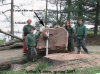
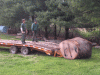
same tree. all we had was a skid loader and a trailer back then. rolled the chunks up the trailer ramps. too heavy.
 

Attachments

  • 171711-bigWhiteOakRollOff.gif
    171711-bigWhiteOakRollOff.gif
    114.4 KB · Views: 140
[ QUOTE ]
I found some pictures.

big white oak removal. all climbing and ropes.

[/ QUOTE ]

That was exactly the setup I was talking about!
cool.gif


I agree witht the idea, that you should be aware of not putting too much force in to the system - but it seems lik a much safer setup, than just using a single pulley, and letting it take all the beating.
smirk.gif


Nice pictures Arbor X!
smile.gif
 
Xman,

How does having the 2nd pulley on the bottom take much weight off of pulley 1? Is it kind of more spreading the weight across the stem? If pulley 2 was higher then pulley one would it transfer more weight off of pulley 1 if for example you had a good sturdy stem above where pulley 1 was? Just trying to piece this all together.

Thanks.
 
just think of a fishing pole.

if you just used the top eye in the pole and had no others, you will break that pole on a big fish right? the more eyes down the pole you have, the more likely you will be able to keep it from breaking.

yes, spreads the bending forces down the stem and directs the pull down the stem instead of trying to break it in two.
 
[ QUOTE ]
Xman,

How does having the 2nd pulley on the bottom take much weight off of pulley 1? Is it kind of more spreading the weight across the stem? If pulley 2 was higher then pulley one would it transfer more weight off of pulley 1 if for example you had a good sturdy stem above where pulley 1 was? Just trying to piece this all together.

Thanks.

[/ QUOTE ]

i read you type again. yes, if pulley 2 was up higher, then 1 on a good strong stem down force may be reduced at pulley one. but you also risk the chance of pulley one trying to get pulled toward pulley two.


but I have done this too. depends on the diameters and situation. often on a similar situation, if the limb I have a block out on has the potential to fail at a v crotch or something, i will take the tail of the sling used for the block and after i tie the block on; take that tail over to the other opposite side and tie it off on the opposite of the v crotch. kinda like a temporary cabling job. very simple, but if my words don't make sense, i will draw.

 
I will always use 2,at least 2, pulleys for lowering rope.If on the odd occasion its not worth putting up pulleys i will still run the rope through at least 2 appropiate forks.
This is obviously going to keep the 2 ends of the rope seperate but more importantly it is to distribute the weight,we call it backloading.
Another very importantant reason is to direct the lowering rope back down to your friction device without any interference.
On most trees you can find a strong central leader wich runs pretty mnuch straight up from the trunk.Up at an appropiate height(depending on tree size and species)you put your main block.You should make it so a rope runs clearly down to a mounted friction device.From that centrally mounted pulley you can set up a lowering point on any various lowering points you seem fit.
You might even redirect to a 3rd pulley/lowering point, or more, at some point. Dont be scared to change your high points around!
 
Hi Chopper.
That was a really good explenation!
smile.gif

A really good idea with the second pulley, to keep the rope from interferring with the stem/other branches.
I rigged down some big spruces today. I only used one pulley. When I took the top off one of them, I really got a big nasty swing, as the lovering rope jammed a little bit. At first I couldn't understand why - my groundguy knows what he is doing, and I was using my regular lovering device. But I am sure it must have been the friction from the stem. I don't see how I could have avoided that - aport from taking fewer wraps on the device.

Anyway - thanks a lot for all the usable posts!
cool.gif

The fishingpole idea makes sence too...!
 
We sometimes use a friction saver to run through in place of the second block. I haven't seen this particular fs in the catalogs, so can't send a link of it, but it is basically a black plastic tube large enough to accept 5/8" rope with steel rings on the end. We found it pretty ineffective as a climbing fs, so we turned it into a rigging device.

Same idea as using a second block, we just set this fs in a crotch and run the rope through it after it has gone through the GRCS and block up high. Only difference from second block is that since the rope is coming from on high, it can drop through the crotch rather than twist around to go under and through a block. The limb the fs is on gets pulled back toward the tree, so it doesn't seem like it is very likely to fail - maybe even less likely than when a block is mounted in the same place.

I have a video of this if you want evidence or further understanding.
 

New threads New posts

Back
Top Bottom