Using more than one block/pulley for rigging

Hi.
When I am rigging big pieces, and when I have picked an ancherpoint a little away from the main stem, I use two riggingblocks. I try to place the second block close to the main stem, so it gets some of the forces, that the primary block would take. Hope that makes sense.... !?
My question is, if you for example get a 20 degree "bend" on the secondary block - how much force does this take off the primary block?
And is there some drawings/diagrams, that provides more information about this subject?
icon314.gif
 
This is an interesting question, peder-d. This seems to be a simple vector problem, so it would go like this:

Assume your blocks are perfect, so the rope tension is the same everywhere. This means the force on any given block is the vector sum of the forces (tensions) on the 2 legs of rope wrapped around the block. Let's say the rope tension is F, the weight of one of your big pieces. With a standard single-block arrangement, the load on the block is 2F.

If you now rotate one leg 20 degrees so the rope can go over a second block, we need to recalculate the resultant force on the main block. Everything is symmetrical, so the resultant force is directed halfway between the two legs, or 10 degrees from either. The component force in that direction, due to just one leg, is F x cos(10 deg), or .984F. The other leg contributes the same amount. The two together produce a net force on the block of 1.97F.

So incorporating the second block has done almost nothing to help out the first block! The picture improves slightly with bigger angles, but even with equally sharing blocks (90 degree wrap around each) the force on each will be 1.4F.
 
yes but as in a big crane the second pully helps off set gravity by pulling the two leads together instead of one being pulled to the ground.
 
[ QUOTE ]
Hi.
When I am rigging big pieces, and when I have picked an ancherpoint a little away from the main stem, I use two riggingblocks. I try to place the second block close to the main stem, so it gets some of the forces, that the primary block would take. Hope that makes sense.... !?
My question is, if you for example get a 20 degree "bend" on the secondary block - how much force does this take off the primary block?
And is there some drawings/diagrams, that provides more information about this subject?
icon314.gif


[/ QUOTE ]

The imporant thing to know is simply that it's a good thing to do.

Also, not just for big pieces, but for working on very weak or thin diameter stuff or also for a speedline anchor point, use the same concept.

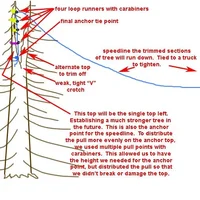
Here's what i mean on the speedline anchor point; if the anchor point is needed to be high, but the diameter is thin, spread out the pull on the anchor point down to a large diameter. This is good in two ways. First way is to avoid cracking off the anchor limb or trunk. Second, if there is a screw up and you did crack it off, hopefully your final tie point will be on a big enough lower area that didn't crack off and things won't come crashing down.

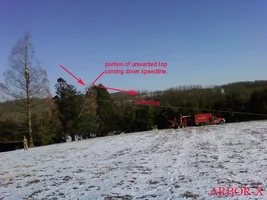
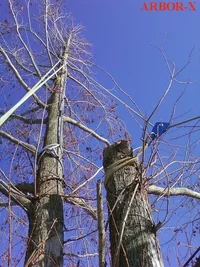
here is a diagram of a simple speedline we did to remove an alternate top in a dawn redwood.
 

Attachments

  • 171237-dawnredwoodspeedlinecopy.webp
    171237-dawnredwoodspeedlinecopy.webp
    50.7 KB · Views: 226
It sure was out in the open.

dropping out the top would have likely broken up the lower limbs, as you know how much of a cone shape dawn reds are. The top would have surely hit the lower limbs, if it was norway spruce you could have gotten away with it without breakage, but dawn redwoods are not so elastic.

I could have cut them very small i guess and tossed them out and maybe not broken anything.

I got up there, saw how numerous and far out the lower limbs were and said, hey, we can speedline this thing in two sections without breaking anything.

so, that was the choice, and it was fun too.

I could also had just driven the crane to it, set up and did it in one pick. But I felt like doing the speedline and not driving the crane truck in the snow feild.
 
i've been looking for our pictures of multiple blocks in rigging like this original post was about, haven't found them yet, but i hope to and I'll put some up that are more relavent to what he was saying.
 
[ QUOTE ]
Why show off

[/ QUOTE ]

nice wording there hollen

should i not post any pictures ever, because if I do, I'm showing off?
mad.gif
And there was no audience there that day, it was way out in the country at an arboretum.

I said it was a SIMPLE speedline.

If I must show more difficult speedlines, I can do so. I was just showing spreading out the forces as this poster was mentioning.
 
[ QUOTE ]
Aahhhh so it was a top restore? Not a removal? I tought you was taking it out.

Nice use and set up.

[/ QUOTE ]

oh, good, now you approve. my day is all better now
grin.gif


Well, if I saw that picture and thought it was a removal, I would have been questioning "why?" also. Well..... I guess you make sense now too.
 
Hi X-man.

That was a good example!
Looking forward to see some pictures of a "normal" rigging situation.
smile.gif


The main goal in a "normal" situation would be to get as much bend as possible on the second pulley, so the primary doesn't get too much of the weight. And therefore should the second pulley be placed as high as possible - the strength of the tree taken in to consideration...?!
I understand the vector-thing - but I am really looking for a rule of thumb, that you can use on a daily basis.
 
I always rig a second block to the stem if my rigging point is away from it. But I mainly do it to keep the rigging fair rather than as a load distributor. If I were on a tree that gave me that much hesitation about strength I would probably double crotch the rigging point.

You can compute the load reduction with basic trig and that's a good exercise, but relying on that in the field seems like it's shaving things a little thin.
 
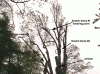
I found some pictures.

big white oak removal. all climbing and ropes.
 

Attachments

  • 171706-bigWhiteOakSnatchBlks.gif
    171706-bigWhiteOakSnatchBlks.gif
    121.5 KB · Views: 195

New threads New posts

Back
Top Bottom