UK. Two ropes at all times(USA next?)

  • Thread starter Thread starter TC
  • Start date Start date
The question I have without being for or against this whole topic is this. For all of those against two lines, how many of you have tried it for a minimum of 3 months continuous use? What was your system and what are some detailed pros and cons you found? ( by detailed I would give an example of extreme rappelling and understanding why some devices have a maximum height standard) For those for two lines, same question? I’m not looking for waste of time answers that some seem to only be able to give, it does no good to give it and doesn’t push our craft in any good direction.
 
The question I have without being for or against this whole topic is this. For all of those against two lines, how many of you have tried it for a minimum of 3 months continuous use? What was your system and what are some detailed pros and cons you found? ( by detailed I would give an example of extreme rappelling and understanding why some devices have a maximum height standard) For those for two lines, same question? I’m not looking for waste of time answers that some seem to only be able to give, it does no good to give it and doesn’t push our craft in any good direction.
It's not being against two lines. It's being against adding another rule for those of us who already follow the rules and aren't going to fall out of a tree.
I have too much work to do and fun to have to make myself run two ropes in trees that don't need them.
 
A while ago I made the comment that such a change needed to be driven by detailed data analysis about the accidents that The Factories Inspectorate/ UK HSE are trying to prevent. So far nothing. A reasoned reaction then might be for industrial rope access to try two lanyards and a climb line (spurs would be pushin it?). Just sayin’. It’s not about “try it you may like it, nor is it about a rule where you have to prove two ropes is unsafe (arbitrary opinion?). Tuff to prove negatives.
If two ropes will save lives I for one would be in but I want to hear real good reasoned justification if this really is a move forward (for trees).
I am also concerned about the tone of some of the comments from course presenters etc along the lines of “You wouldn’t believe these backward neanderthals that don’t see the advantage of two ropes mandatory”. These kind of comments are immature at best, or trite. They certainly don’t build bridges. There’s a time and a place for reasonableness.
I am also drawn to cite a recent TreeBuzz thread about climbing Reds and spurs v.s. climb lines of dubious security. That thread is germaine to this discussion as well.
My two cents is this this has been a good thread based in the arb industry. Stay safe everyone.
 
The question I have without being for or against this whole topic is this. For all of those against two lines, how many of you have tried it for a minimum of 3 months continuous use? What was your system and what are some detailed pros and cons you found? ( by detailed I would give an example of extreme rappelling and understanding why some devices have a maximum height standard) For those for two lines, same question? I’m not looking for waste of time answers that some seem to only be able to give, it does no good to give it and doesn’t push our craft in any good direction.
Biggest problem I have using two wrenches is when moving laterally away from main tie in points when rope angles are really flat and you are 30 feet out sometimes on a codom climbing higher than main tie in point sometimes 40 feet out.Problems are ;
1) weight of two ropes at flat angles is killing my back
2)another rope is going to be really useful,but not redundantly tied to big wood behind me in a situation where biggest likelyhood of injury is taking big swing back towards main tie in point.If l loose ballance while not lanyarded in,or limb im on breaks . A rope in front of me anchored near tip of limb im climbing out on helps counter weight of rope behind me,also aids in ballancing and if limb fails or I fall while not lanyarded in or lanyarded to some miniscule branch second rope would decelerate my swing back towards main tie in point . If you already are towing two systems 40 feet out from main tie in point at very flat rope angle with no available places to redirect from to get better rope angle your not likely to install another rope or tail of climbing line because you’re already to encumbered. If you’re only on one rope then it’s not a problem . Is second rope tied to secure anchor point ? No. Will it minimize injury? Most likely! Unless you turn around somehow and reach behind you and cut main climbing rope,then you might be screwed! Thats the biggest problem I have with trying to standardize the way two ropes are used, its just doesn’t make sense in certain situations! For me anyway.
 
. . . its just doesn’t make sense in certain situations! For me anyway.
That's my take on it. In industrial work at height, towers, buildings, etc., like I used to do, you are mostly up and down to do a specific job in a certain spot and a second line is a no brainer. But there is not the same extensive moving around that an arborist often has to do in a complicated canopy (and no two canopies are alike at that). It really is a different world in trees, from other work at height. I can't see that it makes sense to lump them together with the same strict regs.
 
That's my take on it. In industrial work at height, towers, buildings, etc., like I used to do, you are mostly up and down to do a specific job in a certain spot and a second line is a no brainer. But there is not the same extensive moving around that an arborist often has to do in a complicated canopy (and no two canopies are alike at that). It really is a different world in trees, from other work at height. I can't see that it makes sense to lump them together with the same strict regs.

Going back to the two tie ins in a drop scenario, because of less rope stretch, the stress on the bridge would be higher due to potentially less stretch on the climbing line, and potentially isolating any pendulum effect. So does the bridge need an energy absorber when climbing above TIP in that scenario?
 
... For all of those against two lines, how many of you have tried it for a minimum of 3 months continuous use?...

Given enough time, even the most awkward endeavors can become more fluent. That should not be confused with them, therefore, being better.

Used with understanding, two climbing lines can be of tremendous benefit. Mandating two complete climbing systems at all times, is an attempt to compensate for poor work habits and practices. Statistically, it is lack of utilizing and understanding how to use our systems that fail, not the system itself. Mandates do little to increase understanding.
 
Arb training companies in the UK now required to have all trainee climbers on two ropes at all times.

This vid (from a small training company in England somewhere?) looks at possible (very basic) solutions.

Take a look at the bizarre twin ZigZag setup at 10.00 held together with a velcro strap. In day to day work situations this would be almost unworkable, certainly impractical for moving through, across and up and down a large Oak etc, a huge amount of physical effort required, not to mention the rope tending/managment, bridge management, anchor choices, trailing ends becoming entangled and so on.

BE WARNED, this is one of the most uninspiring and depressing tree vids you'll ever see. It represents a new low point in the history of tree care where a state/gov dictated how we approach our job. DO NOT WATCH if you value the innate and inherent creativity of the tree care industry. This video shows regressive methods carried out in a resentful, reluctant, lacklustre, dull and mean spirited atmosphere.


.
 
Last edited:
TC thanks for finding this and putting it up.
Conjecture: Could a potential solution (for some types of trees at least) be an high point SRT TIP as usual and two 30' CE Lanyards leapfroggin' up lower TIPs as you go? That's not far off what we do now for some types of trees (dense conifers with branches all the way down). You'd have two "climbing lines" all the time. And you can work on the way up.
Another point is that backup devices are easily available:
https:// www.iscwales.com/Products/Back-up-Ropegrab-Devices/
Maybe better than fussing with another SRT device, on the way up at least (requires two structurally separated high TIPS though). Once you get up there you can rig two full climb lines with a stem/ branch choke etc.
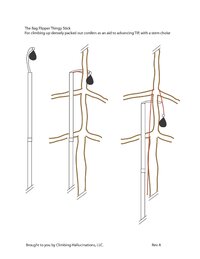
I've been toying with the idea of some sort of stem choking device/ head on a pole - say a 15 long pole with a head - something that is more or less straight with a throw bag on the tip connected to throw line, you push it up the stem through the mess of branches and the with a pull on a wire the head become sickle shaped with the trhow bag on the end still. Twisting the pole and releasing the bag might allow you to fashion a stem choke. My scotch induced hallucination.
 
Definitely a poor choice to use new guys to demonstrate, guessing the extended Prusik friction hitches were being used as a safety feature, can’t accidentally grab above the hitch in a slip or fall. The first guy hadn’t quite got the idea of hip thrusting and was more of brute strength.

The limits of how high above an anchor point the climber can go, and how much slack is allowed must also be considered. And there has to be two systems that allows the climber to descend to the ground.

If using a safety backup that follows the climber, if the main work line becomes useable, the backup device might not allow you to descend without using some additional item, or items.
 
TC thanks for finding this and putting it up.
Conjecture: Could a potential solution (for some types of trees at least) be an high point SRT TIP as usual and two 30' CE Lanyards leapfroggin' up lower TIPs as you go? That's not far off what we do now for some types of trees (dense conifers with branches all the way down). You'd have two "climbing lines" all the time. And you can work on the way up.
Another point is that backup devices are easily available:
https:// www.iscwales.com/Products/Back-up-Ropegrab-Devices/
Maybe better than fussing with another SRT device, on the way up at least (requires two structurally separated high TIPS though). Once you get up there you can rig two full climb lines with a stem/ branch choke etc.
I've been toying with the idea of some sort of stem choking device/ head on a pole - say a 15 long pole with a head - something that is more or less straight with a throw bag on the tip connected to throw line, you push it up the stem through the mess of branches and the with a pull on a wire the head become sickle shaped with the trhow bag on the end still. Twisting the pole and releasing the bag might allow you to fashion a stem choke. My scotch induced hallucination.
one of those?
 
Arb training companies in the UK now required to have all trainee climbers on two ropes at all times.

This vid looks at possible (very basic) solutions.

Take a look at the bizarre twin ZigZag setup at 10.00 held together with a velcro strap. In day to day work situations this would be almost unworkable, certainly impractical for moving through, across and up and down a large Oak etc, a huge amount of physical effort required, not to mention the rope tending/managment, bridge management, anchor choices, trailing ends becoming entangled and so on.

BE WARNED, this is one of the most uninspiring and depressing tree vids you'll ever see. It represents a new low point in the history of tree care where a state/gov dictated how we approach our job. DO NOT WATCH if you value the innate and inherent creativity of the tree care industry. This video shows regressive methods carried out in a resentful, reluctant, lacklustre, dull and mean spirited atmosphere.


.

The orator would do very well in a prisoner of war camp - can out a positive spin on any experience he endures...
 
one of those?

Not to derail the two climb lines thread, but sorta was thinking of something like in the attached pdf sketch (please forgive sketching skills).
Tried making a pole head like this in wood but it broke off. I really like the stem choke idea for a lot of what I climb which has spindly descending branches - again like a lot of the discussion in the recent climbing 2nd/ 3rd growth reds thread on TreeBuzz.

I'd be really interested in what Reg Coates and other experienced folks think of the video/ 2 mandatory lines systems law (and I can imagine what Johnnie Quick could do with it . . . ).
 

Attachments

  • BagFlipperThingyStick.jpg
    BagFlipperThingyStick.jpg
    124.1 KB · Views: 8
Not to derail the two climb lines thread, but sorta was thinking of something like in the attached pdf sketch (please forgive sketching skills).
Tried making a pole head like this in wood but it broke off. I really like the stem choke idea for a lot of what I climb which has spindly descending branches - again like a lot of the discussion in the recent climbing 2nd/ 3rd growth reds thread on TreeBuzz.

I'd be really interested in what Reg Coates and other experienced folks think of the video/ 2 mandatory lines systems law (and I can imagine what Johnnie Quick could do with it . . . ).
Hmmmm, interesting idea! Maybe the thing could have a second hook of some sort below the other one and on the other side, to catch the bag when it swings around, so it is a complete choke?
 
one of those?
I made a thing last year like this boat hook gadget, that fits on any length of pruning saw pole and snags a limb about 6 inches or less in diameter, then instantly brings the line back down to you on the other side of the limb. Works great for the cluttered conifers, for targeting a specific limb above you amid the clutter. Also works sideways for reaching out to grab a limb if you need to position sideways, again in cluttered locations where a throw bag would instantly get snarled up. When the rain quits, I will shoot some video of it. I showed it to some guys at the WesSpur Aerial Rescue thing in Sedro Woolley and they said it looked like total witch craft.
 
I was trying for a "hooky thingy" that maybe could be straightened for shoving upwards thru the clutter of small branches, then turned horizontal so you could flick or twist and "throw the bag around the trunk", not a limb (shown as downwards sloping in the pdf but maybe not tiny enough). The boat hook thing might work for limbs, but have a harder time getting around vertical stuff. Attachability to pole pruner poles and such is the goal, so you don't end up carrying more stuff.
I like the idea of this type of stuff even for choking branches because you could be sure you're right near the trunk if it's a branch you choke onto , or if it's a trunk choke, you don't have to fuss spindly branch safety way above you. Certainly better than a throw bag/ sling shot I've tried in all the clutter of sticks. Also have played around with some of Richard's magnets. Here's to more tinkering.
Cross link to some of the recent discussion in the thread at:

Cheers guys.

Addenda: Not to stay totally in the "new piece of hardware" pardigm, one other thing I played with was a throw line with a loop and one of Richard's magnets attached (where I could get a bag over a small limb). Then I had a pole with a magnet taped to it to try and pull the first magnet around the stem - I wasn' fussed at the time if I choked the stem completely horizontally or on a diagonal, as long as I could pull a rope and alpine butterfly rig around the stem eventually. Limited success i.e. lotta yellin and other words, on a hot hot day.
 
Last edited:

New threads New posts

Kask Stihl NORTHEASTERN Arborists Wesspur TreeStuff.com Teufelberger Westminster X-Rigging Teufelberger
Back
Top Bottom