snunyabizness
Participating member
- Location
- portland, oregon
I am front of the line for the first 11.7x2 trt device he makes. just sayin. the bulldog bone is amazing btw. really loving it.

Follow along with the video below to see how to install our site as a web app on your home screen.
Note: This feature may not be available in some browsers.


Is TRT generally using the same anchor point in the tree? Not to yuck anyones yum but what do folks like about this system?Most of the solutions I see don't address the issues we have in tree access. Our weak link is not the rope or even a property managed multicender but the tree we toss it into. Industrial access solutions don't work well either.
Twin anchor technique if you like address that IMO. A primary and secondary, when warranted, using one or two lines and either or SRT/DdRT.

Tree Access? TRT can be applied as safely or dangerously as any other system. If you are adding second systems then second systems can also work alongside TRT. Sorry Richard, don't get your point, mate. I don't recall anybody saying that TRT had some inherent safety feature. It is a rope system, that is all.Most of the solutions I see don't address the issues we have in tree access. Our weak link is not the rope or even a property managed multicender but the tree we toss it into. Industrial access solutions don't work well either.
Twin anchor technique if you like address that IMO. A primary and secondary, when warranted, using one or two lines and either or SRT/DdRT.
It can be retrieved, that is the unique thing about this stationary system. Tree anchors are always the most difficult thing, but this thread is about a rope system. And a s I said above to Richard, dual systems can be applied to any system.Is TRT generally using the same anchor point in the tree? Not to yuck anyones yum but what do folks like about this system?
I couldn’t agree more with Richard here. Tree anchor is the weak point. Multiplied by human weak point, hubris. A great day? Two separate anchors in the tree. Two separate devices. Safer and more practical work positioning solutions for production and recreational climber alike.
Ok then, in that regard I don't really have anything to add.Tree Access? TRT can be applied as safely or dangerously as any other system. If you are adding second systems then second systems can also work alongside TRT. Sorry Richard, don't get your point, mate. I don't recall anybody saying that TRT had some inherent safety feature. It is a rope system, that is all.
There are other retrievable stationary systems, yes? A canopy anchor with a tail, or a basal system. Or a canobase with a stopper knot. So how is TRT unique in its ability to be retrieved?It can be retrieved, that is the unique thing about this stationary system.
Paul can answer this as well, but one component when retrieving is that you only need to manage the amount of rope between you and your anchor point. It’s quick and clean, especially if relocations often in a wide crown or canopy. Since there is a connector joining the two lines, located anywhere between you and the anchor point, it’s unsurpassable easier to change anchor points when compared to any other SRS.There are other retrievable stationary systems, yes? A canopy anchor with a tail, or a basal system. Or a canobase with a stopper knot. So how is TRT unique in its ability to be retrieved?
Listening! I like having my mind blown into other galaxies!Further, Paul’s anchoring strategies with this system blew my mind into another galaxy. TRT is also adaptable to most any type of work scenario in most any type of tree, even crane work.
First step on that journey is to watch the webinar.Listening! I like having my mind blown into other galaxies!
I’m gonna disagree with it being so underground. It actually combines the best of the best. You simply have to become accustomed to managing 2 tails. The settings I had to use on my Rope Runners made this more important for me than ofthers, mostly due to my 6’5’, 220 pound frame hanging on such thin lines. I had to adjust the bird tight enough that the ropes wouldn’t pass if crossed. Thus, I had to be extra diligent on keeping them fairlead well apart, especially while ascending. This is why I’d still like to slim down my original tandem hitch climber concept. If only I could find the time…First step on that journey is to watch the webinar.
Basically, a loop, can be drawn away and toward you. Things can be attached and manipulated from a distance.
MRS, in its conventional setting, loses the working end when being retrieved. If you set up MRS like the French sometimes do, and extend the working End to the floor, same length as the standing end, then manipulation of the loop is possible. You don’t ‘lose’ the working end.
TRT is lightweight, nuanced, strange and very much an underground way of climbing in trees (the cross dressing Uncle of Arb systems). It borrows from rock climbing twin ropes, Arborist MRS & SRS. Mashing all these ideas together inevitably brings out new ones.
No point sitting there typing, you should ponder it and try it out.
Or not.
I don’t care either way!

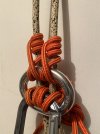
Curious what size ring, rope and hitch?View attachment 81118Twin Stichts with top stoppers to make it more compact and aids releasing.


Paul, could you please re-upload the webinar or find another way to share it?
Would be great!
Regards from Austria
Max