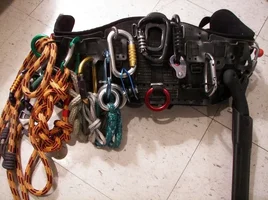
Treemotion mods

Here's my current setup. I like Mark B's spring idea, very easy to locate! Harness equipped as shown weighs roughly 4kg/9lbs.
 

Attachments

  • 105043-Harness006Standarde-mailview.webp
    105043-Harness006Standarde-mailview.webp
    89.7 KB · Views: 383
Lazarus2, would it be valid to assume that a 'figure 8' is inherently unsafe?

To explain my question, it has always seemed to me that the figure 8 is one device that depends entirely on the operator to work properly.

If the operator is tired, or their hand strength is diminished through fatigue, then the figure 8 is not a device to trust for the 'critical' descent. Like in the case of an emergency where you need to get on the ground quickly.
 
Hi Frans

I think an eight is unsafe without a pruisk back up. Some think that is unsafe. Personally, I feel that, as arbs are accustomed to releasing a hitch to stop, then an eight with a prusik is a safe enough back up. I can descend one handed on a prusik secured muenter, and that is very useful in our game. I like the simplicity.

In an emergency, its very easy to come off the end of the line if its too short wth an 8. With a prusik above, there is a second chance.

The issue I have always had with the eight on the footlock descent, apart from what has already been discussed here, is the change over. The period between when the climber holds the rope with his/her feet below the eight, then reaching up to grab the prusik, is very unsafe. This is why I would always hold the rope below the climber as a back up. Until I found out that this wasn't always an effective back up either.

Trouble is, what else is there available to descend a doubled footlock line safely? (specifically when instructing beginners). A munter appears to have the same issues.

My solution is to evolve into SRT to avoid this and many other safety and ergonomics issues with the Footlock.

Thanks for editing my post Mahk - I shouldn't visit TB when I'm having a bad day
tongue.gif


As we appear to have hijacked this thread, I suggest a new one should be started if we wish to continue the discussion.


cool.gif
 
Laz, Why do you consider the change over inherently unsafe? G.Storrick makes a strong case against Prusik backups but you (rightly) point out that arborists are generally accustomed to hitch descents and droppingthe hitch. Since you support the Prusik backup...well during the changeover the eight IS backed up. The instant the hitch is within reach there is no reason that the ropew below the eight can not be grasped as well. 9 I really DO understand your concern but see it as an additional training point. It seems to me that for Instruction purposes or competitions a seperate belay line should always be incorporated in any case. (Oh, and Footlocking sucks mightily so I prefer SRT ascents)
 
Hi Stumper

My point was about the period when the climber takes a footlock to stand and grab the hitch, then the rope slips through their boots - they panic and hold the hitch and just keep going down the rope till their hands melt.

You're right about the alternatives - just put them on a seperate line. I also run the footlock line through a ground anchored SRT line to lower the whole messed up caboodle.

Except I don't teach Footlock anymore.
 
Re: Figure 8 Descent Device

ATC's/fuse/reversino type belay devices are better then fiqure 8's. Less twist. A muentur will flat out twist a rope into submission. Good to know in case you drop your device........
 
Re: Figure 8 Descent Device

So we tried it.

It wasn't effective.

It takes the climber to stop their own descent.

This seems weight dependent, as on lighter climbers it was effective.

I didn't try the muenter this way. I suspect this would be effective due to the friction of rope on rope.


Did you try doubling the eared 8 on the heavy person??
 
Re: Figure 8 Descent Device

The figure eight doesn't generate as much friction as many other tools. On any chart that I have ever seen it is at the lowest rating. Munters work much better. There are several other tools that work with doubled ropes that generate more friction too.

The easiest solution is to use SRT though. Much easier to backup and use.
 
Re: Figure 8 Descent Device

[ QUOTE ]
So we tried it.

It wasn't effective.

It takes the climber to stop their own descent.

This seems weight dependent, as on lighter climbers it was effective.

I didn't try the muenter this way. I suspect this would be effective due to the friction of rope on rope.


Did you try doubling the eared 8 on the heavy person??

[/ QUOTE ]

Allellulia Fairfield!

Thank you for taking the time to trial my observation.

I'm sure doubling up on a rscue 8 would solve it, but too much friction the other way though. The belay devices No bivy mentions will have a similar problem to the 8; no hands free back up without a prusik, and likely to run even if a groundie holds the line. The Reversino is for smaller 8mm ropes - the Reverso would fit a doubled 11mm better.

Like Tom says - lets make the evolutionary leap to SRT and be done with such issues. With SRT, many hands free descent devices can be applied.
 
Re: Figure 8 Descent Device

I am starting to think that alot of guys are only seeing the fig. 8 from only a arbo rope stand point. I dont think I would practice this as a first opp due to the slicness of the rope. Where I think the intention of an 8 is primaraly for kremam rope. If I am wrong please let me know.
 
Re: Figure 8 Descent Device

I never see it as a question of right or wrong, black or white Fairfield. Just lots of shades of very interesting grey.

I enjoy hearing everyones opinions and never feel threatened by them. If we can't express our professional opinions, knowledge, wisdom and experiences freely, then these forums are dead in terms of credibility. We shouldn't feel someone is pulling a lever.

The 8 works differently with different ropes like any device - I don't feel it has any design or use preference to kernmantle. Thats what is so great about actually getting out doing production tree work, don't you think? - finding out for real if something is proficient in a system or not when the chips are down; will it help me manage trees efficiently to procure feeding my family. Will it work when the rope is soaked and caked in mud and sawdust?

This started with a heads up safety issue from experience that was dismissed out of hand by some. Funny how people only hear what they want to hear. There are many ways to skin a cat, but if something is found to be a safety issue, then It needs investigation (thanks again). I try to be very mindful of that all the time, and change the way I work constantly. This used to really frustrate me - but as I became more understanding of how items work from design intent to actual serious use, I accepted the constant flux as continuous evolution - i.e. simplicity, versatility, efficiency and cost effectiveness. This is now feeding back into safe, simple and efficient products and systems for my work. My aim is to share it with anyone interested, though I struggle to find the time.

I recommend that to anyone - look to evolve, not get too involved - recognise when something doesn't really work or is too complex, or unsafe, and find a better way. Like Gerry Beranek's first excellent book - its all in the fundamentals, the rest is just interesting shades of grey.
 
Re: Figure 8 Descent Device

[ QUOTE ]
Why on earth even in a panic why grab whats holding you to the rope?

[/ QUOTE ]

That's a normal survival reaction.

Ingrained from milleniums of falling. The people who fell but didn't grab onto something were eliminated from the gene pool. The ones who did and lived add that little bit of reinforcement to human survival.
 
Re: Figure 8 Descent Device

I agree Tom.

A person cannot remove the survival instinct to grab when falling (unless you are similar in survival instinct to say, a Dodo bird for example).

I like the versatility of a figure 8. It is easy to load and unload, but the 'panic' feature on the Petzl Stop, or the Anthron, ensure that even in panic situations where you just grab the device, they will stop you. But they are harder to load.
 
Re: Figure 8 Descent Device

I have alot of friends that only like to use a Rack. See to me the 8 cant be messed up being put on ( for the most part) . The Rack on the other hand.... well sad sad face when you hear the chingy chingy chingy.
 
Re: Figure 8 Descent Device

[ QUOTE ]
The Rack on the other hand.... well sad sad face when you hear the chingy chingy chingy.

[/ QUOTE ]

This could happen with any tool.

Proper procedure is to make the changeover from ascent to descent while on a belay of some sort. For arbos this could be a lanyard or a friction device/hitch on the access line. The climber has tested their primary belay then begins to get ready for descent. Before putting all of their load on the descent device it is checked with the primary belay still in effect.

If the rap device, figure eight/rack/etc., is setup wrong the climber will not fall. The primary will hold.

If the climber forgets to make the transition from one system to the next without checking the next system they will likely have a fall at some time in their career. Lanyard clipins are checked before the climbing line is disconnected. The same procedure is followed at every changeover.
 
Re: Figure 8 Descent Device

In answer to the question to me, the belay doesn't have on a harness and there is no "belay" 8. I can tell you this works. Maybe I should have stated we use a rescue 8 for the drills. I have put about 150 students through rope rescue training and we always use a bottom belay. The reason for teaching not to grab is for those who love to panic and end up running their fingers through the 8. We then have to bottom belay and get up there and do a "pick Off" which is a rescue.
 
Re: Figure 8 Descent Device

isnt their rappelling involved in SRT? why is this discussion relavent to SRT? I assumed that there was more rappelling involved in SRT.
 

New threads New posts

Back
Top Bottom