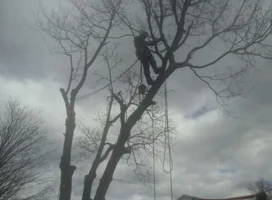
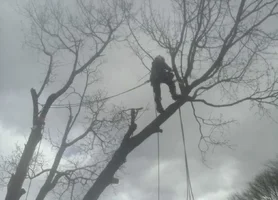
Tree With Power Line (Picture)

According to their specialized training.
I did line clearance my first 4 years of tree work and I promise there’s no earth shattering training going on at those places. The experience teaches you what you can get away with and what to look for as far as the integrity of the lines. So if you know what your doing around those low voltages in my opinion it’s not the end of the world to take on trees near them. Definitely wouldn’t fuck with anything to close to the primary’s. Not necessarily because it’s impossible but it’s too time consuming taking the precautions to cut everything into a million pieces and rope everything super small.
 
I request service drops in every circumstance where I'll (or my climbing line or tree limbs) be within 10 feet. I had a 35 foot redbud to prune last fall and it was over a service line. I called in the utility and he used his 40 ft. bucket to prune part of it for me so that he wouldn't have to drop the line. I knew he would do that, and still called because I don't f*ck with power lines unless I'm an ISA certified (or other similar cert) line clearance arborist. Power line shock is a leading cause of mortality in our industry. My superficial understanding is that @rico is right, if the cover is intact you'll be fine. If it's not and you contact it with water or metal (yourself, wet climbing line, branch, silky hayachi, foggy day, etc.), you'll get zapped with enough juice to stop your heart, but not fry you outright.

Hahah yea at asplundh I’ve gotten hit by indirect contact from a willow branch touching a 13.2 line. A bundle got me before too. The 13.2 was pretty bad I remember seeing sparks coming out of my hand saw then there was like two seconds that I blanked. Didn’t finish the tree. But I knew tons of people with a story about getting hit. One time I swung right into the bare aluminum secondary’s. My stomach and chest touched all three so when I swung back I rode my line to the ground. Nothing happened not that it couldn’t have. I’ve just seen people all over those lines so when this conversation comes up I just like to say someone else’s minimum approach on that service line and secondaries is no touch. And their using all the same gear as you
 
Watched a coworker hit a house drop with a pole saw. Old wooden pole and brand new blade, he didn't get shocked but the arc was wicked and three of the saw teeth got welded. Having a core filled 6 ft section to use around wires should be mandatory, he was lucky.
 
I saw someone hit a house drop with their hand saw after going through a branch. Some zapped saw teeth and soiled underpants were all that happened. I also know of someone who hit a phone line with a small branch and it shorted something out at the gutter / electric drop which led to smoke . They had to call the fire dept, utility companies, etc. BE CAREFUL everyone gets lucky sometimes but don't depend on that luck to last.
 
I ran into this, this evening View attachment 58141
The job was to remove two maples that have seen years of storm damage and had large dead, rotten, and hollow limbs. He needed them removed today as we are expecting bad weather tomorrow and the last storm broke the limb in the pic and ripped the data wire off the house.

I did call the utility company to have them drop this due to the chances of a piece of deadwood breaking and falling on the wires. They were not available until tomorrow so I made the decision to work around it. Basically I followed my game plan that I typed out earlier in this thread, made small cuts and made sure to cut any forks out of the brush that might try to catch on the wire. Everything went great, just needed to have a little extra care when I was cutting near the wires.
I’ve done my share around electrical lines but F-dat ball of tape service drop.

I was on the crew where a weather head was folder over by felling a mature grand fir, the very tippy top had a little hook to it and snagged the service line. You could hear the arc buzzing in the steel pipe. I’ve also seen branch tips sway into a single phase arcing 3’ lighting bolts.

Know what you can get a way with, and don’t test the limits of thinking it’s ok
 
I’ve done my share around electrical lines but F-dat ball of tape service drop.

I was on the crew where a weather head was folder over by felling a mature grand fir, the very tippy top had a little hook to it and snagged the service line. You could hear the arc buzzing in the steel pipe. I’ve also seen branch tips sway into a single phase arcing 3’ lighting bolts.

Know what you can get a way with, and don’t test the limits of thinking it’s ok

There was more tape on there than I preferred which is one of the reasons I called the utility company. In the end I used my judgment, I used to work as an electrician doing industrial and commercial wiring and often walking on wires such as these and much bigger in cable trays while pulling in new wire. When you work with 480 and 600 volts on a regular occasion you start to be less scared (which doesn't mean that you don't respect it) of these electrical currents feeding houses. Very similar to how you grow in your abilities to do tree work.

As for the dangers that this tree held, up until about noon today we had multiple thunderstorms and several tornado warnings. I went to bid 4 uprooted trees this afternoon, I have no doubt that at least part of these 2 trees would have failed today had I not got them down yesterday.
 
I saw a crow on a single phase who’s wings had hit on either side of the insulator, from wire to bracket, and it was just zapping away every few seconds. I guess the wings had been burnt on at that point. It was shooting pretty big arcs and that thing was louder than you’d think. I was waiting for it to burst into flames
 
The utility training is a bit of an odd thing.
I own a line clearance company here in aus.
Even with all of the yearly training we are required to complete, not much of it actually focuses on how to work safely within close proximity to the wires whilst adhering to our reduced clearances.
A big part of the training is about identifying voltages and construction types etc to know what your distances are and how to identify faults, another big part is what to do if an incident occurs.
None of that matters if the person climbing or cutting from the bucket uses poor technique, equipment, species identification etc
 
Hahah yea at asplundh I’ve gotten hit by indirect contact from a willow branch touching a 13.2 line. A bundle got me before too. The 13.2 was pretty bad I remember seeing sparks coming out of my hand saw then there was like two seconds that I blanked. Didn’t finish the tree. But I knew tons of people with a story about getting hit. One time I swung right into the bare aluminum secondary’s. My stomach and chest touched all three so when I swung back I rode my line to the ground. Nothing happened not that it couldn’t have. I’ve just seen people all over those lines so when this conversation comes up I just like to say someone else’s minimum approach on that service line and secondaries is no touch. And their using all the same gear as you
This kind of experience is what creates someone who starts to learn their lesson in terms of job safety and what should be required in terms of training and how to have a heightened sense of awareness among the job site. There could be a number of reasons for the accidents, but knowing asplundh, it was probably due to straight ignorance, (the i didn’t know any better and no one told me not to when I was doing it and I made eye contact with them prior to me making this cut and they didn’t say a word). But you sure end up learning that lesson, and if you can’t recognize the severity of what happened, that you were lucky to just get away with a scare and not death, you’re in the wrong profession.
I have plenty of insane stories of my own, but I don’t have them about 32kv lines, not when they’ve been turned on anyways. We can all brag about one experience over another, but sharing them helps bring information to light, where I may not have to make the same mistake this kid in Colorado made when he decided to make that one cut without chaps on.

Anyways. I bet that kinda stuff makes you really watch what your limits are when it comes to electrical lines.
 
Haha after all that. Did the utility give you a good experience?

I ended up knowing someone who works there so they took care of it.

They disconnected the power and hooked it up from another side of the house where there was a side street and lines in the street, so they dropped it during the week and left it over the weekend but the customer was able to have power obviously.

Would’ve been more of a headache if I hadn’t done that.
 
Bring a generator along for the job.
Good in thought, but in practice...
Sure, run extension cords and plug in whatever they need. But to do it right you'd be talking about a trailer mounted gen set with direct access to their breaker panel.

Speaking of, does there exist an adapter that would allow you to pop out the power company's meter and plug in a 220V gen set to supply power that way?
 
Good in thought, but in practice...
Sure, run extension cords and plug in whatever they need. But to do it right you'd be talking about a trailer mounted gen set with direct access to their breaker panel.

Speaking of, does there exist an adapter that would allow you to pop out the power company's meter and plug in a 220V gen set to supply power that way?

The easiest way is to create a cord with two male ends. Shut off the main breaker in the panel, plug into the generator and a dryer plug or other 240V plug and then start the generator. This will back feed the house using the breaker that your plugged into as a new "main" breaker. It does limit you to 30-50 amps (rating of that breaker) instead of the 100-400 amps of the house's main breaker rating, but it is enough to power most lights, receptacles, and refrigerator/ freezer.

Obviously there is a safety concern if this is not done correctly, just like with all things electrical, should the cord be unplugged while the generator is running there will be power on the male electrical prongs that go to the house. Also if you do not turn off the main breaker, if you forget to shut off the generator before the power comes back on it can overload the electrical circuits as two sources of 240V will be powering the home.
 
Good in thought, but in practice...
Sure, run extension cords and plug in whatever they need. But to do it right you'd be talking about a trailer mounted gen set with direct access to their breaker panel.

Speaking of, does there exist an adapter that would allow you to pop out the power company's meter and plug in a 220V gen set to supply power that way?

The quick answer is no. The only way to do it right is with a generator rated for the load and connect the whole house. If a freezer is the only concern, just use a portable generator and a 10 awg extension cord and you are good to go. I never recommend back feeding power into a customers house. If they have issues with the wiring and the back feed does not like it, they will be blaming you for the damage.

Another issue is that if you connect the whole house and then they overload the generator just a little, you will have voltage drop in the house and you will possible damage appliances. It is best to deal with temp power on an appliance by appliance basis.

If you guys want to start a temp power thread I would be more than willing to contribute my opinions. I am an electrician and building inspector so I have more than a few opinions. All in the name of sharing info and keeping people safe.
 
The easiest way is to create a cord with two male ends. Shut off the main breaker in the panel, plug into the generator and a dryer plug or other 240V plug and then start the generator.
That must be why I have a 240V plug right next to my panel.. someone was thinking ahead. Or, they had a dryer right next to the panel in the past..

I'd like to see a meter adapter created & sold. When the power company comes to cut the power & drop the line, they can remove the meter themselves.
Then, tree service installs the adapter and fires up the gen set - that has voltage "inverter" protection to prevent load related voltage drops.
When my work is done, the power company reinstalls the meter and turns power back on.

Seems pretty logical?
 
Are you guys seriously still trying to keep the serial killers victims cold while your fuckin around with a tree?
Great ideas but its his ass if those body's thaw and start smelling up his place and drawing unwanted attention.
Its your ass if your not an electrician and you fry his circuit
Could also rent mr.ding-a-lings ice cream truck...he don't sling dope in the winter.
 
Yes that is the secondary. Two hits carrying 120v equaling 240v with a grounded neutral. I say this because as a journeymen wiremen we sometimes work this hot. Even though low voltage on SE cable if there is a Nick in wire or fray in THHN insulation a hot conductor carrying 100 amps goes to ground you’re looking at the surface of the sun in an instant. Well faster then an instant. So before making any moves take a look at the cable and if tree has skuffed insulation you want a CO from the utility company ASAP. Not only will you take the house out but you’ll blow fuses off the pot transformer at pole, which in turn takes that whole circuit down(1 side of street) They are not inexpensive.
Second point is that when lines grow through trees/obstacles there’s added tension on the wires which if you’re in the wrong place boom it’ll knock you off balance. Any slack in your rope and you’re in trouble in a hurry.

Hope this helps.
Rob
 

New threads New posts

Kask Stihl NORTHEASTERN Arborists Wesspur TreeStuff.com Teufelberger Westminster X-Rigging Teufelberger
Back
Top Bottom