Tree-to-Ground Guying

[ QUOTE ]
Sub a utility contractor for the ground work.

[/ QUOTE ]

[ QUOTE ]
[ QUOTE ]
I don't know why they would go to all that trouble when you can screw an anchor in the ground in about two minutes or less.

[/ QUOTE ]An anchor big enough to guy that tree?

You must have some hefty arms, dude!

[/ QUOTE ]

These should give you the resistance you neeed:
http://www.abchance.com/helical/square-shaft.asp

The smallest size is rated for 60,000#.
http://www.abchance.com/resources/technical/ss-product-ratings.pdf

Installed with a hydraulic device on a skidsteer.

http://www.abchance.com/resources/case-histories.asp#drawtelecom
See the "Guyed Towers" section.
 
[ QUOTE ]
kevin, what's a johnny ball? a ceramic insulator?

[/ QUOTE ]

Yes, the ceramic insulator on the guy line.
http://www.cesco1.com/Product.cfm?ID=6757&MainCatagoryID=9932&SubCatagoryID=0
MN_NelloCatalog402_guy-5_21.jpg
 
Got a photo of that insulator in place? And could it be explained a little more? Has it ever been used in a tree cabling system?


[ QUOTE ]
Excellent point about lightning protection. The best guesses from "authorities " I've heard are that systems do not likely draw strikes, but guesses are still guesses, no matter who makes them.

[/ QUOTE ]


I'm certainly not an authority, but my guess--or rather my opinion, based on what I've seen throughout the years--is that trees with cables (and without a johny ball) are more prone to strikes. How much so, I'm not sure.
 
Mahk;
They've been in use for ever in the utility industry.
We install them using preforms, the preforms loop through the insulator and through each other but don't make direct contact with each other.
If the glass gets broken the steel preforms are still looped together and can't let go.
Lightning is attracted to ground and particularly where there's a difference in potetional.
If the tree was in gravel the ground potential is poor but add a steel guy and locate it near a drainage ditch without the insulator and you're asking for trouble.

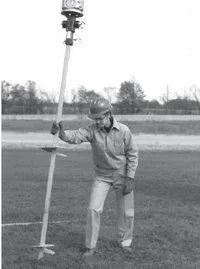
This is the helical screw in anchor.

119039-helicalanchor.JPG
 

Attachments

  • 119039-helicalanchor.webp
    119039-helicalanchor.webp
    12 KB · Views: 33
Structural qualities are quite high.
They seldom get replaced, I've seen strand break before the insulator.
They also serve to protect anyone on the ground.
This type of utility guy would be static and I don't know if that's acceptable for a tree.
For anything specific the manufacturer should be contacted.

An arborist in the tree making the attachment and someone on the ground setting the anchor and tensioning the guy shouldn't take more than a couple of hours max.
 
[ QUOTE ]

This type of utility guy would be static and I don't know if that's acceptable for a tree.


[/ QUOTE ]

I wonder about using synthetic rope for an insulator in those cases where the guying is permanent and dynamic?
 
I like the idea of using the johnny ball! I'm glad to have learned this.

The helical screw anchor -Is this screwed in with a rig (a truck with rotating attachment?)
 
I'm skeptical of synthetic being "permanent" and holding up to the elements, namely sun.

I've thought up a spring idea at the end of a cable, about 3 or 4 years ago.

Then, about a year ago, I saw a huge pedestrian suspension cable bridge in the mountains of North Carolina.

It had the perfect springs on the cables that supported the bridge. It's springs were a better design than what I had thought of.

I took quite a few pictures of them. Not too hard to make.

Dynamic, but with the lasting qualities of galvanized steel cable. Cool!

I was going to keep it to myself until I made and installed one of these. But I've decided to share the idea now.
 
This is an interesting topic.
When using guys I would think you would want at least one above and one below the area of concern so that both parts of the tree move in unison.

[ QUOTE ]
Is this screwed in with a rig (a truck with rotating attachment?)

[/ QUOTE ]

That's correct, many machines have these attachments now.
 
[ QUOTE ]
I'm skeptical of synthetic being "permanent" and holding up to the elements, namely sun.

[/ QUOTE ]

I agree. This is my problem with dynamic cables. However, any client that would accept the cost of guying a large tree may consider annual inspections and eventual replacement. I would like to see the structural specs on the johnny balls before I would consider their use for guying a very large tree.
 
I can tell you first hand that even the largest trees seldom break the messenger , the pole usually goes first and I've never seen a broken insulator unless it was shot by a moron.
Even when the insulator is broken the guy remains intact.
 
Yup, better show some more of that tree. What happened to the wanker who started this thread?

pic 1 is the base; 1 root wiht a little rot, 1 with a big burl. Overall, well anchored. former driveway around it will have gravel removed and mulch applied.

pic 2 is the defect--exactly 50% of the circumference, spiraling, and 10' long. heartrot is not a concern so no i am not drilling it. Cracks are a major concern--i can stick my handsaw blade all the way in at one point.

probed around, nothing punky in there. i can also stick my handsaw between the woundwood and the xlem on both edges of the wound. xylem is very hard and very tough, no idea what caused the wound.

pic 3 is me standing where the proposed ground anchor would go. my TIP is just under where I would install the cable. I will go look at the tree on a windy day, to see how--or if-- the trunk moves.

Again, extreme reduction instead of support is a last resort. I may reduce a few tips depending on confidence in any support system. There is way too much solid and valuable tree there for the owners to talk about removal.
 

New threads New posts

Back
Top Bottom