Tough decisions

treevet

Branched out member
Location
Cincinnati, Ohio
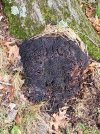
Whatever this double grapefruit size degraded basal infection on the bottom of this Pin oak I just looked at is, one thing can be fairly certain...it won't likely let this tree off easy in future years. It is difficult to prescribe needed pruning and a support system (cable) when this tree right off the back of the house some 80 to 90' tall which clearly appears now for all intents and purposes healthy and reasonably decay free...for now. Tree cancer?
 

Attachments

  • 20211217_123901.jpg
    20211217_123901.jpg
    908.1 KB · Views: 46
@KTSmith might be the best to tell you what you’ve got. If it’s a root rot fungus, which seems to be usually the case when something is growing there, that tree needs to go, and as soon as possible.

I’m cases like that, even when the tree looks healthy, I always WRITE clearly the the hazard the tree has, to protect myself when it falls if the homeowner has not yet done something about it. Sometimes they just won’t until it’s laying in the living room.
 
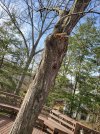
They have 3 key trees in their scenic woodsy back yard...that one, this one on the deck (80' Red maple the deck was built around) and a giant compromised White ash that has seen the battle with EAB which is not gone but has subsided. Do I tell them all 3 of these trees are high risk trees in a target rich environment and need "to go" ?

Sometimes I run into clients battling cancer and their tree/s have bad decay causing infections and are high risk and it is just very difficult to tell someone who it would seem things couldn't possibly get worse that indeed they have.

20211217_123536.jpg
 
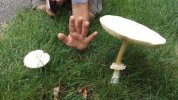
Saw this fungus on a client's property last summer and from a distance I thought they had a property light installed. Some are interesting and not really hurting anything and at times symbiotic.

thumbnail (12).jpgthumbnail (12).jpg
 
They have 3 key trees in their scenic woodsy back yard...that one, this one on the deck (80' Red maple the deck was built around) and a giant compromised White ash that has seen the battle with EAB which is not gone but has subsided. Do I tell them all 3 of these trees are high risk trees in a target rich environment and need "to go" ?

Sometimes I run into clients battling cancer and their tree/s have bad decay causing infections and are high risk and it is just very difficult to tell someone who it would seem things couldn't possibly get worse that indeed they have.

View attachment 79333
I would want to see more to have an opinion on the Red Maple. If the fungus on the dead wood on that cut is the only fungus, it may not be too much of a concern.

If the Ash is being treated for the borers, maybe it will survive. Otherwise, maybe it needs to go or needs treatment.

My typical approach to that is to give them the bad news as gently as I know how. I’ll tell them that I’ve found some things that concern me, outline what I believe they may be, and if I am not 100% (and even sometimes if I am) convinced that the tree needs removal, I will refer them to another arborist for a second opinion. I always recommend the same guy, he’s probably one of the most knowledgeable out there, and all he does is consulting, so his opinions are unbiased and almost guaranteed to be correct.

As for the thought that you’re giving bad news to someone who has cancer (or anyone who you feel may not need more bad news) I would still present the bad news gently, keeping in mind that it is hard for a cancer treatment to keep someone alive if they’ve been killed by a falling tree.
 
Treevet: with the lawn agarics, I’d look at the stipe base, immersed in the thatch. If swollen and sac-like, I’d go with genus Amanita. Hard to tell otherwise. If that, toxic to eat but not damaging to lawn or trees.
[later addition]: if the stipe base tapers to a rounded end, I’d start with genus Lepiota or a segregate genus. Still, not a concern for tree or turf health.
 
Last edited:
Treevet: I’d start with that oak conk being an old Inonotus, probably I. dryadeus.
Kevin, that's what I thought but can wait until it fruits in spring to summer to id it as I doubt it can be cultured for an id in this condition can it? This is early stage of infection as I looked at this tree a year ago and nothing. Everything about this tree appears as it should...except the fruiting body. It needs canopy work but not impending and might be wasted money me thinks.
 
I would want to see more to have an opinion on the Red Maple. If the fungus on the dead wood on that cut is the only fungus, it may not be too much of a concern.

If the Ash is being treated for the borers, maybe it will survive. Otherwise, maybe it needs to go or needs treatment.

My typical approach to that is to give them the bad news as gently as I know how. I’ll tell them that I’ve found some things that concern me, outline what I believe they may be, and if I am not 100% (and even sometimes if I am) convinced that the tree needs removal, I will refer them to another arborist for a second opinion. I always recommend the same guy, he’s probably one of the most knowledgeable out there, and all he does is consulting, so his opinions are unbiased and almost guaranteed to be correct.

As for the thought that you’re giving bad news to someone who has cancer (or anyone who you feel may not need more bad news) I would still present the bad news gently, keeping in mind that it is hard for a cancer treatment to keep someone alive if they’ve been killed by a falling tree.
I really like your thoughtful last sentence.

I am surprised no one called the tree out on a less than optimum cut at the point of infection (which appears to be saprophitic ?). About 10 years ago I was called to this residence with this (at the cut) giant limb laying on the roof. There was a good 6 to 8 inches of melting snow on the roof and the roof was broke wide open. The tree trunk was encased in ice...completely. I brought in my crane sub with a 50 tonner and I rode the ball, he injected me into the top of the canopy and I tied in, rappelled onto the roof, choked the leader, went back up and cut off the leader and boomed it off the house so the water flooding into the house could be dealt with.

Hadn't heard from this person for 10 years and then a second time about the maple after a call about the oak re pruning and cabling. I also entered a lattice work door under the deck and tree to check the buttress on the maple and found what appeared to be degraded Ganoderma lucidum between the buttresses. Varnished mahogany appearance and still identifiable. This tree is fully budded for next year.

My analogy to human cancer and alarming people extends to the point that if people are diagnosed with cancer do they end their lives immediately. Can dying/infected trees be made lower risk with pruning treatments and wring the most years possible from them until the time comes and the HO is ready for the loss? It is all very perplexing.

If I am called re a tree in obvious decline from whatever reason I often consider the feelings of the homeowner and try to deadwood the tree, make it as safe as possible...and continue to reduce and prune it as the deadwood dictates ...if I feel the risk level is low....until it isn't.

68141_661269113990691_7245929201376856253_n.jpg
 
I really like your thoughtful last sentence.

I am surprised no one called the tree out on a less than optimum cut at the point of infection (which appears to be saprophitic ?). About 10 years ago I was called to this residence with this (at the cut) giant limb laying on the roof. There was a good 6 to 8 inches of melting snow on the roof and the roof was broke wide open. The tree trunk was encased in ice...completely. I brought in my crane sub with a 50 tonner and I rode the ball, he injected me into the top of the canopy and I tied in, rappelled onto the roof, choked the leader, went back up and cut off the leader and boomed it off the house so the water flooding into the house could be dealt with.

Hadn't heard from this person for 10 years and then a second time about the maple after a call about the oak re pruning and cabling. I also entered a lattice work door under the deck and tree to check the buttress on the maple and found what appeared to be degraded Ganoderma lucidum between the buttresses. Varnished mahogany appearance and still identifiable. This tree is fully budded for next year.

My analogy to human cancer and alarming people extends to the point that if people are diagnosed with cancer do they end their lives immediately. Can dying/infected trees be made lower risk with pruning treatments and wring the most years possible from them until the time comes and the HO is ready for the loss? It is all very perplexing.

If I am called re a tree in obvious decline from whatever reason I often consider the feelings of the homeowner and try to deadwood the tree, make it as safe as possible...and continue to reduce and prune it as the deadwood dictates ...if I feel the risk level is low....until it isn't.

View attachment 79371

Thank you. I try to be thoughtful on occasion. And I have the frequent duty of telling people all too often that their big old tree is about 20 years past saving, so I try to do it nicely.

I saw that cut, and unfortunately with all of the Amish tree services around here, I see a lot of those. Usually far more advanced in decay, and compromising the trunk.

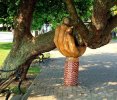
When possible, I am all for keeping a tree if it can be pruned to be safe, but sometimes making a tree with Ganoderma safe means cutting it down to a stump 10 feet tall.

I like that support, the hand is creative. Is that your doing?
 

New threads New posts

Kask Stihl NORTHEASTERN Arborists Wesspur TreeStuff.com Teufelberger Westminster X-Rigging Teufelberger
Back
Top Bottom