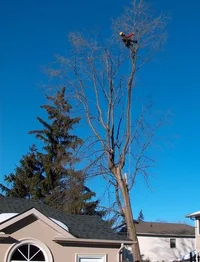
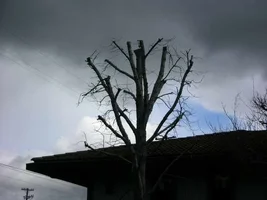
Topping with exprience

Full top + Long slender bare stem = Need to reduce. Tree does not look good immediately after pruning, but I tell folks to call me in 2 seasons and tell me how it looks then.

Nice job. Small wounds.
 
THis is a good old topic. AS blinky said a ways back, since all cuts have the potential to effect the tree none should be made without a reason.
Most people want topping done out of fear of branch failure, particularly in high winds.If we do a good e-val of a tree, most of the time we can remedy potential problems with thinning ,or maybe even reduction cuts on specific limbs .For example ,limbs that are more horizontal and obviously loaded. Just make a few quality cuts on the offending limbs. We have not topped a tree in many years.
I also feel like even with reduction using the 1/3 rule we should know how different species will respond.Some trees you can bend the rule on others you must be very conservative on. Those pics that Cameron showed are great examples of a really poor compartmentalizer.
How do you all feel about the amount of foliage removed on a tree relative to the specie? Is it a hard fast rule or do you agree that diff trees can be treated differently?
 
Time of year for severe pruning is a big consideration. If I have the choice, I'd rather do major reductions in mid summer when all of the foliage is out and working. The tree is replacing the used starches spent buying leaves and making starches to build itself over for next year.

I found that I could do very little reduction work on paper birches without causing whole branches to die. It seems like anymore than about 15% foliage of a branch would kill it.
 
[ QUOTE ]
Time of year for severe pruning is a big consideration. If I have the choice, I'd rather do major reductions in mid summer when all of the foliage is out and working. The tree is replacing the used starches spent buying leaves and making starches to build itself over for next year.


[/ QUOTE ]

Totally agree, July 15-Sep 15 for us.
 
Now the reason for the reduction.
108265-3reduction.JPG
 

Attachments

  • 108265-3reduction.webp
    108265-3reduction.webp
    55.5 KB · Views: 51
I dont see how reducing that tree will help anything. It looks like it could have been thinned out. Will the tree not respond with a bunch of suckers everywhere you cut it?
Just curious.
 
Jesse,

You'r right, a few sprouts could be expected at the cut. But...more importantly, there will be many more that will develop lower in the crown filling the bare trunk space with growth. The center of gravity is lowered and the tall, whippy limbs are shortened.

Subordination is the pruning style that should be followed.

Ed Gilman has the best pruning book available. You NEED to read this and understand subordination. To me, Gilman has shown me what to prune, Shigo taught me how the tree responds and where to make the cuts. The two go hand in glove.
 
Well stated ! Tom I agree.I would like to expand on the idea of lowering the center of gravity. I took a class With Dr Luley about a year ago. The main topic was wood decaying Fungi. With a lot of talk about hazard trees. There was a good discussion about shortening the "lever". The shorter the lever the less leverage .Simple stuff but true. The idea was instead of running around removing all the trees with mild to moderate trunk issues this would be away of putting off removal and supporting the trunk. This was apparently part of the work they are doing in Germany with pull testing trees.
I like subordination. It is the way to go on this
 
[ QUOTE ]
[ QUOTE ]
Time of year for severe pruning is a big consideration. If I have the choice, I'd rather do major reductions in mid summer when all of the foliage is out and working. The tree is replacing the used starches spent buying leaves and making starches to build itself over for next year.


[/ QUOTE ]

Totally agree, July 15-Sep 15 for us.

[/ QUOTE ]


I've read and heard many times that the best time for pruning is winter, when the tree is dormant (deciduous). I've even heard some people say that the ONLY time to prune is during the winter.

Many homeowners and the public in general seem to be convinced that winter pruning is good and pruning during other parts of the year is bad. Never has made much sense.

jp
grin.gif
 
[ QUOTE ]
I dont see how reducing that tree will help anything. It looks like it could have been thinned out. Will the tree not respond with a bunch of suckers everywhere you cut it?
Just curious.

[/ QUOTE ]

That tree was previously topped, hence the reduction.
 
Winter is a good time to prune but labeling it 'best'??? By what measures? The benefits to the tree are debatable. Somethings are better some worse. All things considered I think late summer is better for the trees.

Winter is better for the company though. Work always seems to come in during the summer. Having some work waiting for winter is good.
 
Good job on the reduction. Was there any decay started at the previous point of topping. Did you consider a cable at for the two large stems right at the point of the topping or did they form a good connection and seal the cut?
 
I was always instructed by the nursery where I got my peach trees that I need to prune them when they where dormant for best results in bearing fruit for the following year. I believe that fruit trees and ornamental trees differ in reasons for pruning.

BTW there is a local contractor here in town that has a whole page add in the yellow pages advertising 30 years exp. and tree topping.
 
Prunus species should be pruned after flowering in the summer to minimize the risk of serious virus attacks, in practice they are usually pruned after fruit picking sor labor capacity reasons. They should never be pruned in the winter or spring time.
 
"I also feel like even with reduction using the 1/3 rule we should know how different species will respond.Some trees you can bend the rule on others you must be very conservative on. Those pics that Cameron showed are great examples of a really poor compartmentalizer."
ABSOLUTLEY
I defintley agree, I mean you wouldnt abide to that with a willow over a house that the client wanted to keep would you? Or a norway maple with extensive decay and structural defects that they needed for "screen." Still that being said I wont top something for no good reason. If anybody ever has seen the elms in front of the Mass state house and in the Boston Garden(feel free to chime in and show some pics OTG) you will see sometimes you have to top things. Sometimes you have to make descions based on your own experience, and realizing the clients pay the bills, and they want what they want.
Willows, silver maples, lindens (not so much but still) apples, red maples to a point, and river birches are all trees that IMO you can bend this rule on. Escpecially the first two silvers and willows, you can pretty much cut them down to nothing and still get nice growth..

 

New threads New posts

Back
Top Bottom