Shadowscape
Been here a while
- Location
- far north
What are you using for a lanyard my man, a ships hawser?
Follow along with the video below to see how to install our site as a web app on your home screen.
Note: This feature may not be available in some browsers.
What are you using for a lanyard my man, a ships hawser?

Careful postin’ sexy content like that.

Wow, I never would have guessed that. The Norway's that grown here look so much different. Short and wide with sun scalded tops. Agree on the pruning challenges, they're not the most fun trees to work on by any means. Kinda naturally lions tail themselves, hard to reduce tastefully for sure.Locust is looking good!
Both trees in the post are Norway Maples. They are a particular challenge to reduce for a number of reasons. To name few…
- Timing: gotta prevent too much sap flow.
- Thin, leggy habit: difficult to reach extreme periphery/limited options to subordinate to (especially if another company gutted the tree out in the past!)
Natural lion tail is accurate for sure. I wonder if the arid elevation your way has something to do with the crown conditions. Mac Swan coined the term “Maple Pattern Baldness” for how the Sugar Maples bald out in the top center up by him in Burlington. Funny guy. I used to think they developed so many strong lateral branches that water essentially gets diverted too many times before reaching the top center. Maybe during drier periods they can’t handle that? Dunno.Wow, I never would have guessed that. The Norway's that grown here look so much different. Short and wide with sun scalded tops. Agree on the pruning challenges, they're not the most fun trees to work on by any means. Kinda naturally lions tail themselves, hard to reduce tastefully for sure.
I did another round of pruning dead tops on a client's Norway yesterday. Same condition occurs in the silver maple hybrids, honey locusts and Populous species. Anything with light colored bark with obvious chlorophyll in the cambium. Always on the South side, the trees are water stressed and cooked from a long extended summer of high temperatures and no clouds/rain.Natural lion tail is accurate for sure. I womder if the arid elevation your way has something to do with the crown conditions. Mac Swan coined the term “Maple Pattern Baldness” for how the Sugar Maples bald out in the top center up by him in Burlington. Funny guy. I used to think they developed so many strong lateral branches that water essentially gets diverted too many times before reaching the top center. Maybe during drier periods they can’t handle that? Dunno.


Just barely setting in here. All of our deciduous trees are non native for the most part so we get a bit of a wonky fall color palette, still some beauty here or there.Trees are in full color in northern Minnesota. Another week and they will be down, except for the oaks. Out all my windows are reds and yellows glowing in the sun. Beautiful fall day.
Great post!I did another round of pruning dead tops on a client's Norway yesterday. Same condition occurs in the silver maple hybrids, honey locusts and Populous species. Anything with light colored bark with obvious chlorophyll in the cambium. Always on the South side, the trees are water stressed and cooked from a long extended summer of high temperatures and no clouds/rain.
The last two years have not been as bad as the two years before. We had long lasting summer conditions that never triggered the start of senescence. The green leaves and cambium get smoked in late October when we go from highs of 80° to lows in the teens overnight. The next year, those damaged branches are visited by boring insects as a vector for some types of fungi causing the pattern baldness. Worst affected are trees surrounded by pavement. Our urban forest is looking pretty shabby around here
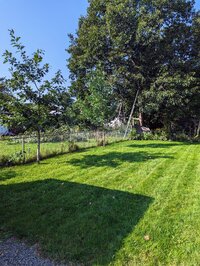
What did the smashed fence look like prior to the ladder being set up?
Still smashed up. It fell over last winter and I just haven't got around to replacing it yet.What did the smashed fence look like prior to the ladder being set up?