Tips/techniques for reducing the "kick"/push-back of a top from the trunk it's being cut-from?(minimizing the sway of the standing trunk)

eyehearttrees

Not a new Member
Location
Tampa-Area
As title asks :)

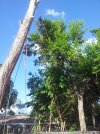
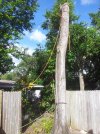
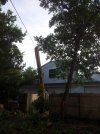
Recently took a rather large (relative-to-tree) top from a Live Oak and was amazed at how it changed the integrity of the trunk, from my "safe space" (a fork/union around 30' aloft) I could now easily induce some wobble in the trunk....now the whole plan of a quasi-normal "rig sections of trunk to the trunk itself" dismantling worries me since I've changed(damaged) the trunk's strength...
(for context, the top I took was a leaning top that was on a leaning trunk, it was felled in the direction of its lean and it was only gently roped IE I did butt-tie it to the trunk below where it was cut but the top was allowed to fall freely, the rope was merely to prevent the butt from going somewhere undesirable once the top/tip settled into the eath, didn't want the butt flipping 20' to the left and hitting something)

Humboldt notching seems an obvious move, since during Moment/hinge-action the two faces would 'close/touch' in an angle that lets the top 'slide' off, instead of the "pivot off" you get with traditional notching....

Am also guessing it'd help to induce slower/gentler falls (ie use wedges), versus "gunning through the hinge" and letting the piece begin fully-unemcumbered descent when its still nearly upright (my understanding is that it's either 30deg or 45deg into the fall that the piece exerts the most force onto the trunk/stump it is falling off of)

What about notch depth? What about notch angles? Does it change based on medium V large trees?


Thanks a ton for any advice/insight here :D Re that tree that I weakened, I can't just bomb the rest of the pieces and at 30' on a compromised stem I'm not experienced enough to gauge whether it's still OK to rig-from the spar anymore so I'm gonna be rigging "side ropes" to the pieces, literally tethering the to-be-cut pieces to adjacent trees, so that when they hit the ground they shockload nearby trees (ideally it'd have been a vertical speedline from my spar, but there's a fence directly below....which makes it suck even more because I want the pieces to 'push off' the spar so they clear the fencing better, but would rather be fixing the fence than be on a spar that gets pushed over :p )
 
I think it was either in a Reg video, or from Beranek's 'Fundamentals', or both, where the width of the notch/face-cut is cited as a major control knob for the amount of pull the departing top places on the remaining spar. With a narrower notch, the top isn't allowed to push back against the spar as much before the hinge severs itself.

I imagine that what you cited about powering through the hinge after the piece gets moving would work similarly, but be - potentially - slightly more risky since it relies on precise timing, not bogging down partway through the cut, etc., etc.
 
As a counter example, wherever I got this info from also stated that an extremely wide notch can actually cause push initially, then - because the hinge remains intact through a large arc of travel - cause a pulling action prior to departure/hinge-fracture, making the resulting spar wobble more violent.
 
My approach:

Pullover line set with a piggy back MA
Very wide open-face notch
Bore cut back cut
Leave a good thick hinge
Nip the corners
Wedges
Tension pullover
Make back cut but don't pullover right away
Pound in wedges to initiate tip over...take up slack with MA
Continue and keep the hinge wood attached if you can. Keep the hinge allows the energy stored in the top to transfer slowly down into the trunk. Otherwise it pushes back leading to the spar tuhwanging back.

The top will tip/be pulled over and close the face.
Let the top breakoff the face and fall into your rigging..or air mail.

Practice with small diameter and light pieces to work out the hinge confguration.
 
The oscillation of remaining stem after felling the top is not evidence of weakening or damage from cutting said top. It's a phenomenon of leverage produced by shortening the stick and removing the motion damping leaves and branches. Same thing happens to long branches that get reduced, they get springy and bouncy when they were droopy and saggy before.
That oscillation is the same energy absorbing strength that you were obsessing over with ropes, but in the tree you get to feel it after there is nothing left on the trunk but you. Flexion and resistance. When you feel the resistance as a snap-back you know that tree just got stronger. Shorter levers produce less force.
 
I haven't done it myself but I've heard some guys will leave a limb or 2 on the stem below the top to help with the shock.
That's a good strategy too.

The more mass there is in the trunk the more energy it takes to put it in motion. First day physics class. Dampen the load.

too often we get in the mental mode of 'pruning' a removal. Better to leave some mass down low and work in horizontal layers rather than concentric layers.
 
If you watch video closely or are a keen observer, you'll see that the majority of trunk shake during negative rigging of wood is caused by the top slamming back into the trunk. The reason allowing the line to run reduces the ride for the climber is mostly due to the fact that the piece is hitting lower on the trunk, so the impact will occur on a much more stable area. I wo0uld think that once a top is out and you only have 30' of trunk left, that trunk is pretty stable, unless the tree was dead or roots compromised etc.

Tops can be a different scenario. A lot of that has to do with the type and size of the tree you are working on. Generally, as the top starts to go over, very early in the fall, the force pushes back on the cut (top of the spar), when the face closes, the top will start pulling the stem forward for the few seconds it takes to break the hinge. The angle of the top when the face closes and the strength of the hinge will make a huge difference in the amount of forward pull. If the face is 45 degrees, that top is going to be hanging way out from the stem when the face closes, putting a lot of leverage on the stem.

Once the top releases the stem will rebound into what can be a wild oscillation. You're going for a ride.

To reduce the ride in tops I use a very narrow Humboldt and try to thin up the hinge so it doesn't hold on too long after the face closes. I believe you can also use a wide-open face, well over 90 degrees, so the force of the top is pulling more down that out when the face closes, however, this will cause the tips to hit much closer to the stump, so the but can spring backward past the stump, which can damage any obstacles that may be behind the tree.

Can you post up some pics?
 
Last edited:
I think it was either in a Reg video, or from Beranek's 'Fundamentals', or both, where the width of the notch/face-cut is cited as a major control knob for the amount of pull the departing top places on the remaining spar. With a narrower notch, the top isn't allowed to push back against the spar as much before the hinge severs itself.

I imagine that what you cited about powering through the hinge after the piece gets moving would work similarly, but be - potentially - slightly more risky since it relies on precise timing, not bogging down partway through the cut, etc., etc.
Could you elaborate on 'narrower notching'? Can't tell if you mean the notch's total opening/height (IE a smaller/narrower angle of face cut would mean the piece has less distance to "fall"/tip before the notch faces contact, and push-back begins), or if you mean a narrow notch relative to diameter (IE it could be a big tall notch, but it's only 20% deep into the tree instead of usual ~1/3rd)
Thanks!!

(BTW if you're able to link Reg's it'd be massively appreciated, have seen every one of his vids and definitely learn best from him :D )
 
My approach:

Pullover line set with a piggy back MA
Very wide open-face notch
Bore cut back cut
Leave a good thick hinge
Nip the corners
Wedges
Tension pullover
Make back cut but don't pullover right away
Pound in wedges to initiate tip over...take up slack with MA
Continue and keep the hinge wood attached if you can. Keep the hinge allows the energy stored in the top to transfer slowly down into the trunk. Otherwise it pushes back leading to the spar tuhwanging back.

The top will tip/be pulled over and close the face.
Let the top breakoff the face and fall into your rigging..or air mail.

Practice with small diameter and light pieces to work out the hinge confguration.
Thanks a ton for replying man, I know there's many other outstanding arborists here but, with your posts, I know for-sure it's high-grade material :D

"Piggy back MA" -- is this "z-rigging", IE setting a friction hitch on the pull-line, pulley onto that friction hitch, and now pull the rope through that pulley for 3:1? Is this how you'd set it up (I can't help but think the "progress capture"[hand ascender, lol] could've been placed in a smarter way, this required it to be slid to capture progress every time the rope was pulled, but did help as we were trying to fell a ~25' spar at about 45deg against its "corkscrew lean", thing did land where desired but missed the fencing by under a foot (the fencing left up, we'd removed a panel to make room for the fall)
20201106_175226.jpg
[the friction hitch with a 2" micropulley would be on the line in-between the ascender, and the 4" pulley, thought I snapped this before removing it but surely still conveys how I setup pulls, I keep the hitch&pulley on the incoming line til I've gotten the tension needed, then leave it there with the ascender as 'capture', I remove the 3:1 because as the tree came down in this instance it meant this line would go slack for a second and taking-up that slack & reestablishing pull was the goal here....didn't end up happening that way though but was the goal!]


"Very wide open face notch"
Does "open face" = "traditional", as opposed to Humboldt? I'd been thinking it through over&over and keep thinking "humboldt = less kickback" since, when the faces meet and Moment is highest, the stump is providing WAY less "resistance" to the departure of the piece cut from atop it..

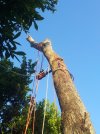
What about leaners, especially leaning pieces while aloft? The last cut I made before felling the remaining stump was an ~8' piece, and the top-half of this tree had much more pronounced lean than the lower half... Since it was a "serious cut" for me (at my skill level), I planned the hell out of it, decided Humboldt cut for less kickback, a 2" step at the hinge to discourage slide-back, planned to bore like 50% of the center after notching (it's a Live Oak, the smallest holding wood is typically all they need), and sapwood cuts ('nipping the corners' as you say) as well as doing ~1" full grooves on both sides (reducing funny behaviors from the anomalously stronger outer edges of the trunkwood)
All seemed well til I got up there, started cutting the bottom half of my Humboldt, and quickly my saw is pinched :mad: Had wedges & hand-axe, couldn't move it....was barely over 1" of bar pinched in there but it wasn't going anywhere....I wasn't planning to make a deep notch, precisely to prevent risks of this happening, and it happens like a few inches into the wood (when I tried pivoting-out as I felt it pinching, I got it out most of the way except that last ~1", had to spur down&back up with another saw to cut it out :/ )
20201105_170157.jpg
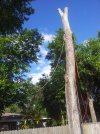
Thankfully it was on the leaning side, so once I cut the piece it just kinda dangled....that 355t has taken a serious fall before and didn't skip a beat, not trying to push my luck there again lol. Those ropes on it are "safety ropes", measured before the cut, anchored to adjacent trees, they're simply to peg the piece to my drop zone if it tried flipping-up after hitting the ground, there was a fence so couldn't set a VSL.

Once I got that ^ piece off (and then removed a fence panel to make room :p ) I was ready to fell the trunk, had to fell it nearly 30deg or 40deg away from its lean (though its lean is weird...will post more pics below that'll show what I mean), did this precisely how you describe (which is like dead-on for what I found from Terry Hale and WorkSafe BC, though I guess it makes sense you guys all agree ;D ), and - amazingly - it did work/go well (we were strongly expecting it would just fall with its lean and crush a piece of fencing we didn't want crushed, was just the 'right/efficient' way of doing this thing given the context we were in!)
Am eager to fell more trees, once understanding hinges there is a lot of fun to it, blows my mind how much control you can have when going slow, using wedges and a pull line (esp with MA) and just taking your time moving it bit-by-bit til it's ready to take-over for ya ;D Without having bore-cut the middle ~50% of the trunk, I'm doubting we'd have gotten it to pull the way we wanted, Live Oaks are so damn tough I wish I had a closeup of the holding-wood that was left on that trunk it was nearly nothing!!

Can you post up some pics?
Since it'd help most in this context I'm gonna post them from right after topping, to after felled....this entire job I was carrying my new wedge collection, was watching notch/felling videos between sessions (this was a many-days job for me)
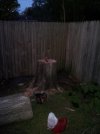
Tree leaning-out of yard, into neighbor's backyard (where I was dropping most pieces, and the yard I felled it into, the way it leans would've crushed a ton of fencing so we setup a pull at like 45deg from the lean, and cut the notch about halfway between the lean and the pull-line's force, and succeeded in moving its landing zone enough to save the fencing we wanted to!)
20201105_150550.jpg
side view for lean:
20201105_150515.jpg

Ready to drop, removed a fence panel but the lean would still smash more fencing. One rope to top is mech advantage, goes to front of opposing yard (where it met a 3:1 setup), other rope to top is another 'fixed length' that had about 10' of slack to prevent any serious bounce, and the 3-strand at the bottom goes to an adjacent tree-stump (already felled that Oak some years back, now it's a planter :D ) so the butt-end wouldn't roll into the fencing once felled:
20201106_143329.jpg
and from neighbor's yard:
20201106_160820.jpg

Gotta love just-barely wrapping before dark:
20201106_175738.jpg20201106_180020.jpg :D

[edited-in: I wanted to add something-- when doing the back-cut // pulling-over, I should add that I used a 2" wide polyester webbing strap to take 2 wraps around the trunking about 1' above my back-cut, to prevent blow-outs/shearing/barberchairing/etc during the felling]
 
Last edited:
Could you elaborate on 'narrower notching'? Can't tell if you mean the notch's total opening/height (IE a smaller/narrower angle of face cut would mean the piece has less distance to "fall"/tip before the notch faces contact, and push-back begins), or if you mean a narrow notch relative to diameter (IE it could be a big tall notch, but it's only 20% deep into the tree instead of usual ~1/3rd)
Thanks!!

(BTW if you're able to link Reg's it'd be massively appreciated, have seen every one of his vids and definitely learn best from him :D )
Narrow opening - 15deg vs. 60deg, for example. The idea, as best as I understand it, is to promote breaking of the hinge before the top begins to exert a subsequent pulling influence on the remaining spar.

I'll see if I have a sec later to find wherever I heard/read about that. I'm not 100% sure where, exactly. It may have even been in "Fundamentals..." (Beranek).
 
We have had this discussion before, so lets be clear here folks.. It is the pushback and the inevitable rebound which causes sway when blowing a top, and the 3 biggest variables which influence this is the height at which you are taking a top, size of top taken, and the species involved..You could use guy lines if your really worried about sway, but there is not all that much you can do in the way of cutting that will have a big influence on the pushback. We can however have some control as to when our top disengaged from the spar...Get it to release early while the spar is still being pushed back and you can keep your top at or slightly behind the stump... Keep your top attached until after the forward movement of the rebound begins and you can "launch" or 'throw" the top, causing it the land out in front of the stump.

Here is a top taken at 130-140 ft.. A close faced undercut, allow time for the top to commit to the undercut, then get after the hinge getting it to release during the pushback phase, which keeps the top at or behind the stump....


I will find a vid of getting a top to release during the forward motion of the rebound.
 
I haven't done it myself but I've heard some guys will leave a limb or 2 on the stem below the top to help with the shock.
It's convenient and very comfortable to do that occasionally. If I can, I do it, but not if the top has a chance to get caught on the branches below.
 
Agree with Colb here.. Leaving limbs below you can do a great job of dampening things when taking a top or a log. It can be a real pain in the ass sometimes, but when you really need to settle things down it can be very useful technique..

I would also add that if you can keep your top on the spar well into the rebound/forward motion you can slightly lessen the severity of sway...
 
As Rico said the diameter and size of top is the single biggest factor. As the diameter rotates it pushes, it will keep pushing until the two surfaces clear each other. To some degree the narrower the face=less surface area slipping past each other. Humbolts help a little, bit are a must if there is any chance of brushing another tree with the top. Fast cutting the hinge after the top is committed to the absolute minimum needed, can help.
 

New threads New posts

Back
Top Bottom