Tilia cordata Brace and Cable

Treespotter,

In all the cables I installed, over 24 years, not one lag (and I tried to use lags over bolts, to limit amount of drilled wood) pulled out due to decay, and not one top broken due to decay. So, I am convinced that, using proper procedures and techniques, this is not a big issue. I have switched to about 90% dynamic, and so the concern becomes even smaller.

Yuck?! There are landmark sized trees all over the area that are still there because someone cabled them, like this Red Oak in Denver. These people would really miss this tree, and it is holding together very well.
 

Attachments

  • 72970-FH000037.webp
    72970-FH000037.webp
    39.6 KB · Views: 86
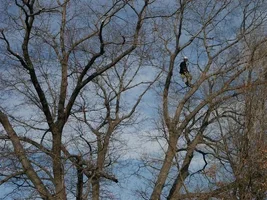
Yeah, me and Matt Mayo in 2005. 3 cables, 1/2" ehd, to welded eyebolts through about 14" diameter wood. The tree has included bark between all 3 leaders. Pictures were taken prior to installation.
 

Attachments

  • 73000-FH000036(Small).webp
    73000-FH000036(Small).webp
    101.2 KB · Views: 71
I have never seen any bracing in action (being carried out) i'd love to have a go at doin it.

My concern is where there is included bark and you brace the tree, does this not allow the problem to develop again.

Maybe its the company i work for (we mainly do removals) but we would have removed that limb and allowed the tree to 'fill in' over the coming years acknowledging the fact that the tree may never have 'proper' text book form.

its a subject that intrests me but unfortunatly most folks round these parts want their trees out, no changing their minds

jamie
 
jamie,

If that linden was growing in the forest, you could leave it alone. This tree's structure almost guarantees future failures. Our client has 20+ years "invested" into this tree. At some point, a tree will become a liability; this one isn't there yet. I believe a large removal wound low on the trunk combined with the resulting growth hormone imbalance and imminent root death due to the removal of nearly half the tree's crown, one would have to assume more liability than bracing and cabling. I think it's great that you have an interest in cabling. Do you think your employer would be open to cabling if there was a demand for it in your area?
 
[ QUOTE ]
Treespotter,

In all the cables I installed, over 24 years, not one lag (and I tried to use lags over bolts, to limit amount of drilled wood) pulled out due to decay, and not one top broken due to decay. So, I am convinced that, using proper procedures and techniques, this is not a big issue. I have switched to about 90% dynamic, and so the concern becomes even smaller.

[/ QUOTE ]
At that time in Holland the proper way to cable was to drill through the stem all the way. Loads of trees survived that work but I think the 'lag' system is to be preferred over the bolting through.


[ QUOTE ]
Yuck?! There are landmark sized trees all over the area that are still there because someone cabled them, like this Red Oak in Denver. These people would really miss this tree, and it is holding together very well.

[/ QUOTE ]
Let me quote one of my own last sentences:

[ QUOTE ]
I am with you all the way in bracing if it would be the last resource and the only way to save the tree...


[/ QUOTE ]
smirk.gif
It's not all as black and white as we would wish it would be.
 
Good stuff,like the before and after pics.
nice to see a tree not condemed or large limbs removed opening up heart wood when it can be put back together.

Bolted a chesnut together about 7 years ago that had a simular split it has survived every storm since and the bolts have been totally callused over,im sure the tree will need further work in future but it seems fine now.

The only cabling ive seen fail alot is in oak,the tanin just seems to eat the metal and it never heals properly,also chesnut does not seem to like metal in it,always work's a treat on beach though and gets totally enveloped by it! some times to well and it cant be adjusted with tree growth!.

I have not done any invasive bracing for a while.
mostly installed cobra,never seen that fail,although i took down an ash last week that had some installed (not by me) that im convinced would of failed as it was not installed properly.
Have heard though that cobra is not insurance approved??I think in future slings with D shackles and a switch back to wire would work well for any of my future bracing.
ill save the cobra in the shead for the fruit trees!
 
Hey first post!

I have pulled some Lindens back together over the years and have found that the lags will ocassionally pull out. These are trees that are more of an emergency cable and brace rather than a preventative C/B. I find the whole system has to be much tighter when a whole limb has to be winched back into its original position. Lindens are very soft wood and seem to be more prone to having lags pull out.

In these situations now with Lindens and Basswoods, I use eye bolts through the entire limb to prevent the possiblity of a lag pulling out. Just my own observations.

I noticed you didn't countersink the braces at all. Any reason for this?

Have never seen a tree fail with cables in it. Didn't get to a C/B in time once though, that turned into a removal, HE,HE.

Just one question, do you guys make the whole cable, ie. both cable ends on the ground?
 
Welcome WPArborist!

Through bolts were used to anchor the strands(cables) on this linden. I will measure the distance and have the ground crew cut the strand to length. I'll put it together and trim the excess. I'm kinda particular. Although, having the guys put it together can save some time. The tree is thin barked so I saw no need to countersink the brace washers. On the close-up pic of the brace above the crotch, you can see where the washer sunk into the branch slightly after the tension was released onto the strands(cables).
 
I have 1 cable end made on the ground and then cut to length, and I make the other end in the tree. Was just wondering how other people did it.

One more question does countersinking or not countersinking speed up or inhibit the trees growth around the nuts and washers?

Good job though, people are pretty happy when you say you can save their tree.
 
Speeds it up. However, an article in one of the trade mags a couple years back recommended that it not be done, especially on the nut end, due to increased decay in the wood.

Bolts are usually more appropriate for holding trees that have been pulled back together, since there is greater tension than on a typical steel cable (which you're trying to install under very little tension.)
 
[ QUOTE ]
Bolts are usually more appropriate for holding trees that have been pulled back together, since there is greater tension than on a typical steel cable (which you're trying to install under very little tension.)

[/ QUOTE ]

Well stated.
 
I understand that the cable should slightly loose to allow for some movement, I have just found that typically when winching limbs back into place that the whole system is more taunt than a preventative C/B.

I'm not sure if I'm convinced on not countersinking, as far as this particular situation, it seemed to be fine. If however you are dealing with a harder wood, then the less the wood will contour to the washer. Isn't part of the purpose of countersinking to have the washers perpendicular to the rod? Could a deformed washer jeopordize the support the rods are meant to give to the crotch?

As far a decay I can accept that to a certain degree. Isn't some decay rather inevitable though? Wouldn't the force that is exerted by the nuts and washers kill the bark, cambium, phloem, xylem etc. that is underneath it creating a wound and an entrance for decay anyways?

Please correct me if I'm wrong. I hope I don't come off as being arguementative, that's not my intent, I'm just asking.

Thanks
 
Not at all. I've been waiting for others to chime in on the countersinking, because I was taught the same thing that you mentioned, but then read that article (and a quick search of my piles of back issues came up empty.) I was specifically talking about eye bolts, though, not threaded rod down lower. I believe the same article discouraged that (installing bolts through crotches), as well, but since I can't find it...
 
I would be interested in reading that/those particular articles if they are available somewhere.

What I find with some articles or reports is that they are very focused on 1 particular point and may not look at the situation that a particular technique is designed for.

While obviously trying to limit the amount of decay and optimizing the conditons for the tree compartmentalize should be taken as important. I do not think it should be viewed as the sole and paramount focus in C/B.

Similiar to certain trimming, the overall health of the tree is affected to a certain degree, but when compared to the safety, structure or future well being it can be accepted as beneficial and therefore an acceptable risk.

If a tree is deemed "safe" to be C/B, then I believe the greatest focus should be on supporting the structural defect to prevent future failure. Then follow appropriate actions to minimize wounds and maximize the compartmentalization process.

Just my thouhgts.
 
I have a few comments on the original job.
First, the eye bolts or lags are not welded or forged closed and look like some cheap hardware store bolts. Were they rated?
The second thing I noticed, and it is subtle, but you could have stacked alternating washers and nuts on the end of the brace rods. We can assume that all the wood under the washer will eventually rot away, especially with a basswood and low on the trunk, and then there's nothing left holding the rod. Creating something for the new wood on the end of the rod to grow onto gives the tree something outside the CODIT walls to support the rods over time.
Lastly, and this is a can of worms, but doing a crown reduction is a stress on a tree. Removing 15% of the crown should not make the difference between the newly cabled tree standing or falling. It will slow the growth of the tree, which is counter-intuitive, to me anyway. Don't we want to add new wood at a fast rate to overcome the advancing decay? Perhaps some fertilizer would be better.
 
I understand your logic and reasoning beind stacking the washers and nuts, I do hafe some questions though.

If decay does occur behind the first washer, there will be some movement allowed at the crotch. That movement back and forth could damage the barrier zone and effectively allow the decay to travel further out, eventually comprimising the support of the second washer. This is assuming that the tree has the ability the to react quickly enough to envelope the first nut and washer.

Would it be better to minimize the total surface area that has to be compartmentalized rather than increasing the total area by adding more nuts and washers?

Should the support of the crotch be solely placed upon the callus and woundwood that are inherently weaker?

Certainly taking measures to improve the growing conditions is a good recomendation, there is the possibility of adding growth too quickly though, that can increase the risk of ringshake.

As far as crown reduction, well I can undertand the reasoning both ways.

WPArborist
 
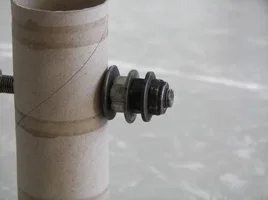
By alternating nuts and washers, do you mean like this...

I can dig that idea, but decay is not always inevitable. It has not been my experience, upon dissection, to find rotted wood surrounding braces.

The circular bent eye bolts are 1/2" rated at 300lbs SWL. I cannot find documentation of the design factor so I'm not sure of the tensile strength. While not my first choice, they meet the requirements for this particular job. Two strands(cables) were installed as the failed portion contained yet another co-dom (one was subordinated, the other was only pruned for branch spacing). The diameter of the branches at hardware termination were 5" and 6-7". ANSI part 3 lists 300lbs. and 1/4 common grade as acceptable at these diameters. I suppose the 6-7 should be upgraded to 8" however, given the size and species of tree combined with the pruning and bracing, I am confident in the hardware.

I hear you on the pruning and would like to learn/discuss how this might impact the healing process. Fertilization will not get my vote without foliar and soil sampling. As shown, fertilization may reduce root:shoot ratio, allelochemical production, drought tolerance; stress tolerance in general.
 

Attachments

  • 73927-general034LargeWebview.webp
    73927-general034LargeWebview.webp
    22.7 KB · Views: 50
WPArborist,

Have you encountered ringshake in post-bracing inspections?

I may be wrong, but once callus lignifies and becomes woundwood, I believe it is stronger than "normal" wood.
 
Well I went and re-read an article written by Shigo. I do believe you are correct, thanks for pointing that out. The barier zone is weak structurally not the woundwood. My bad, amazing what you forget if you don't use it.

I think the point can still be taken though. A rod provides support by being able to resist the outward force exerted by the tree. The wood between the washers will provide the most support and not the wood on the outside......right? So if the first washer provides no support then the second washer will only have maybe 3/4" of wood to support the crotch, this doesn't seem suitable.

No I haven't seen ringshake, just something I read.

In all the trees that have had braces in them that I have had to remove, it was never because of decay comprimising the rods. It is always the tree was dead or dying.
 

New threads New posts

Back
Top Bottom