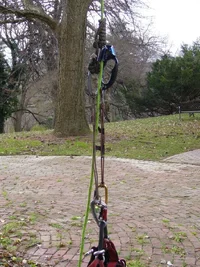
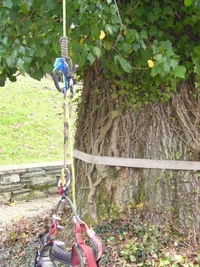
Mahk, just read your comments on the croll.
It is actually plenty strong enough at 12kN for the application. But I know what you mean - Ansi states a high static strength. And that is the standards failing; trying to encompass all activities under one requirement. We must look at the forces that are actually imposed in the way that we climb. This is the beauty of the EN standards - they are specific to key activities.
For example, the Croll is designed to pass a certain standard. This device used appropriately always maintains the slack out of a system, which greatly facilitates safe and ergonomic climbing. If used on an 11mm type A kernmantle rope, the cam may cut the sheath, but not the core. The Croll is a good distance from the other ascender. I also attach to the other ascender with the spelegyca which will absorb energy to only 5kN - which won't damage the sheath. Great back up from two seperate ascenders.
Using an ascender with a prusik attached at the top doesn't instill confidence in me in the event of a fall slip - because the ascender is the one that is gripping the rope; if the rope shaeth is severed, the prusik will likely slip off the sheath. Which is probably why Mahk says to unclip the cam. But this will lock the prusik slowing progress. Which brings us back to footlocking ergonomic issues.
I recommend the croll to maintain slack out of the system, and facilitate bio-mechanically efficient climbing technique, instead of using upper body strength above head height.
The Frog system in my opinion (and most other workers at height), is the safest, most compact and efficient technique
for access.
To work the tree on the way up, Just quickly switch to a grigri and then reascend with the Frog.
This thread has now culminated in realising what is wrong with the ANSI blanket strength requirement, rather than lack of sufficient strength in certified equipment. But there are ANSI standards for other work at height aren't there? Why can't they be adopted