
The locked Brummel in hollow-braid rope preserves the eye even if the buried tail comes unspliced. It is nowhere near as strong as a proper splice, but if it is stronger than you need, it is safe to use a substandard splice.
There are two tucks involved in making the Brummel: first the short end is taken through the standing rope to make the eye; second the standing rope is taken through the short end.
The first tuck is unnecessary. The "half Brummel" that results from skipping the first tuck still preserves the eye even if the buried tail comes unspliced. It does not preserve the eye shape any more but acts like a noose.
I decided to run a couple of break tests in 5/16-in Tenex Tec. As always, in testing Brummels, the tails were not buried to form splices.
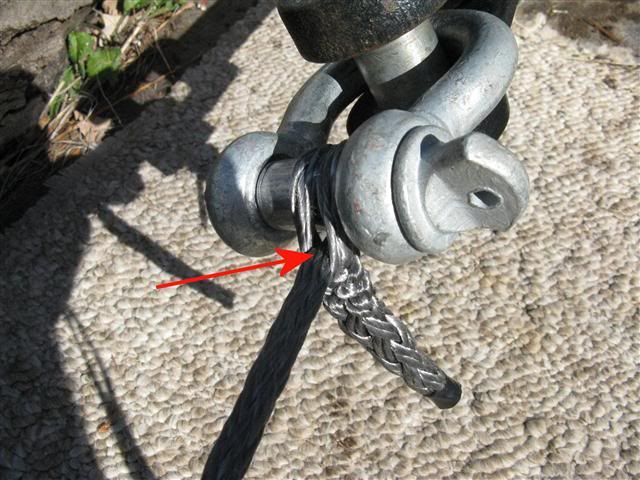
The photo shows one of the tests at a tension of just over 1000 lbs. The red arrow points to the spot on the main rope that is going to break. This is the spot on the main rope that is under full tension, but is being crushed from the side by the Brummel. Worse yet, because the rope is moving around the steel pin as the tension increases, it is being pulled through the increasingly tight constriction caused by the Brummel. Note that the geometry of this configuration is that of a girth hitch.
The half Brummels broke at 2120# and 2350#.
The same experiment with the same rope using full locked Brummels gave 2594# and 2742#. The full Brummels are about 19% stronger in this rope than the half Brummels.
There are two tucks involved in making the Brummel: first the short end is taken through the standing rope to make the eye; second the standing rope is taken through the short end.
The first tuck is unnecessary. The "half Brummel" that results from skipping the first tuck still preserves the eye even if the buried tail comes unspliced. It does not preserve the eye shape any more but acts like a noose.
I decided to run a couple of break tests in 5/16-in Tenex Tec. As always, in testing Brummels, the tails were not buried to form splices.
The photo shows one of the tests at a tension of just over 1000 lbs. The red arrow points to the spot on the main rope that is going to break. This is the spot on the main rope that is under full tension, but is being crushed from the side by the Brummel. Worse yet, because the rope is moving around the steel pin as the tension increases, it is being pulled through the increasingly tight constriction caused by the Brummel. Note that the geometry of this configuration is that of a girth hitch.
The half Brummels broke at 2120# and 2350#.
The same experiment with the same rope using full locked Brummels gave 2594# and 2742#. The full Brummels are about 19% stronger in this rope than the half Brummels.


