Navigation
Install the app
How to install the app on iOS
Follow along with the video below to see how to install our site as a web app on your home screen.
Note: This feature may not be available in some browsers.
More options
You are using an out of date browser. It may not display this or other websites correctly.
You should upgrade or use an alternative browser.
You should upgrade or use an alternative browser.
The Body Language of Trees - A handbook for failure analysis
- Thread starter Phil
- Start date

Muggs
Been here much more than a while
- Location
- Canuckistan
7. "In an unpruned, healthy tree the relative area of the crown, stem cross-section, and the root plate will be perfectly matched to the wind load as 'measured' by the tree.
It would be life-threateningly extravagant for the tree to treat itself to an impressively thick trunk beyond the needs dictated by the windiness of the site or the size of its crown."
Can't say I agree with this one. Trees are stoic warriors fighting against more than just wind load. In nature, trapped in place where they happened to germinate, they battle for light, often piling on reaction wood to grow at odd angles reaching for the sun. Their roots are not solely concerned with anchoring against wind either, often struggling in poor soils or desperately seeking water.
I think if a tree has a "goal" in life, it is simply to produce as much seed as possible, to continue the lineage. Guarding against being toppled by the wind is definitely important toward that goal, but not the only concern for the plant...

5. "It is compressive loading which most often caused failure. The resistance of wood to compression is often only half as great as its resistance to tension."
Taken as a stand-alone statement, without further explanation, that is a very misleading statement for tree workers that could easily lead to misunderstanding. This is another quote from the same paper that should be understood in the context of how these properties apply to tree work.
"Perpendicular-to-grain properties are significantly lower
than the equivalent parallel to grain properties."

ATH
Been here much more than a while
- Location
- Findlay, Ohio
Right...this isn't compression wood and tension wood as we think of it. That's the way we usually think of it and the question @Dan Thornton asked makes sense to us in that regard.Taken as a stand-alone statement, without further explanation, that is a very misleading statement for tree workers that could easily lead to misunderstanding. This is another quote from the same paper that should be understood in the context of how these properties apply to tree work.
"Perpendicular-to-grain properties are significantly lower
than the equivalent parallel to grain properties."
But when it is parallel to the grain, stand that 2x4 on end. You can put more weight on top of the board than you could hang off of the bottom end of the board.
That's an engineering property of wood, not a behavior of a standing tree.
At least that's what I am understanding here. Maybe I'm off too though.

Phil
Carpal tunnel level member
- Location
- Oak Lawn, IL
8. "Thin stems have relatively large root-plates, that is high rootplate radius / stem radius values. Relative to stem radius, fat (heavy) trunks require less room for anchorage, they press down more heavily than thin ones on the frictional surfaces between the root ball and the surrounding ground (called high normal force)"
I think a person has to ponder the mechanics of a bend failure in terms of compressive and tension. IIRC the wild card is that after partial compressive failure the bulk of the fiber still takes large compressive load but is weakened for any tensile application. The crushing shape change may place more cross section into compressive service which could explain upper cross section tensile failures in broken branches, despite the tensile capability being higher.
Phil
Carpal tunnel level member
- Location
- Oak Lawn, IL
9. "The axion of uniform stress:
The average thickness of an annual ring is regulated by biological factors and by the growing conditions, whereas its relative thickness at different points on its circumference is directed mainly by the stresses imposed by the mechanical loading at each point. This also provides an accurate historical record of loading that cannot be falsified and is therefore of value as irrefutable evidence in a court of law."
The average thickness of an annual ring is regulated by biological factors and by the growing conditions, whereas its relative thickness at different points on its circumference is directed mainly by the stresses imposed by the mechanical loading at each point. This also provides an accurate historical record of loading that cannot be falsified and is therefore of value as irrefutable evidence in a court of law."
Phil
Carpal tunnel level member
- Location
- Oak Lawn, IL
I'll ask my buddy. I don't have access to the book though.Phil, Any chance you could fill out the bigger writeup text about the ring thickness and load? More details please
Phil
Carpal tunnel level member
- Location
- Oak Lawn, IL
10. "When a reparative symptom is found, the only assumption that can be made is that the tree has a defect which it is attempting to counter by means of adaptive growth. On no account must every tree bearing symptoms be felled! In the human sphere this would mean dispensing with all medical treatment and the immediate liquidation not only of all who are ill, but also of all those who are recovering. Both are inconceivable."

Can't say I agree with this one. Trees are stoic warriors fighting against more than just wind load. In nature, trapped in place where they happened to germinate, they battle for light, often piling on reaction wood to grow at odd angles reaching for the sun. Their roots are not solely concerned with anchoring against wind either, often struggling in poor soils or desperately seeking water.
I think if a tree has a "goal" in life, it is simply to produce as much seed as possible, to continue the lineage. Guarding against being toppled by the wind is definitely important toward that goal, but not the only concern for the plant...
Continuing the lineage is accomplished by having one allele in existence. In counterpoint, having lots of copies of an allele is a recipe to attract predation. If there is a value system in evolution it is in an allele being present (1, 2, 3... -> infinity alleles), or absent (0 alleles). "How many" is an entry point into discussing the different life history strategies of the phenotypic gladiator of an allele.
Phil
Carpal tunnel level member
- Location
- Oak Lawn, IL
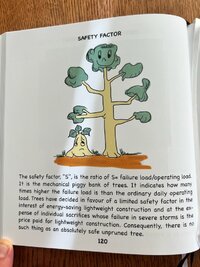
11. "Safety Factor = breaking stress of the material / working stress. The preservation of a species is costly when an individual dies and has to be replaced. But it is undoubtedly more expensive to design each individual to withstand the most unlikely loads. The natural ballance is therefore the safety factor. Ex: most all animal bones are between 3 and 4.
Trees are 4.5"
Trees are 4.5"
Phil
Carpal tunnel level member
- Location
- Oak Lawn, IL
The original text I posted was from the original book. These pages are taken from the updated book. Which can be purchased much cheaper than the original if interested in adding it to your library.Phil, Any chance you could fill out the bigger writeup text about the ring thickness and load? More details please
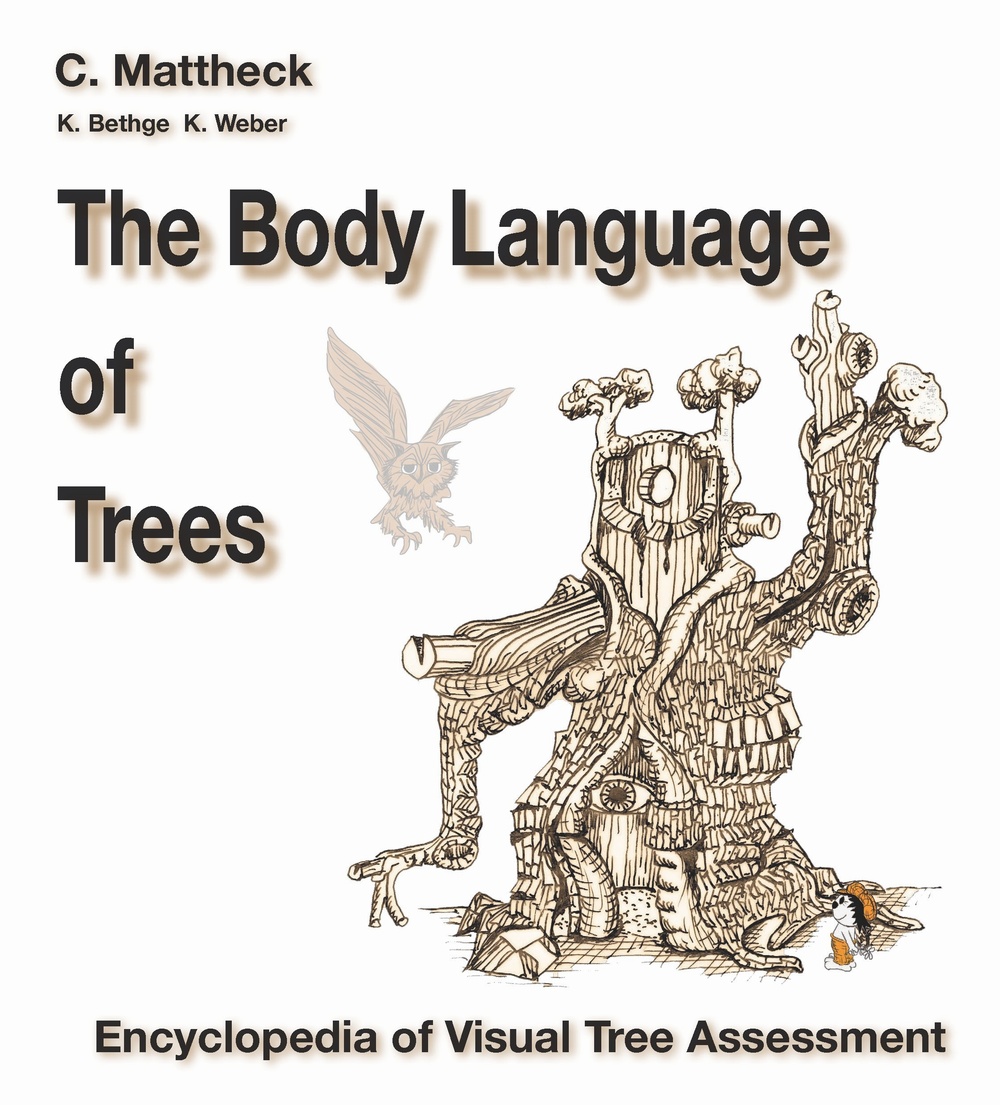
The Body Language of Trees: Encyclopedia of Visual Tree Assessment from Summerfield Books
Buy The Body Language of Trees: Encyclopedia of Visual Tree Assessment Hardback by Mattheck C. ISBN: 9783923704897
 www.summerfieldbooks.com
Attachments
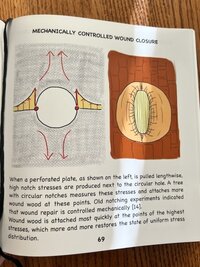
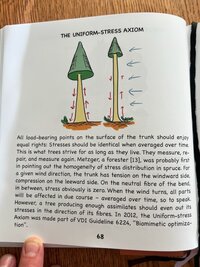
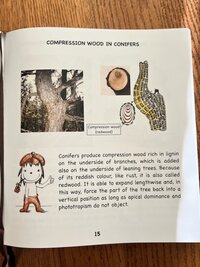
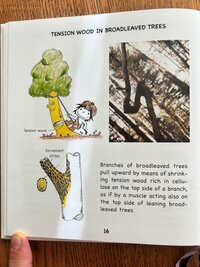
Phil
Carpal tunnel level member
- Location
- Oak Lawn, IL
Pages are from the updated book.2nd good one - can you get the backup info for the 4.5? thanks
Attachments
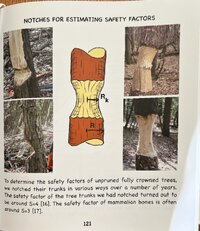
Could you tell me what citation [17] is?Pages are from the updated book.
I sense a wee tad of less engineering analysis. i.e. notching the tree - then what, pull it over or wait for a wind storm? also what about possible fiber strength variation between the removed wood and the remaining wood. I'll just presume cross sectional moment of inertia was involved in the math and not just diameter. call me curious or critical, topic is of interest to me
request for chapter's list of citations/references - would make great reading please and thank you
request for chapter's list of citations/references - would make great reading please and thank you












New threads New posts
-
test
-
-
-
-
 Light 14 or 16" narrow kerf bar for 200t or 201t
- Started by southsoundtree
- Replies: 9
-

-