The Aerial Friction Brake is here!

Early in my career all we had were natural crotches. Friction was controlled by stub/branch/trunk wraps. The catch...no standard amount of friction. Using the device means having the same amount of friction e very time. Like South Sound says...a bit of trunk friction can be used too. At least for the initial drop.

Look at the breaking strength of the Belay Spool. Then set your own safety factor. 5:1...10:1...20:1??? Still plenty strong.

Being able to use both ends of the rope saves soooo much time! A lot of the time the climber would take over lowering after the initial drop was controlled. Then the groundie can get away from the rope and use both hands to lay out the limb. Once the limb is on the ground the climber will pull up the other end of the rope and start to setup the next cut. Groundie deals with the first limb...and is ready to belay the following drop. Repeat and repeat...
 
Druid

I always like reading your posts. Very much like reading Hunter S. Thompson

Yup...allowing the climber a short break after every cut is nice

When I use my Belay Spool its for limbs. Not much big wood because I'd shift to a larger diameter rope. With The AFB it seems the rope capacity is bigger so bigger loads. Less climber lolly gagging
 
Okay, my post was a little exaggerated, but I do have some issue with the friction device being with the climber. Fine as it is, but I've read more than a few posts where the intent is to be able to work alone, or at best with a single groundperson who may or may not be around during those hairball drops.

I think a crew should have a minimum of three people, with a second individual who can rescue climb and has the appropriate gear ready. At least for larger removals and pruning.
 
Hyperbole is appreciated. You use it to make valid points

Agreed...sort of ...I've worked with a groundie who
Was my equal as a climber. In that case two
Is a crew. Each job is considered individually. Not much different than the justification of one handing a chainsaw all of the time 'because I can'.
 
Yeah, I've worked a lot as a 2 person crew, and it's typically fine (other person also a climber with gear). But on some of the hairy removals, especially around power lines I still like 3 or 4 people there. Plus lunch is more fun in a group - after a few weeks with just one other worker, you start just staring at your sandwich wondering if the other one can shut up about their epic story and just learn to run the ropes faster on the ground.
 
What do groundworkers do anymore? Is there anything easier or better built than a port-o-wrap? (American, not the Chinese knockoffs) We used to get to smoke a cigarette during those down times when a huge top came over and skidded down the tree to the ground help. A little coup, like a victory lap and all the smooth tobacco fix of a Gauloises Bleu for the effort. Now we're running the goddamned ropes up there on top of it?

Efficient Smefficient.

This reminds me of the bastards down at the Kroger, encouraging me to do all of their work at the U-Scan lane. I used to have fun lording over the bag-boy, telling him to take all that stuff out of the plastic bags, and put it into paper bags. All I do now is mess up the U-scan process by shifting items from the bagging area, and wait around like an idiot while the attendant eventually comes over and pushes a button to let me go.

SZ
 
Talk about friction! I avoid self check lanes unless I know I need to steal organic food for pesticide price on some produce. Then I fumble a few buttons and voila, regular cilantro, like magic. Otherwise it's just me cursing out loud while computers tell me that my syntax is wrong.
 
The self check out asks me how many shopping bags i wld likebto buy. The answer is always none, however i usually want to take a few for free.
 
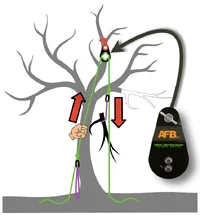
The TreeStuff.com AFB (Aerial Friction Brake) is a high productivity tool with a capability that is difficult or nearly impossible to accomplish with other rigging devices. The major benefit is that AFB can provide controlled lowering friction in both directions. And, the AFB can control this bi-directional lowering from a distance *without* having to re-rig the device. You can't do that with a port-a-wrap.

The AFB is 'beefed-up' version of the BMS Belay Spool (on steroids). I have owned and used the BMS Belay Spool on several jobs over the past five years. It, and the AFB, are “friction blocks” that effectively combine a pulley and a friction lowering device. After trying several configurations, a Belay Spool, and more importantly, the stronger AFB proves to be particularly efficient tool in one important application. Alternate lowering of loads is one of most productive uses of the AFB.

A climber slings a load to a rigging mid-line loop in the tree, cuts and lowers the load. This raises another loop/sling into the tree. A groundie releases the load, while the climber slings another load to the other side of the
rigging line. This process is repeated back-and-forth. Thus, the climber and
groundie can work without having to wait for each other which greatly improves, nearly doubling productivity.

The simplistic illustration, below, graphically represents an efficiency that would be hard to beat with any other device.AFB Rigging.webp
 
The TreeStuff.com AFB (Aerial Friction Brake) is a high productivity tool with a capability that is difficult or nearly impossible to accomplish with other rigging devices. The major benefit is that AFB can provide controlled lowering friction in both directions. And, the AFB can control this bi-directional lowering from a distance *without* having to re-rig the device. You can't do that with a port-a-wrap.

The AFB is 'beefed-up' version of the BMS Belay Spool (on steroids). I have owned and used the BMS Belay Spool on several jobs over the past five years. It, and the AFB, are “friction blocks” that effectively combine a pulley and a friction lowering device. After trying several configurations, a Belay Spool, and more importantly, the stronger AFB proves to be particularly efficient tool in one important application. Alternate lowering of loads is one of most productive uses of the AFB.

A climber slings a load to a rigging mid-line loop in the tree, cuts and lowers the load. This raises another loop/sling into the tree. A groundie releases the load, while the climber slings another load to the other side of the
rigging line. This process is repeated back-and-forth. Thus, the climber and
groundie can work without having to wait for each other which greatly improves, nearly doubling productivity.

The simplistic illustration, below, graphically represents an efficiency that would be hard to beat with any other device.View attachment 35427
Well said!
 
I don't see how the slings in the rope wouldn't be a colossal failure from a time/efficiency perspective. I've never removed any trees where all the limbs and rigging remained equidistant from the block. If you move one leg shorter or longer (for rigging convenience), than that other loop gets sucked into the device, or becomes further out of reach, right? And then the tail on each side of the lowering has to be extra long to incorporate the distance of travel that using either end would require?

But here's my real question. Is it a pain in the ass pulling the slack back to the climber with the wraps around it?
 
But here's my real question. Is it apain in the ass pulling the slack back to the climber with the wraps around it?

I have a belay spool. Run it with used tachyon. Sometimes the rope binds against the tree. The AFB deals with that with the wider cheek plates.
I have found that pulling one leg of rope is more weight than I like to pull. (wet rope, sappy rope compounds this) So I flip the running end while pulling the standing end. Overall I feel it is a good tool and I will likely upgrade to the AFB.
 
But here's my real question. Is it apain in the ass pulling the slack back to the climber with the wraps around it?

I have a belay spool. Run it with used tachyon. Sometimes the rope binds against the tree. The AFB deals with that with the wider cheek plates.
I have found that pulling one leg of rope is more weight than I like to pull. (wet rope, sappy rope compounds this) So I flip the running end while pulling the standing end. Overall I feel it is a good tool and I will likely upgrade to the AFB.

Thanks for the reply, seems like it runs pretty smooth then.

But more importantly, how did you start your post by quoting mine, but end up without a space between "a" and "pain"? Did you diligently type out what I wrote, with just that small error, like some kind of scrivener? Why not just hit Reply and delete out whatever you don't need in there?
 
....But here's my real question. Is it a pain in the ass pulling the slack back to the climber with the wraps around it?

Bear in mind that I have not had a chance to play with one yet, but because the climber will be close to this in most situations, it should be easy enough to open the side plate and remove wraps.
 
But here's my real question. Is it apain in the ass pulling the slack back to the climber with the wraps around it?

I have a belay spool. Run it with used tachyon. Sometimes the rope binds against the tree. The AFB deals with that with the wider cheek plates.
I have found that pulling one leg of rope is more weight than I like to pull. (wet rope, sappy rope compounds this) So I flip the running end while pulling the standing end. Overall I feel it is a good tool and I will likely upgrade to the AFB.
I'm sure rope choice will change how each grips the spool. I ran 1/2 inch polydyne with it wasn't the smoothest.. I'm not sure maybe a more firm not so squishy rope may work better. Sorta like people,possibly.
 

New threads New posts

Kask Stihl NORTHEASTERN Arborists Wesspur TreeStuff.com Teufelberger Westminster X-Rigging Teufelberger
Back
Top Bottom