The Aerial Friction Brake is here!

The original BMS Belay Spool was a game-changer for me!

After we got it dialed-in I asked my crew how much work it saved. The consensus was about .5-1.5 people on a typical takedown. Multiply that by your billing rate and you can see the value.

Being able to use both ends of the rope and the climber as a belayer/rigger speeds up the job!

Now that it has better cheek plates, a sheave up top for a sling and enlarged a bit..whew...it makes me 'almost' want to take on doing removals again!
 
The only thing I worry about is trying to retrieve 100' of rope. How much friction will the rope weight cause? Will it be a bear to pull back up?

I found that the rope would tail up quite easily. Not as easy as in a pulley. Easier than using any other sort of false crotch for rigging though. Once in a while the rope would need a little flip to get it to tail. Using a harder lay rope will make this easier.

The key here is that the bollard is NOT round. It's made from a square block of solid stainless steel. Carroll Basset worked out the radius for the edges so that the rope would roll like it was on a round. Clever man! I'm soooo happy to see this tool redefined as an arbo tool.
 
Flicking the working end of the rope upward as you pull down on the standing end should help it to advance with a lot of friction, max wraps.
 
This flicking move was a necessary every time when I used belay spool and got old fairly quick to me. Then the size of branches aren't all the same and your fighting just to feed them down sometimes... Or going back to device to adjust friction before to match piece being removed.. Has its place and time I guess. I just never felt like it was a great changer for myself. The belay spool that is. I do like the large side plates on this one cause had that happen to when the thing rotated and pinched on the spar with some heavy shit on it that took some doing to move..
 
Then the size of branches aren't all the same and your fighting just to feed them down sometimes... Or going back to device to adjust friction before to match piece being removed...
This issue is what has never completely sold me on aerial friction devices...outside of maybe the rig 'n wrench. It's just SO much easier for the groundsperson to worry about friction and material management and the climber to worry about climbing and cutting.

Sometimes I feel like we're coming up with solutions to problems nobody has, but then again I don't know what situations everyone face daily.
 
TTF, were you using three wraps? Two wraps side by side, or with a gap between. I didn't have issue with it.

I only used it set remotely above me when I had a lot of weight.

A little trunk wrap friction can be added if you are running too much weight, as well as redirecting through a biner, or munter, or other source of friction.

Never really a problem for me.

Sometimes, when working without a rope man, I'd just cut and let it run. I could then add the friction I needed by pushing the rope against the trunk to lock it up, or grabbing it, so long as I couldn't get my fingers into the BS.
 
Easier than using any other sort of false crotch for rigging though.

How about natural crotching? Did you find it easier than using a stub--where you can add and remove wraps instantaneously? Even the same stub of the limb you are removing (G. Beranek style)?

**I realize with this device you have the option of letting it run; that option is very limited with natural crotching off a stub. But it sounds like the wll is low anyway, so that doesn't seem to be a concern.
 
TTF, were you using three wraps? Two wraps side by side, or with a gap between. I didn't have issue with it.

I only used it set remotely above me when I had a lot of weight.

A little trunk wrap friction can be added if you are running too much weight, as well as redirecting through a biner, or munter, or other source of friction.

Never really a problem for me.

Sometimes, when working without a rope man, I'd just cut and let it run. I could then add the friction I needed by pushing the rope against the trunk to lock it up, or grabbing it, so long as I couldn't get my fingers into the BS.

I went around with a wrap. Had to hold it hard in the hand sometimes. Don't remember all the details .. Worked with it on a half to a dozen jobs then just went with multiple ringery, and I told the ground to take a half wrap more or less on Porter. I hold line after impact he walks out branch no biggie.. See ya b.s.
 
It's a stub/block/pcd you take with you when needed. I've lost control when rope is forced on impact rigging on natural crotch and stub rigging early in my career. Sometimes it's risky sometimes it's not. AFB is makes all that stuff easier to manage for the arbclimber.
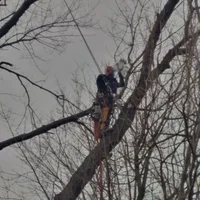
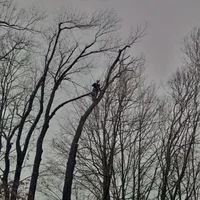
Here it is on a big black cherry removal.
The high tip is not my primary just a work positioning . Many times times it is the arbclimber who is in the bets position to do the initial run-catch-run-catch and lower to thread the needle through understorey to the ground.
 

Attachments

  • IMG_20151126_113257_hdr.webp
    IMG_20151126_113257_hdr.webp
    298.9 KB · Views: 54
  • IMG_20151126_113311_hdr.webp
    IMG_20151126_113311_hdr.webp
    1 MB · Views: 47
It's a stub/block/pcd you take with you when needed. I've lost control when rope is forced on impact rigging on natural crotch and stub rigging early in my career. Sometimes it's risky sometimes it's not. AFB is makes all that stuff easier to manage for the arbclimber.
Here it is on a big black cherry removal.
The high tip is not my primary just a work positioning . Many times times it is the arbclimber who is in the bets position to do the initial run-catch-run-catch and lower to thread the needle through understorey to the ground.
That looks like a good application for what you are doing there. I would have probably have still used a natural crotch, but may have had to go a little higher to take a slightly smaller piece(s). [hard to tell from a photo the actual size of that spar]
 
I can't vouch for this myself, but for sure I'm not a fan of the whole concept of a climber controlling friction in the crown. On paper it sounds fun, but on further thinking it feels more like the old venerated sex act of "69" - too many people working at the same time. Elbows and limbs going here and there - too much t0 focus on. It feels very Protestant somehow.

What do groundworkers do anymore? Is there anything easier or better built than a port-o-wrap? (American, not the Chinese knockoffs) We used to get to smoke a cigarette during those down times when a huge top came over and skidded down the tree to the ground help. A little coup, like a victory lap and all the smooth tobacco fix of a Gauloises Bleu for the effort. Now we're running the goddamned ropes up there on top of it?

Efficient Smefficient.
 
Wow nick your product videos are really great!

This is really exciting, especially those days when you're a little short handed, someone sick etc. my question, it seems to me you ought be able to add/remove wraps midline by opening the sheaves up and throwing another half hitch over, (where in the video you feed an end through..) is this so?
Thanks mate, best
 

New threads New posts

Kask Stihl NORTHEASTERN Arborists Wesspur TreeStuff.com Teufelberger Westminster X-Rigging Teufelberger
Back
Top Bottom