Strongest Block Attachment Sling

[ QUOTE ]
Wow, those are BIG numbers. How often do you rig a 2000# chunk of wood likesay 24" diameter red oak by 10' long? To me, that's a monster piece of wood to be catching on a natural anchor point. You could block it negative with 3/4" Stable Braid and stay inside a 10:1 safety factor AND have enough stretch to protect your anchor point from the GIGANTIC shock of a 2' or 3' drop. With Amsteel you'd be no safer but banging your rigging and anchor a LOT harder. Seems pointless.

I'm more than happy with double braid poly and Tenex. My idea of pushing it would be taking that 2000# chunk with a butt tie on an overhead anchor with a bitchin' good roper. If I had to go negative, I would go no more than half that size... That leaves me with better than a 10:1 safety using 9/16" stable braid.

Just as an aside, I had to cover for a climber once who tried to take a ~20" by 20' chunk of white oak on a block. He was in a big hurry so he was cutting big pieces... but he failed to notice that his cut was about 18' from the deck. The rope hardly got a taste of it when the piece swung around and pinned him to the trunk. I finished that tree the next day and it was not pretty.

Why risk it?

[/ QUOTE ]

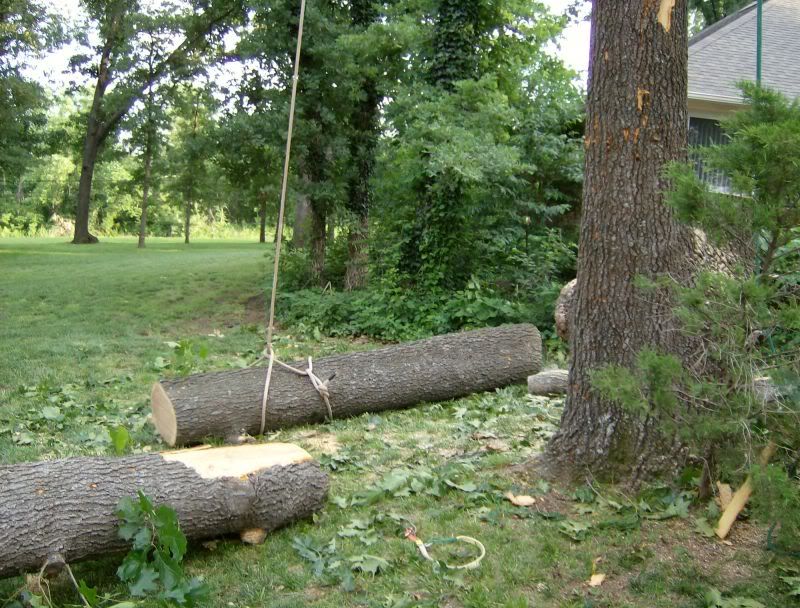
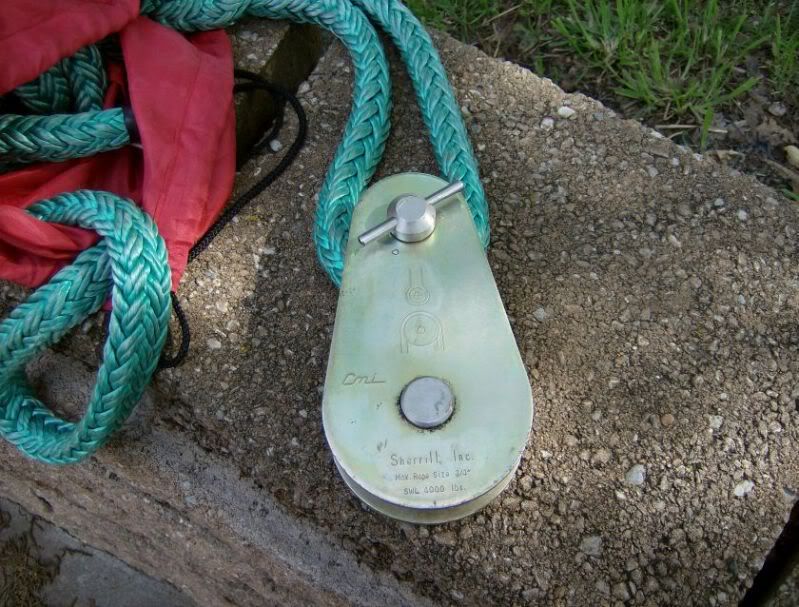
How often? Sometimes. This is a 10 footer but it was tip tied. using a 3/4 tenex sling with 3/4 double braid and a 3/4 CMI block.

I use the tenex sling mostly for redirects and double braid for an anchor these days.
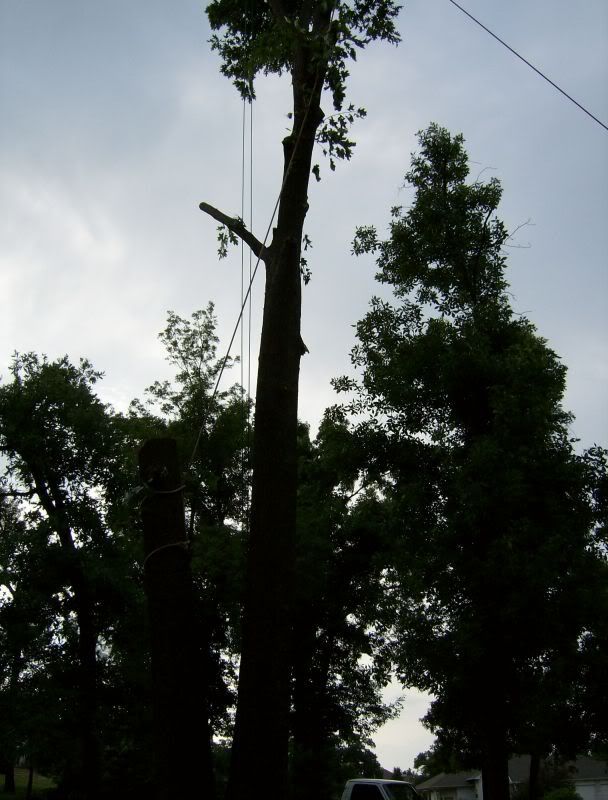
badtree010.jpg


badtree014.jpg


trees09010-1.jpg
 
Hmm.. that didn't post the first time for some reason. If it was removed for some reason my apologies for reposing it. Not sure if I fat fingered something or not.

On the topic though I am like you Blinky, I take them big when I feel comfortable but when I am slamming wood I like to take reasonable pieces. I'm with the why risk it crowd.
 
Had a friend out of CA tell me they would block 16 footers with a 1" bull rope. Needed to keep the logs 16' for the mill. That is something I would like to see.
 
[ QUOTE ]
tod_k: ...One thing to keep in mind while slamming heavy wood close to the ground like in the attachment is that the force comes into the sling very quickly. On such peices I have seen some melting on the sling at the hitch...They strectch, thats how they melt at the hitch.

[/ QUOTE ]

This is a valid point about the speed at which energy is injected into the system. If the energy (heat) has time to dissipate, temperature stays low. The same amount of heat, if it has less time to dissipate, has only one place to go, and that is increased temperature. The hidden nugget in your comment is that you saw melting at the hitch, not the rest of the sling. The sudden stretch of the sling wasn't a problem, and though it surely absorbed energy as it stretched which ended up as heat, what heat was produced was distributed throughout the rope mass and wasn't enough (probably not nearly enough) to cause a large temperature rise. Why the problem with the hitch? Because that's where there was actual slippage of one piece of rope against another. This produced a lot of heat confined to the rubbing surfaces. The very limited mass of the surface fibers had to absorb a lot of heat with very little time to dissipate it and local melting occurred.

[ QUOTE ]
Scarred4life:...Oooooor are we not creating enough force to stretch the dyneema therefore seeing no melting????

[/ QUOTE ]

As I suggested above, it is not the force or the stretch that causes a damaging temperature rise, it is the localized heating at rubbing surfaces. Obviously Dyneema is more susceptible to this than polyester. Some sling arrangements might be inherently very stable against slippage--a whoopie for example. Some knotted versions--a cow hitch maybe--might go through a fair amount of squirming and crawling as they absorbed the load. When I have pulled knots to failure I have been impressed by the extent to which they squirm and crawl (and melt!) before failure. Splices (the whoopie I mentioned) are immune to this.
 
Great post. During this thread I have only been talking about the high forces of dumping heavy wood. This is were I prefer poly. With an exotic, the cover will still see damage resulting in an expensive sling worthless. And I also free if your risk managment is dependent on sling choice you need a new plan. But every little bit may help.
 
i melted a 3/4 inch tenex sling together at the bight on a cow hitch a week ago attached to a pulley lifting the weight of a lead off a house so that i could cut it into smaller pieces to chunk into the yard. it was all that sling wanted when we started winching. job done safely and i planned on losing a sling in the bid.
 
Couple quick questions Moray. Have u pulled any of the dyneema slings to failure? Would be very curious to see the results and melting etc. Second in a block attachment situation generally the melting would occur at the bite on the throat yes or no? If so how does a whoopie eliminate that?
 
[ QUOTE ]
i melted a 3/4 inch tenex sling together at the bight on a cow hitch a week ago attached to a pulley lifting the weight of a lead off a house so that i could cut it into smaller pieces to chunk into the yard. it was all that sling wanted when we started winching. job done safely and i planned on losing a sling in the bid.

[/ QUOTE ]

That's crazy.

If a sling melts (polyester), it's seeing temps of 480* and higher. Too much force. You're lucky failure didn't occur.
If you planned on losing the sling, why not invest in a larger, stronger 1?
 
[ QUOTE ]
[ QUOTE ]
We have switched to AmSteel for our sling of choice on rigging blocks. Its stronger lighter and smaller in diameter giving us a better bend ratio. I believe were using 1/2" with a tensile strength of 34K

[/ QUOTE ]

Be aware that Amsteel Blue has almost 0 stretch. That means the <u>tree</u>, lowering line and pulley absorb the added force.

[/ QUOTE ]

Yes!! I had a 5/8th spectra eye sling made. Tensile around 54,000.
But, due to the fact that HMWPE fibers shouldn't be subjected to shock loads, and are very abrasion sensitve, I don't think they are a good choice for negative blocking, as has been made clear by Todd and Norm.. Prolly fine if the dynamic loading is kept under 10-20% of SWL.
 
[ QUOTE ]
I'm with ya Todd. Heavy loads close to the ground make me scratch my head quite often pondering a better way. And they stretch without a doubt, just look at the throat after dumping big wood.

[/ QUOTE ]

Excellent thread and input, just read the whole thing. Here's 3 short videos whereby we double rig large sections close to the ground.....obviously, tree failure was not a concern in each case. We use a dual bollard throughout each example, but a similar system could be set up with two singles.
Not meant as a derail, but I guess I’m just suggesting that if its that greater concern then there are other methods out there, perhaps just not in the text book.

http://www.youtube.com/watch?v=aiqK8z_4GyM
http://www.youtube.com/watch?v=60kSkXlglQA (forward to 2.00)
http://www.youtube.com/watch?v=jaGo69VxZJg (a clear view of the last log right at the end)
 
[ QUOTE ]
Couple quick questions Moray. Have u pulled any of the dyneema slings to failure? Would be very curious to see the results and melting etc. Second in a block attachment situation generally the melting would occur at the bite on the throat yes or no? If so how does a whoopie eliminate that?

[/ QUOTE ]

I have pulled them to failure, and yes, there is melting. The bite at the whoopie throat would definitely be a source of rubbing friction, but the actual amount of motion there would probably be very low. It would also help to have both legs of the loaded eye pressing against adjustable eye, thereby increasing the surface area that must absorb frictional heat. Only actual experience would tell us if it actually performs much better than a knotted alternative (my guess is yes).

[ QUOTE ]
I have pulled polyester slices to failure on a testing machine at a rate of 4 inches per minute (ultra slow pull). There is melting in every piece of rope where it parts.

[/ QUOTE ]

I can confirm this. Every time I have broken a plastic rope there has been melting at the site of rupture. When I have broken knotted ropes there has also been surface melting in the heavily loaded nips of the knot. It always comes down to how fast the system gets loaded, how much force presses the rubbing surfaces together, and how much they slide. Riggers probably have more control over the last parameter than the other two.
 
Thanks for the post Reg. Seems brilliant and honestly feel a little slow for that idea never crossing my mind but will definitely be storing that one in my box of tricks. Thanks again! Any known problems to look out for in that system?
 
i'm having a couple made by 7/8" double braid eye slings made just for that purpose now norm. my guy at pinnacle arborist supply says a one inch spliced double braid won't fit into a 3/4" arborist block. i have never tried it personally, are you sure a one inch sling will fit norm? because i would rather have a couple of 1" slings than a couple of 7/8" slings.
 
Lol yea i read it. I've never tried reading just the last line of something but I suppose it'd speed up books :) Did you read it? I'd start with the title. And somehow people tend to bend things to what they favor and don't remain objective I'd say. Unless of course you have often used hydraulic presses to pry apart your ropes during tree removal operations? I not sure but you reference this testing procedure as to why certains things are better or worse and that press has "nothing to due with tree care and tree rigging". Seems to me their application for the study is no different than a press it's just what they chose to test it with and have the added benefits of having actual abrasion and things occur. Maybe I'm way off but thats what I got from it.
 
Thinking about it further it seems to me it covers many similar things the fiber would experience in our application. Abrasion, twisting, compression, shock loading. Though I'd like to see something on the heat and friction part of it cause surely there had to be some friction and heat created somewhere if they "shock loaded" it.
 
[ QUOTE ]
Thanks for the post Reg. Seems brilliant and honestly feel a little slow for that idea never crossing my mind but will definitely be storing that one in my box of tricks. Thanks again! Any known problems to look out for in that system?

[/ QUOTE ]

Obviously it takes longer to set up each chunk, but you can go bigger and put the brakes on sooner where the tree is strong enough.

The bollards really ought to have the same radius, and be it the same either fixed or hanging i.e. 2 + GRCS or 2 + Portawrap.

The lines need to be kept apart from the L.Ds up to the blocks via Redirects (so the falling log doesn’t hit them on the way down. I took a wrap with a sling and then attached a prussic/shackle combo at each end to set the position. Also, set a good distance between the blocks so they dont bang together.

The two rigging lines need to be equally tight throughout….so prior to falling the chunks we pre-tension and maintain the equal rate by joining both lines together via prussic + connector + 3 rd line to control the decent.

Its still work but it will as-near-as half the wear on your lines. Thanks

Embedding 3 photos.
219115-Handforthpoplar003.jpg

219115-LBYH069.jpg

219115-Handforthpoplar006.jpg
 

Attachments

  • 219115-Handforthpoplar006.webp
    219115-Handforthpoplar006.webp
    80.5 KB · Views: 54
Could someone please clarify what is meant by "negative" when it comes to rigging down chunks? Do you mean using a false crotch and block and pushing the piece off into a lowering line? I know the thread is about slings...thanks for the input.
confused.gif
 

New threads New posts

Back
Top Bottom