
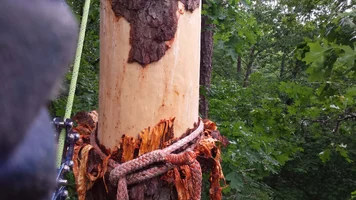
stripped bark with a loopie sling

Nish

Branched out member
Location
North Carolina
I secured a large section of 30" dbh fallen oak with a block attached by loopie to a stout pine trunk. when I cut out the supports of the fallen oak, the loopie stripped off a section of pine bark (see photo). The owner, fortunately, didn't care about the pine. Thoughts on avoiding this? Thoughts as to what will become of the pine?
 

Attachments

  • loopie stripped pine.webp
    loopie stripped pine.webp
    393.3 KB · Views: 122
The top of the pine is done. Depending on the specie it may crown out in to muilti leads.

The only way I know of avoiding this, is to go smaller. Many wraps with a dead eye, or in a basket with a double eye. Using a flat 4" sling, and smaller pieces. Spring bark can slip very easily so perhaps if it can wait until later in the year it might less damaging
 
Thanks evo. I'm also wondering if this could have been avoided if I had winched the holding rope tight before hand, both to reduce shock load and pre-tighten the sling around the pine.
 
this is one of those mistakes that you can only learn about by experience... great picture and thanks for sharing... I personally do not use loopies in the tree, as anchor points for blocks. Too much slop ofr my taste. Keep in mind that bark slip is seasonal, with spring being the greatest time of weakness. It is somewhat species dependent too. Around here, tulip is most susceptible.. YOu have to cut notches to secure the sling for crane pics.... otherwise a tube of bark can pull right off... keep the sling tied off above a branch union when settign blocks .... using a loopie to create friction on the bark of a straight stem fr a heavy load is not recommended..
 
Sometimes we chop up brush in the back of an flatbed F250, putting a rope underneath to pull the load out of the truck at the yard. Take 5 wraps on a tree and drive away.
The Pines do that all the time in the warmer weather, not so much in the cold. Reguardless of how many wraps or how tight you hold 7 wraps, does it all the time.
A bit different scenario but maybe some insight.

Sent from my SM-G920V using Tapatalk
 
I'm gonna have to agree with Evo on this one, but do you think a nylon strap would have been better (small tow strap/ rigging sling) if there was no way to go smaller? I do think that increasing the tension would have tightened the sling and reduced shockload. Like Daniel said, ya live and ya learn.
 
I have decided I'm going to use two wraps around the gin point to help distribute force and increase friction(when i deem necessary).I use loopies alot and had same thing happen,it was a fresh set and the first load on it was a trunk section,almost wiped out the fence. I also have the problem of them compressing so hard around the piece there attached to that it will crush the cambium all the way around,with any type of sling it seems.
 
Sounds like the solution might be in the rigging line.........
I.e., get those pieces running more distance so your not catching loads as much.
If you stop your car from moving 60mph by slamming on your brakes, it's not the tires fault that the rubber melted.
 
I heard from a logger friend of mine that If you are felling Tulip down hill it will often shoot out of it's own bark and travel much farther that expected. From the look of the picture I don't think the damage could have been avoided.
 
Using spansets with a wider area of contact might help ; the slackline community uses trees predominantly for their anchor points, and it's common practice to use "treepro" in order to prevent this from happening to trees. It ranges from padding to old towels to cardboard, but I have yet to hear of someone stripping bark during slacklining!

Obviously the forces aren't all the same but it seems to work pretty well in my experience
 
Padding works. On thinner barked trees (especially in the spring), if we are going to put a huge load on them, we use a 4' by 10' piece of 3/8 + thick conveyor belt on first. However we avoid having the need to do so. Taking a long dead eye, and wrapping it as many times as you can around the stem, then tie it off with a sheet bend to its self. Place the knot in the rear, and then pull 1-2 wraps (not one that has the knot) for the block works great too. Think of a exaggerated wrap 3 pull 2 anchor, but more so wrap 5 pull 2.
 

New threads New posts

Back
Top Bottom