Stopper knots and screw links for life support?

Something to keep in mind with using a carabiner, is that he is leaving this carabiner at his tie in point without constantly monitoring it. There is a chance the gate could open while in contact with the tree.
 
I was not there / or see them.
I don't know what you are referring to ?
Pics ?
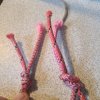
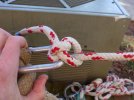
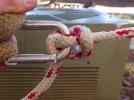
Flat overhand/ European Death Knot / EDK
Good for pulling after rappelling as its asymetrical


Flat figure 8
bad
Rolls out

F8 Traced with standing end on opposite sides.
Strong
Symmetrical, bulkier.
Not so easily pulled after rappelling.


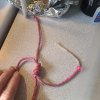
I use a double edk sometimes, if the rope doesn't knot very-well16442606974316142884089369888940.jpg16442607682955113549659174252795.jpg
 
Something to keep in mind with using a carabiner, is that he is leaving this carabiner at his tie in point without constantly monitoring it. There is a chance the gate could open while in contact with the tree.
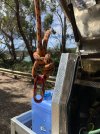
That's exactly why I decided to use a delta link tightened with a wrench.

It's pretty hard to beat the Petzl ball bearing large diameter rescue pulley even if it's not rope friendly. I realize I'm not the typical user, so I work around the one shortcoming.
 
Last edited:
Use a DMM Durolock for security. I'd rather have a pulley with a becket also, for peace of mind. Still wondering why you need to untie the link?
 
Last edited:
If you're trying to keep the length as short as possible, splice an X-ring on the end of the "anchor" rope and ditch the pulley and screw link.

If length isn't an issue, why not tie your preferred (easy to untie) loop in the end of the rope and connect the loop to the pulley with a big screw link? (I think it takes a 1/2" screw link to get a gate opening wide enough for a climbing rope.)
 
--coupla things to comment on, here.
To the OP, though, your idea has merit and has me with a zipper pull tab (w/hole) and part of my belt buckle now entangled in cordage, in crude (don't reach for that belt knot!) approximation to your stopper situation. (-;
IMO, you could make a simple OH stopper such that the tail was pointing upwards and then take that tail around the main line ("SPart") and back down through the OH :: this should secure the stopper against loose falling away from the link, and bulk up the knot a bit to benefit both security (bend-resistance vs. 1 dia is lessened to that now vs. 2dia) and strength (but how many of you would need to make what kind of fall for strength to matter?!). Yes, turning around that link is small-dia bending, but limited to, what, about a quarter of its arc --and then the line feeds away and around parts of the knot; and the metal's kinder to the rope than other rope, I think (and better heat sink, and w/less friction).
Sadly, I know of no testing done for stoppers for any frame of reference. I've seen some com.fisher stuff with an rope reeved through a metal connector, OH stoppered, and the tail hog-ringed back to the main line.

"fig.8 roll out ..." :: this calls for detailed explanation. I see no way a Fig.8 stopper is going to roll, period, in this case at hand.

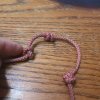
"offset" (not "flat") Fig.8" rolling out. Well, yes, that's been noted by some; and it's been a recommended knot by some French caving group, with testing, IIRC. MUCH DEPENDS ON HOW THE KNOT IS DRESSED & SET --esp. the setting. That pink & red knot shown above by SSTree has lousy setting : the turns around the tails should have been hauled tight, pulling the tails down to project roughly perpendicular to the SETTING --which is qua *stopper* knot, not *joint*!--, and only THEN do the SParts get pulled apart in their opposite directions; and there should be no material give to feed their choking turn to open the knot. As for the Offset OH (EDK), one can tie off the tail of the *choking* strand --i.e., that strand whose turn at the point where the SParts enter is what pulls them close together-- with an OH around the tail of the twin strand (and if w/mixed-dia ropes, have the thinner do the choking, as it will face rolling over a larger rope).
Testing has been done for some such knots with typical slow-pull-to-rupture method; but abseilers don't gain massive amounts of mass on descent ... , but do give sometimes variations in loading force, which ... might have some ratcheting-out effect on material? --THIS, naturally, isn 't tested for.

*kN*

 
You could tie a bowline with a scaffold knot tied with the Bitter end. The bowline is easy to untie and the scaffold knot would minimize risk of the bowline Working loose. Would be even better with a Yosemite bowline, but I can never remember that knot20220207_204118.jpg
 
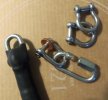
As @Jehinten suggested, the pinto is great in this configuration for a number of reasons. But mainly no gates to come undone/be cross loaded up at the TIP where you can’t readily inspect. Pintos are very textile friendly and weird stuff can happen to remotely set hardware.
I preferred bowline with a tie off, stable and can be undone when required.
 

Attachments

  • 44F9BFBC-55DC-4563-9528-7A96A8918EDD.jpeg
    44F9BFBC-55DC-4563-9528-7A96A8918EDD.jpeg
    536.9 KB · Views: 46
  • 47552F83-80F5-47E0-A8F0-73263AA7034F.jpeg
    47552F83-80F5-47E0-A8F0-73263AA7034F.jpeg
    557.8 KB · Views: 44
As @Jehinten suggested, the pinto is great in this configuration for a number of reasons. But mainly no gates to come undone/be cross loaded up at the TIP where you can’t readily inspect. Pintos are very textile friendly and weird stuff can happen to remotely set hardware.
I preferred bowline with a tie off, stable and can be undone when required.
Would it be less stress on the Pinto to tie into the becket rather than the eyes? Obviously, the spacer limits the flexure of the sideplates, but I wonder if they still bend inwards under load and pinch the spacer, which looks like it's not a tight fit. Seems like that might be easier on the rope as well, although there should be near zero rope movement.

Just asking/guessing; I don't have a pinto.
 
Would it be less stress on the Pinto to tie into the becket rather than the eyes? Obviously, the spacer limits the flexure of the sideplates, but I wonder if they still bend inwards under load and pinch the spacer, which looks like it's not a tight fit. Seems like that might be easier on the rope as well, although there should be near zero rope movement.

Just asking/guessing; I don't have a pinto.
It possibly would put less load on it. However there wouldn’t be enough room for the rope to tie to the becket and also run through the pulley.

When it’s upright, the rope runs on top of the pulley and then you have a larger cavity below the pulley for using the becket.
 
What are folks thoughts on tying a clove as your anchor to the mailon and a half hitch above it as a precaution.

OP, when youre setting your line, you pull the entire line through and back down to the floor, then attach your pulley and haul back up to desired height?

I feel like a dmm perfect O would be fine enough to connect pulley and clove or 8 on a bite or bowline etc.

Also pinto definitely sounds great, pricier option but hey your life is on that line...
 

Attachments

  • 1644583572146849292624671027021.jpg
    1644583572146849292624671027021.jpg
    217.7 KB · Views: 33
OP, when youre setting your line, you pull the entire line through and back down to the floor, then attach your pulley and haul back up to desired height?

Also pinto definitely sounds great, pricier option but hey your life is on that line...

You're right about setting the line. I've got plastic friction savers over the TIPs on the yard trees I climb, so the little extra wear on the soft Voyager rope isn't an issue. I'll use the tougher-skinned Mercury rope when climbing most other places.

The Petzl rescue pulley had the largest diameter pulley of the ones I looked at back then, and I thought that was important. The reasonable price was appealing since I was using two pulleys in a 3:1 system. I switched to 2:1 mrs after I got stronger. The Pinto Rig would be a good choice now, too.
 
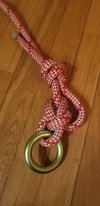
This is the top end of a remotely installable 3:1 MRS setup, circa 2007, used for facilitating rec climbers who had trouble with 2:1 MRS. I was curious to see what I used on the delta, there you have it, backed F8 on a bight. CMI large radius steel pulley, 9,000+ lbs rating as I recall.

487519649_93d94b685e_c.jpg


-AJ
 
Heck, I took photos so I darn well oughta post 'em!
The stopper attachment looked interesting;
be nice to see some test data on it. I like how it
makes a partial turn around the screw link
(in some dressing & settings). So, to be more
sure, I tossed in a wrap of the main line,
tucking that tail back out through the overhand (OH)
stopper.

Note that I'm showing a less appealing condition:
half-inch yacht line to an oval 'biner (so, much
larger opening for the stopper to catch).

(-;
 

Attachments

  • knots_StopperNooseHitch-ML-1.jpg
    knots_StopperNooseHitch-ML-1.jpg
    137.3 KB · Views: 18
  • knots_StopperNooseHitch-ML-2.jpg
    knots_StopperNooseHitch-ML-2.jpg
    133.4 KB · Views: 18
Njdelaney nailed it.

Well, it looks like Tree Buzz has kept me safe again. I hadn't heard about the accidents with the figure 8 knots. I would have started out low and slow, but at my age any fall is potentially a life-changing event. I'll stick with what I've been doing for the last several hundred climbs. It's not really that hard, I know how to do it, and I know it works.
At any age any fall is potentially a life changing event, my wife is a rn and worked the trauma ward at UC Davis in Sacramento (best trauma hospital in our area) and she's had patients in their 20s and 30 who were quadriplegic from tripping walking down the street.
 
Overhand is a bad stopper (left most)

Extra time through ( middle knot) is a good stopper, depending on the cordage.

Three passes through the hole (right side) is a good stopper, depending on the cordage.

K.I.S.S. and streamlined/ low- profile, without extra gear. 16616330571073785658389735689050.jpg
 

New threads New posts

Kask Stihl NORTHEASTERN Arborists Wesspur TreeStuff.com Teufelberger Westminster X-Rigging Teufelberger
Back
Top Bottom