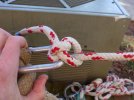
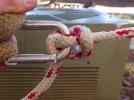
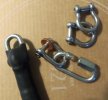
--coupla things to comment on, here.
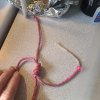
To the OP, though, your idea has merit and has me with a zipper pull tab (w/hole) and part of my belt buckle now entangled in cordage, in crude (don't reach for that belt knot!) approximation to your stopper situation. (-;
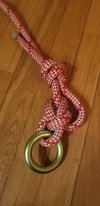
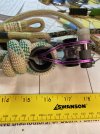
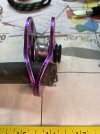
IMO, you could make a simple OH stopper such that the tail was pointing upwards and then take that tail around the main line ("SPart") and back down through the OH :: this should secure the stopper against loose falling away from the link, and bulk up the knot a bit to benefit both security (bend-resistance vs. 1 dia is lessened to that now vs. 2dia) and strength (but how many of you would need to make what kind of fall for strength to matter?!). Yes, turning around that link is small-dia bending, but limited to, what, about a quarter of its arc --and then the line feeds away and around parts of the knot; and the metal's kinder to the rope than other rope, I think (and better heat sink, and w/less friction).
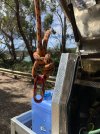
Sadly, I know of no testing done for stoppers for any frame of reference. I've seen some com.fisher stuff with an rope reeved through a metal connector, OH stoppered, and the tail hog-ringed back to the main line.
"fig.8 roll out ..." :: this calls for detailed explanation. I see no way a Fig.8 stopper is going to roll, period, in this case at hand.
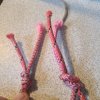
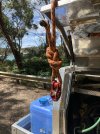
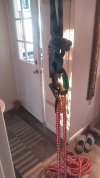
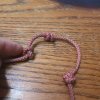
"offset" (not "flat") Fig.8" rolling out. Well, yes, that's been noted by some; and it's been a recommended knot by some French caving group, with testing, IIRC. MUCH DEPENDS ON HOW THE KNOT IS DRESSED & SET --esp. the setting. That pink & red knot shown above by SSTree has lousy setting : the turns around the tails should have been hauled tight, pulling the tails down to project roughly perpendicular to the SETTING --which is qua *stopper* knot, not *joint*!--, and only THEN do the SParts get pulled apart in their opposite directions; and there should be no material give to feed their choking turn to open the knot. As for the Offset OH (EDK), one can tie off the tail of the *choking* strand --i.e., that strand whose turn at the point where the SParts enter is what pulls them close together-- with an OH around the tail of the twin strand (and if w/mixed-dia ropes, have the thinner do the choking, as it will face rolling over a larger rope).
Testing has been done for some such knots with typical slow-pull-to-rupture method; but abseilers don't gain massive amounts of mass on descent ... , but do give sometimes variations in loading force, which ... might have some ratcheting-out effect on material? --THIS, naturally, isn 't tested for.
*kN*