Stopper knots and screw links for life support?

Winchman

Carpal tunnel level member
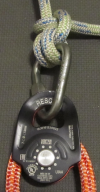
What's your opinion about running an 11.7mm rope through a 5/16" oval screw link and then tying a stopper knot for life support? The opening in the screwlink is only slightly larger than the rope, and the knot is larger than the outside width of the screw link. I'm thinking about using a figure 8 because it's easy to tie and non-binding, but could also use the bulkier Ashley stopper. I'm not sure about the non-binding quality of the Ashley, though.

I'm presently using an anchor hitch on a 3/8" delta screw link to hold the pulley at the top of my mrs climbing rig, but it takes more time to tie and dress than a figure 8, and it's moderately difficult to untie after climbing.

I see stopper knots being used on saddle bridges, but they're always going through round holes where the knot is supported all the way around.
 
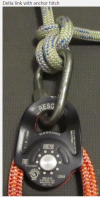
Delta link with anchor hitch
1644236943586.png
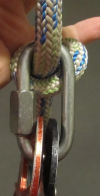
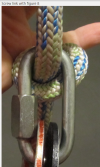
Screw link with figure 8
1644237034714.png
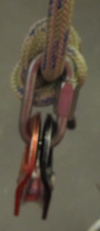
Screw link with Ashley
1644237183394.png
Both links are Maillon Rapide, and they will stay on the pulley.
 
Last edited:
Correct me if I'm wrong, but your setting your 11.7 as a basal tied false crotch, then climbing MRS on the Vortex? If so I'd go with the Alpine Butterfly and your choice of the delta link or screwlink that's pictured.


Just for clarity, tie your connector into the Alpine Butterfly, not knot block.

Nothing wrong with a knot blocking setup, but I don't see the benefit in your circumstances, if I was correctly describing your climb system.
 
I'm presently using an anchor hitch on a 3/8" delta screw link to hold the pulley at the top of my mrs climbing rig, but it takes more time to tie and dress than a figure 8, and it's moderately difficult to untie after climbing.
Why do you need to untie it?
 
I wouldn’t climb on a jamming knot setup like that, with or without a practical reason. Easy enough to use a traditional auto locking carabiner to connect the pulley, and tie any of a few anchor knots. They all can be easily released by rotating the knot out of the carabiner. If I were doing this more than once I would invest in something with an eye at the end for ease of use.
 
If a stopper knot is the only thing between me and a fall, I want a very secure knot. Personally, I would not trust a simple figure 8 stopper knot without a massive tail. I see no problem using a stopper knot with an oval quick link, provided the knot is reliable.

Not being much of an MRS climber, I'm not positive I have a clear picture of how this pulley fits into your system. Is it at the very top, as in a friction saver application?
 
The figure 8 is a relatively slender knot in one axis and that is soft rope. I wouldn't be comfortable doing that in an oval quick link personally. I also can't think of any reason not to use the AB for this purpose. If you don't like unscrewing the quick link, it can even be tied running. Richard Mumford has a good video of how to tie the running AB.
 
If a stopper knot is the only thing between me and a fall, I want a very secure knot. Personally, I would not trust a simple figure 8 stopper knot without a massive tail. I see no problem using a stopper knot with an oval quick link, provided the knot is reliable.

Not being much of an MRS climber, I'm not positive I have a clear picture of how this pulley fits into your system. Is it at the very top, as in a friction saver application?
If I remember right, he sets the pulley up and over a high TIP and runs MRS on the pulley with a separate rope. Kinda doing all the leg work to climb SRT without any of the benefit, but to each their own!
 
Njdelaney nailed it.

Well, it looks like Tree Buzz has kept me safe again. I hadn't heard about the accidents with the figure 8 knots. I would have started out low and slow, but at my age any fall is potentially a life-changing event. I'll stick with what I've been doing for the last several hundred climbs. It's not really that hard, I know how to do it, and I know it works.

Working a tight eye through the opening in the oval link with the sharp threads every time I climb just didn't seem like a good idea, and leaving it all hooked up isn't an option for a variety of reasons peculiar to my situation.
 
Working a tight eye through the opening in the oval link with the sharp threads every time I climb just didn't seem like a good idea, and leaving it all hooked up isn't an option for a variety of reasons peculiar to my situation.
If you splice it yourself, you can make the eye slightly larger. Or request a certain sized eye to be spliced the next time that you replace your rope.
 
Njdelaney nailed it.

Well, it looks like Tree Buzz has kept me safe again. I hadn't heard about the accidents with the figure 8 knots. I would have started out low and slow, but at my age any fall is potentially a life-changing event. I'll stick with what I've been doing for the last several hundred climbs. It's not really that hard, I know how to do it, and I know it works.

Working a tight eye through the opening in the oval link with the sharp threads every time I climb just didn't seem like a good idea, and leaving it all hooked up isn't an option for a variety of reasons peculiar to my situation.
Sounds like you've really come into climbing, maybe not backwards, but sideways.

Just curious, do you use the MRS rope to retrieve the floating false crotch?
 
What's your opinion about running an 11.7mm rope through a 5/16" oval screw link and then tying a stopper knot for life support? The opening in the screwlink is only slightly larger than the rope, and the knot is larger than the outside width of the screw link. I'm thinking about using a figure 8 because it's easy to tie and non-binding, but could also use the bulkier Ashley stopper. I'm not sure about the non-binding quality of the Ashley, though.

I'm presently using an anchor hitch on a 3/8" delta screw link to hold the pulley at the top of my mrs climbing rig, but it takes more time to tie and dress than a figure 8, and it's moderately difficult to untie after climbing.

I see stopper knots being used on saddle bridges, but they're always going through round holes where the knot is supported all the way around.
Its. not clear to me , are you tying the link directly to the rope or is it running free,
If tied, the bend radius is too small, weakening the knot
If its running free , remember that the figure 8 is narrow in cross- section and might pull thru if it gets side loaded.
Finally, how well does your rope hold a knot
some of the stiffer climbing lines tend to work loose if not under load, and shaken.
IT's not the easiest to untie, but as a stopper, consider the double overhand, and always leave at least 18'' of tail
 
I am not a fan of Figure-8's for life support.
I personally know 3 people that have had figure-8's roll out !
One was an ITCC Technical Judge; I'm sure it was tied, dressed & set properly. He recommends a double over-hand.

Second was a WI TCC Judge.
Third was a rock climber.
Were they a "flat F8" that looks a bit like a "flat overhand"/ EDK?
 
What I'm doing now is this. The white rope (Voyager 11.7mm) goes over the limb or crotch and down to a basal anchor. The orange rope (Vortex 12.5mm) goes down to the Zigzag. The Voyager holds knots really well, and it's easy to tie. The 3/8" delta link provides a decent radius for the knot and also lets the pulley move around to keep everything in line with the loading.
1644252414859.png

I sometimes use Mercury instead of Voyager.

This is what I was thinking about. The Voyager would go through the oval link, and then I'd tie the stopper. The knot just bears against the side of the link. The 5/16" link fits very close to the rope, and the knot is wider than the link in most directions, so I thought it might be safe to use. I would have liked a larger bend radius of a 3/8" link, but then the opening would have been much too wide.
1644253206858.png

I really wish I could tie directly to the pulley, but it's just not rope friendly IMO.

My limited experience with the double overhand stopper is that it's nearly impossible to untie after significant loading.
 
Not an opinion… that’s a fact :)

I like your first set up much more than the second. Still would use a regular biner, I don’t see how the use of a delta screw gate helps you here. And a regular biner makes sliding tight knots out of it very easy. Something that’s impossible due to the threads of the lock gate, which you made reference to.
 
Still would use a regular biner, I don’t see how the use of a delta screw gate helps you here. And a regular biner makes sliding tight knots out of it very easy. Something that’s impossible due to the threads of the lock gate, which you made reference to.


Exactly!

There seems to be a theme in treework that emulates big wall climbing. Shaving grams of weight off the gear. If grams and ounces are used...no worries. If a different system were ever to weigh pounds different then maybe pay attention.

Find an HMS biner with a no hook nose.

My preference is to use a double fisherman's for an eye termination. One huge reason is that the tail exits parallel with the rope instead of poking out 90* acting like a catch. DF is much more fair.
 

New threads New posts

Kask Stihl NORTHEASTERN Arborists Wesspur TreeStuff.com Teufelberger Westminster X-Rigging Teufelberger
Back
Top Bottom