
Navigation
Install the app
How to install the app on iOS
Follow along with the video below to see how to install our site as a web app on your home screen.
Note: This feature may not be available in some browsers.
More options
You are using an out of date browser. It may not display this or other websites correctly.
You should upgrade or use an alternative browser.
You should upgrade or use an alternative browser.
Stitching and whipping
- Thread starter ficus
- Start date


chris_girard
Branched out member
- Location
- Gilmanton, N.H.
I have a strong opinion on this. I don’t think that whipping is such a great idea for tree work as our lines tend to run over picky surfaces such as bark and the ground for both rigging and climbing lines. This can wear the whipping area as well as cause snagging issues on small pulleys.
I do definitely believe in lock stitching my splices, but again you have to be careful of how you go about it or you could ruin a perfectly done splice. What I do is an invisible lock stitch method that I learned from Master Rigger Brion Toss.
What you want to do is gently seat the first 2 or 3 stitches so you don’t distort and weaken the splice and then take a minimum of 8 stitches, seating them firmly. You can vary the angles that you go in at, both laterally and longitudinally, to pick up the greatest number of the interior yarns. Try and go in at the same spot that you come out at, so you don’t create bumps on the cover. Afterwards, just cut the yarn off flush.
I do definitely believe in lock stitching my splices, but again you have to be careful of how you go about it or you could ruin a perfectly done splice. What I do is an invisible lock stitch method that I learned from Master Rigger Brion Toss.
What you want to do is gently seat the first 2 or 3 stitches so you don’t distort and weaken the splice and then take a minimum of 8 stitches, seating them firmly. You can vary the angles that you go in at, both laterally and longitudinally, to pick up the greatest number of the interior yarns. Try and go in at the same spot that you come out at, so you don’t create bumps on the cover. Afterwards, just cut the yarn off flush.
- Location
- Springfield MO
I've never had a whipping snag on anything that I remember but I do like the invisible lock stitch. I've seen like a cutaway of the method on paper. Is there any theory on any whipping or lock stitching creating a "perf", or perforation that could weaken a splice? 'Scuse the derail.
- Location
- Springfield MO
Ficus, I see a lot of lock stitching located close to the throat of a splice. When I was actively splicing I was taught that it's simply too difficult to get a needle through the tightest portion and that moving it a little farther down along the bury was acceptable.

Norm_Hall
New member
- Location
- Wauconda, (Chicago),IL,USA
[ QUOTE ]
I've never had a whipping snag on anything that I remember but I do like the invisible lock stitch. I've seen like a cutaway of the method on paper. Is there any theory on any whipping or lock stitching creating a "perf", or perforation that could weaken a splice? 'Scuse the derail.
[/ QUOTE ]
I've seen many 'whippings' unravel on climbing ropes and rigging slings. Years ago, a climbing was using a 16 strand split tail and the whipping had worn off. While climbing, the buried part of the splice began to 'unbury. Pretty scary! I've also seen rigging spliced eye slings that had the whipping worn off, and the buried portion of the eye started to pull out while loading and unloading.I haven't done any whipping on any of my splices for years. Perfectly satisfied with stitching only. Not a fan of whipping.
The rope construction determines the starting point of the 1st stitch.
I've never had a whipping snag on anything that I remember but I do like the invisible lock stitch. I've seen like a cutaway of the method on paper. Is there any theory on any whipping or lock stitching creating a "perf", or perforation that could weaken a splice? 'Scuse the derail.
[/ QUOTE ]
I've seen many 'whippings' unravel on climbing ropes and rigging slings. Years ago, a climbing was using a 16 strand split tail and the whipping had worn off. While climbing, the buried part of the splice began to 'unbury. Pretty scary! I've also seen rigging spliced eye slings that had the whipping worn off, and the buried portion of the eye started to pull out while loading and unloading.I haven't done any whipping on any of my splices for years. Perfectly satisfied with stitching only. Not a fan of whipping.
The rope construction determines the starting point of the 1st stitch.

- Location
- Chapel Hill, NC
I use the invisible lock stitch Chris describes and work it through the whole taper but I don't pull it it very tight. If you only lock the throat the taper can still bubble out, especially with hollow braids.
But then, after the lock stitch, I whiplock most splices as close to the throat as i can... which isn't very close in the case of 24 strand double braid but on hitch cords it's right at the base of the eye. I do it because it looks cool, I like fancy whiplocks. It's kind of meditative to do it too.
The lock stitching is what keeps the splice together and uniform; the whiplock is mainly for coolness.
Whiplocks DO wear, but not much. I think I've only replaced one ever. I also whip the ends of my ropes, those wear faster but it's no big deal to replace them. I will not abide a raveled rope end and tape always comes off at the worst times.
But then, after the lock stitch, I whiplock most splices as close to the throat as i can... which isn't very close in the case of 24 strand double braid but on hitch cords it's right at the base of the eye. I do it because it looks cool, I like fancy whiplocks. It's kind of meditative to do it too.
The lock stitching is what keeps the splice together and uniform; the whiplock is mainly for coolness.
Whiplocks DO wear, but not much. I think I've only replaced one ever. I also whip the ends of my ropes, those wear faster but it's no big deal to replace them. I will not abide a raveled rope end and tape always comes off at the worst times.
chris_girard
Branched out member
- Location
- Gilmanton, N.H.
One important thing to remember with either lock stitching, or whipping, is that BOTH are really only intended for the first 10-20 pounds of force that is applied to the eye splice, and is to keep the splice from creeping out under low loads.
Once a heavy enough load is applied to the eye, the cover and core lock down on each other and the friction generated inside (with a long enough tapered tail) by the ropes keep them from slipping.
On 3-strand line, I never lock stitch or whip. Instead, I’ll apply a double constrictor knot at the end of my splice, and cut the strands off flush. A Mariner’s tapered splice is also a nice way to finish of 3-strand.
Once a heavy enough load is applied to the eye, the cover and core lock down on each other and the friction generated inside (with a long enough tapered tail) by the ropes keep them from slipping.
On 3-strand line, I never lock stitch or whip. Instead, I’ll apply a double constrictor knot at the end of my splice, and cut the strands off flush. A Mariner’s tapered splice is also a nice way to finish of 3-strand.
- Location
- Springfield MO
Sorry, I may have misspoken. What I was referring to is what I've heard called "throat seizing". Like a whipping, then supplimented with thru stitching like what you might find on Hattier's work in that trade mark "Charlie Brown" stitch. I would not trust a simple whipping to finish off any splice. Rope ends only.
- Location
- Watertown, WI
I usually lock stitch 4 full stitches (in one side and out the other) on 2 directions crossing the stiches essentially on the inside of the rope. I then tie a knot in the whip twine where the last stitch ends. Then i make a "whipping" over all the stitches, I like doing this so i do not wear the lock stitching.

Tony
Carpal tunnel level member
- Location
- Lancaster, PA
[ QUOTE ]
Where do you position your stitching/whipping and why?
[/ QUOTE ]
I'm with Gunny Highway on this issue. To paraphrase: Whip me, Beat me, but don't ever bore me. . . .

Tony
Where do you position your stitching/whipping and why?
[/ QUOTE ]
I'm with Gunny Highway on this issue. To paraphrase: Whip me, Beat me, but don't ever bore me. . . .
Tony
[ QUOTE ]
One important thing to remember with either lock stitching, or whipping, is that BOTH are really only intended for the first 10-20 pounds of force that is applied to the eye splice, and is to keep the splice from creeping out under low loads.
[/ QUOTE ]
I have seen this written many times, and I am sure many people believe it, but has anyone ever seen any evidence for this? That is, does anyone know of an actual instance of a splice that slips apart at low load but holds tight at greater loads?
I have done a fair amount of destruction testing on a variety of ropes of various fiber types and I have never known one to behave this way. For this to be true you have to imagine that the splice cover expands to accommodate the bury inside without pushing back against the core. I have seen some very ragged heavily tested Amsteel Blue that approximated this condition, but this rope was so beat up no one in their right mind would think of splicing it in the first place.
There is still a use for stitching even if the low-load creep idea is just a fairytale. It will prevent a mishandled splice from working apart, for one. But the really cool thing it can do is greatly increase the holding strength of a splice. It would take a long discussion to describe why this is so, but I can describe a simple experiment I did that illustrates the point.
I rigged up some 3/16 Amsteel Blue with a very short bury, so short that the splice reliably pulled apart under about 10 pounds tension. Then I stitched the throat of the splice with 3 stitches of 2-pound test sewing thread. This should have added about 6 pounds to the holding capacity of the splice on a good day, but that wasn't what happened. Instead the splice now held 100 pounds before the thread broke and it pulled apart. This is an easy experiment for anyone to do--no fancy equipment required. It shows that throat stitching performs valuable functions not only at low loads but at high loads as well.
One important thing to remember with either lock stitching, or whipping, is that BOTH are really only intended for the first 10-20 pounds of force that is applied to the eye splice, and is to keep the splice from creeping out under low loads.
[/ QUOTE ]
I have seen this written many times, and I am sure many people believe it, but has anyone ever seen any evidence for this? That is, does anyone know of an actual instance of a splice that slips apart at low load but holds tight at greater loads?
I have done a fair amount of destruction testing on a variety of ropes of various fiber types and I have never known one to behave this way. For this to be true you have to imagine that the splice cover expands to accommodate the bury inside without pushing back against the core. I have seen some very ragged heavily tested Amsteel Blue that approximated this condition, but this rope was so beat up no one in their right mind would think of splicing it in the first place.
There is still a use for stitching even if the low-load creep idea is just a fairytale. It will prevent a mishandled splice from working apart, for one. But the really cool thing it can do is greatly increase the holding strength of a splice. It would take a long discussion to describe why this is so, but I can describe a simple experiment I did that illustrates the point.
I rigged up some 3/16 Amsteel Blue with a very short bury, so short that the splice reliably pulled apart under about 10 pounds tension. Then I stitched the throat of the splice with 3 stitches of 2-pound test sewing thread. This should have added about 6 pounds to the holding capacity of the splice on a good day, but that wasn't what happened. Instead the splice now held 100 pounds before the thread broke and it pulled apart. This is an easy experiment for anyone to do--no fancy equipment required. It shows that throat stitching performs valuable functions not only at low loads but at high loads as well.
Tony
Carpal tunnel level member
- Location
- Lancaster, PA
Moray,
I have puropsely not lock stitched some hollow braid split tails, single eye and climbed using a blakes. There was some splice creep after a dozen or so climbs. Not enough to cause failure, but present.
Furtheremore, I have inspected hollow braid splices prior to climbing comps and training courses have been able to manually force creep into them. The cordage was of course disqualified for use.
Tony
I have puropsely not lock stitched some hollow braid split tails, single eye and climbed using a blakes. There was some splice creep after a dozen or so climbs. Not enough to cause failure, but present.
Furtheremore, I have inspected hollow braid splices prior to climbing comps and training courses have been able to manually force creep into them. The cordage was of course disqualified for use.
Tony
chris_girard
Branched out member
- Location
- Gilmanton, N.H.
moray, that's some really interesting findings. Thanks for taking the time and sharing them with us.
I too would like to hear more stories from people who may have experienced this low-load creeping actually have happened? No doubt about it (as your test shows), stitching the throat is a good idea for high loads as well.
What about the idea of pulling the stitches home too tight and distorting the buried splice and making it weaker? Have you done any tests that may prove otherwise? I'm just curious.
I too would like to hear more stories from people who may have experienced this low-load creeping actually have happened? No doubt about it (as your test shows), stitching the throat is a good idea for high loads as well.
What about the idea of pulling the stitches home too tight and distorting the buried splice and making it weaker? Have you done any tests that may prove otherwise? I'm just curious.

- Location
- Perrysburg, Ohio, U.S.A.
I had someone send me a piece about a year back of some I think it was 5/16 or 3/8 staset on a shackle. They had not stitched it and had used it on a sailboat where ,when it was not under tension from the sail, was getting thrashed back and forth. It backed out from the throat about an inch, and had herniated at the top of the eye. After taking it apart and examining it, I have no doubt in my mind that it would not have happened had it been whipped or lock stitched.

rfwoodvt
New member
- Location
- This side of eternity.
I've seen what Shawn mentions and I have seen it in many a hollow braid splice.
the key conditions seem to be cyclical light loading and unloading as in the thrashing of a luff sail and/or a loose weave in the rope.
Mostly, though, it seems, in essence, the easier it is to bury the tail the easier it is for it to back out.
I have not doubt my 16 strand won't back out anytime soon. But tenex, polypro and amsteel splices have all exhibited backwards creep.
Without a doubt the one that creeps the most is polypro. but the one that surprised me the most was my tenex slings.
I use locking brummels with full bury and taper (according to yale and samson directions) but felt stitching would be redundant to the LBs only to find that the tails had begun creeping out.
Once they started they came out at a faster pace, though none of them came all the way out. For the tenex it seemed the side to side movement from loading and unloading the rigging block played a roll. (these were all tight eyes on the bushings)
Large eye tenex shows less of this tendency but still shows it. After a while the tail "bumps" up at the insertion point if I don't stitch it.
As for double braid creep, that is a medium hard bury so one would expect only slight creep but so far the only creep I have seen is from a poor crossover or not removing all the slack properly. doesn't mean it wont' creep, just that I haven't' seen much of it.
the key conditions seem to be cyclical light loading and unloading as in the thrashing of a luff sail and/or a loose weave in the rope.
Mostly, though, it seems, in essence, the easier it is to bury the tail the easier it is for it to back out.
I have not doubt my 16 strand won't back out anytime soon. But tenex, polypro and amsteel splices have all exhibited backwards creep.
Without a doubt the one that creeps the most is polypro. but the one that surprised me the most was my tenex slings.
I use locking brummels with full bury and taper (according to yale and samson directions) but felt stitching would be redundant to the LBs only to find that the tails had begun creeping out.
Once they started they came out at a faster pace, though none of them came all the way out. For the tenex it seemed the side to side movement from loading and unloading the rigging block played a roll. (these were all tight eyes on the bushings)
Large eye tenex shows less of this tendency but still shows it. After a while the tail "bumps" up at the insertion point if I don't stitch it.
As for double braid creep, that is a medium hard bury so one would expect only slight creep but so far the only creep I have seen is from a poor crossover or not removing all the slack properly. doesn't mean it wont' creep, just that I haven't' seen much of it.
Excellent discussion, guys. There is no doubt that an unstitched hollow-braid splice can creep apart in use, though I must admit I was dubious when someone first mentioned this to me. The interesting question is how does this happen? Right after I became aware of this issue, and when I still wondered if it was true, I rigged up a brand-new hollow-braid splice and very carefully placed ink marks at the splice throat so I could detect any creep. I then attached a footloop very close to the ground so I could comfortably step in the loop to load the splice. I loaded the splice 500 times over the course of 20 minutes or so until I was exhausted.
There was not the slightest indication of any movement of the splice. I was about to rush into print with this result but on a sudden hunch I took the same splice, which had not been distubed in any way, and simply bent it back and forth about 40 times. I was shocked and amazed to see the core had crept out a full half inch!
I repeated the bending experiment later with a different type of cord and again noticed some creep, but much less than with the first cord. I have also noticed the problem with locking Brummels that rfwoodvt mentions. I had just finished a brand new Ice Tail eye with locked Brummel and standard bury. Before I made the first stitch, for some inexplicable reason, I decided to bend the throat of the splice. The insertion point was on the outside of the bend and the bending action simply and immediately levered out a short section of bury, leaving a permanent bump and a slight bend. Of course there was no fixing it and I used it for about a year before I simply couldn't abide looking at it anymore. I took it apart and respliced it without the Brummel. Now it is pretty and symmetrical and straight and will always stay that way.
From a practical point of view, creep does happen and stitching prevents it. From a theoretical point of view, I doubt if it is ever due to simple loading but if it is I would be very interested to know it.
There was not the slightest indication of any movement of the splice. I was about to rush into print with this result but on a sudden hunch I took the same splice, which had not been distubed in any way, and simply bent it back and forth about 40 times. I was shocked and amazed to see the core had crept out a full half inch!
I repeated the bending experiment later with a different type of cord and again noticed some creep, but much less than with the first cord. I have also noticed the problem with locking Brummels that rfwoodvt mentions. I had just finished a brand new Ice Tail eye with locked Brummel and standard bury. Before I made the first stitch, for some inexplicable reason, I decided to bend the throat of the splice. The insertion point was on the outside of the bend and the bending action simply and immediately levered out a short section of bury, leaving a permanent bump and a slight bend. Of course there was no fixing it and I used it for about a year before I simply couldn't abide looking at it anymore. I took it apart and respliced it without the Brummel. Now it is pretty and symmetrical and straight and will always stay that way.
From a practical point of view, creep does happen and stitching prevents it. From a theoretical point of view, I doubt if it is ever due to simple loading but if it is I would be very interested to know it.

This IS an excellent discussion!
As I read through this post, I appreciate the astute observations that have been made.... and find the 2 lb stitching test to be very interesting. I have always found it counter-intuitive to be told that lockstitch and whipping does NOT contribute to the strength of the splice...
I understand that lockstitching and whipping cannot take the place of a poorly crafted or executed splice... but surely it must add to the overall strength!
(maybe not 'legally' tho')
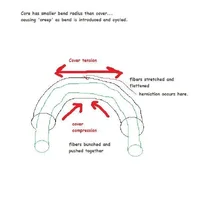
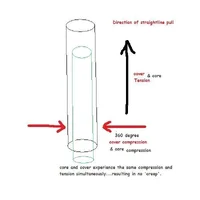
I'd like to share the metaphor that occurs to me regarding tails backing out, and how the cover interacts with the core/bury...... In my mind, I see a bend in the throat the same way I see tension and compression build up in lateral branches, or hinge-wood. Imagining (a bend) in the 'chinese fingertrap' of the cover and how it compressess on the bottom and elongates and thins on the top....and how that interacts with the smaller diameter (read: bend radius) core/bury... this snapshot illuminates for me the requirement for lockstiching and whipping. Under straight pull load, it's a 360 degree equalized tension and cover compression is at 90 degrees to the jacket..... under any other bend (or luff) the individual strands are acting like a snake shedding it's skin...using mild tension and compression.
The next time you're teaching someone how to splice...who's never done it, nor imagined how it works.... before you show them how to do it, take a couple pieces of hollowbraid apart with them.... and the need for lockstitching will instantly become apparent. I realized the illuminating power of disassembling a splice at our last splicing class.
And thought to myself.. 'Duh.. why didn't I show them that in the first place?"
As I read through this post, I appreciate the astute observations that have been made.... and find the 2 lb stitching test to be very interesting. I have always found it counter-intuitive to be told that lockstitch and whipping does NOT contribute to the strength of the splice...
I understand that lockstitching and whipping cannot take the place of a poorly crafted or executed splice... but surely it must add to the overall strength!
(maybe not 'legally' tho')
I'd like to share the metaphor that occurs to me regarding tails backing out, and how the cover interacts with the core/bury...... In my mind, I see a bend in the throat the same way I see tension and compression build up in lateral branches, or hinge-wood. Imagining (a bend) in the 'chinese fingertrap' of the cover and how it compressess on the bottom and elongates and thins on the top....and how that interacts with the smaller diameter (read: bend radius) core/bury... this snapshot illuminates for me the requirement for lockstiching and whipping. Under straight pull load, it's a 360 degree equalized tension and cover compression is at 90 degrees to the jacket..... under any other bend (or luff) the individual strands are acting like a snake shedding it's skin...using mild tension and compression.
The next time you're teaching someone how to splice...who's never done it, nor imagined how it works.... before you show them how to do it, take a couple pieces of hollowbraid apart with them.... and the need for lockstitching will instantly become apparent. I realized the illuminating power of disassembling a splice at our last splicing class.
And thought to myself.. 'Duh.. why didn't I show them that in the first place?"
Attachments
chris_girard
Branched out member
- Location
- Gilmanton, N.H.
Very good points you guys. Mark thanks for the visuals and analogies. The diagrams make it easy to see and help understand what is happening both inside and outside the rope.
A homebuilder once told me, that to understand how to build a house, you should first have to take one apart. I believe that this is true with splicing as well. It gives people a better understanding about the rope’s construction and characteristics IMO
A homebuilder once told me, that to understand how to build a house, you should first have to take one apart. I believe that this is true with splicing as well. It gives people a better understanding about the rope’s construction and characteristics IMO
New threads New posts
-
test
-
-

-

-
What's on your mind? TCI Magazine wants to know
- Started by Tree Care Industry Assoc.
- Replies: 23
-
 Apr 09 (Free CEUs) & May 07 - 'Urban Forestry Today' Webcasts @ Noon (Eastern)
- Started by UFT
- Replies: 0
-


