stitched splices? regs and standards?

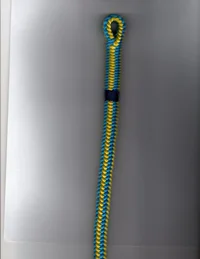
I recently talked with a climber friend who couldn't wait to show off his new lanyard setup he purchased from a company on the "wes" coast. The first thing that caught my eye was that the Eyes at each end of the 16 strand blue and yellow striped rope were sewn kinda like the GRIZZLY spliced stuff I have purchased, but I noticed 3 issues, smaller thread, looser weave, and the shrink tubing had no adhesive to help it stay in place. (they were sliding up and down the lanyard by the second day.) I tactfully put a sherrill's book in his hands. Now on to my Question, are there any standards or guidelines to look at about these types of splices? Can they be replicated by hand?

 
Thanks for your input, that didnt exactly answer my question, I too can hand splice, I guess I wasn't clear with my concerns....My friend is a climber in training, not yet seasoned like you and I, He didn't see anything wrong with what he recieved. I was looking for help from someone who knew something about the subject....I want to know what the standards are for stitched splices. example: eye splice,3-strand twist must have 5 tucks per strand. Hey, while I've got the attention of such an expert can you, teach me to HAND SPLICE my ocean split tails, and HTTP static lines.
 
Well I'm no seasoned vet, but a novice splicer. I'm sorry I do not have any information for you regarding stiched spice standards. My post was more to express my dislike towards the stitched splice and my obsession with hand splicing. I have made a few I2I out of ocean polyester 8mm and 10mm, but good luck with splicing that static line.
 
No worries, Its just the safety aspect of it I was concerned about or I would have never typed it up. I climbed for 5 years on store bought stuff before I started making my own goodies. The guy that purchased that lanyard didn't see any thing wrong with the stitching which looked like kite string..I just wondered how many more were out there and how were they holding up...
 
I've not heard of any existing standards regarding stitched eyes, but I'm interested in reading them if anyone finds more info.

Regarding the lanyard: I agree that the shrink wrapping slipping around is a little disappointing, but I've bought a sewn eye2eye from wesspur before and been satisfied with what I got. The string isn't beefy beefy beefy, but from what little I know about sewn eyes (which is nothing really) it inspired enough confidence in me to trust my life to it over and over. I second the suggestion to contact Wesspur. They've always answered my questions and addressed concerns I've had in a very professional manner.

Also, kudos on splicing ocean i2i's. The only i2i's I've made so far are ice tail (super easy). I'm about to try to make my first ocean i2i's....got any tips? I've heard it's not an easy to splice cord.
 
Hit man,

To address your questions. First, it is important to remember that a stitched eye does not rely on the strength of the stitching for its overall strength. It is the friction between the pieces of the bite of rope that is the main strength bearing member. (think seizing) Certainly the stitching adds something, but a smaller stitching cord is more a indicator of the type of machinery used than anything else.

Second, for the friction in the bite to work it must be uniform in tension. Precicely uniform with very little variant. So to answer you second query, it is not possible to replicate by hand.

The shrink tubing is nearly a protector. Electric table tape or a condom will work as well, but perhaps not as long in the case of the latter!

As for standards, you are well within your rights as a consumer to ask for and be provided with understandable, documented stats that equipment you purchase meets or exceeds industry standards. Ask for it and determine if it is suitable. That burden falls on you alone. I commend you for recognizing it and persuing it.


Tony
 
The Treemagineers have some pretty sexy stitched eyes. I'm pretty sure there are standards for stitched eyes in the UK but I don't really know. All splices have to meet a minimum breaking strength to be sold by dealers so I guess that counts as a standard requirement.?. As far as the twine goes, I'm sure it's possible to make very small diameter products from the majority of available fibers, IE dyneema.
 

New threads New posts

Back
Top Bottom