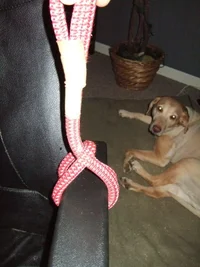
Stillson or Cow

skew

New member
Have been having an ongoing debate with a couple of bros over the name of this knot. It was told to me that it was called a Stillson because "the guy that taught it to me was called stillson". The only people I have heard call it this also worked with this guy so we figured he made it up. Then I see this t-shirt from Sherrill that has pictures of knots and it is called stillson. Anyone,Anyone, Bueller, anyone?
 
Bueller....Bueller.....Bueller.....

I had to do it!
grin.gif


Sorry, no help here.
 
[ QUOTE ]
Have been having an ongoing debate with a couple of bros over the name of this knot. It was told to me that it was called a Stillson because "the guy that taught it to me was called stillson". The only people I have heard call it this also worked with this guy so we figured he made it up.

[/ QUOTE ]

I learned it as the Stillson hitch back in 1988 when I attended an advanced climbing class at Penn State. It was shown as the perfered way to attach a block above the Hobbs Lowering Device.
 
It is a cow hitch as far I as know. For a while there it seemed like everyone wanted a knot named after them. If you look back in the books, I think that you will find that it has been called a cow hitch for a long time.
 
[ QUOTE ]
It is a cow hitch as far I as know. For a while there it seemed like everyone wanted a knot named after them. If you look back in the books, I think that you will find that it has been called a cow hitch for a long time.

[/ QUOTE ]

Correct.
 
i've always thought that Stillson Hitch was specific to our industry; a name for a Cow/ Ring/ Lark's Head etc. or Girth etc. if pulled from both ends. Before treewerk i thought a Stillson was a type of pipe wrench.
 
Yeah that is exactly right Mark. Ron ( or "yankee from hell" as my brother called him) was the guy who told us that some guy called stillson showed it to him. I guess Tobe down at Sherrill consulted Ron for the shirt!
tongue.gif
 
This is very gooooogleable!

http://www.iwillknot.com/

A Cow is similair to a choker; only made in a piece of rope not sling; and pulled from 1 end. Same thing pulled from both ends is a girth hitch. Cow is similair to Clove; only 1 Turn reversed; ends still come out middle, and trapping bar is not a Z slant like Clove, but straight instead.
 
Ever notice how the cow is tied differently in Tree Climber's Companion (pg 77) vs.Art and Science of Practical Rigging (pg. 53)? Either way looks ok but the final half hitch and the tucks are quite different.
 
On Sunday I was in the French Quarter [New Orlean] and found an old bookstore. When I left they had more space on the shelves since I scored some cool books. One of them is titled, Encyclopedia of Knots and Fancy Rope Work by Raoul Graumont and John Hensel. The book was written in 1946. This book is similar to Ashley's but there are pictures of the knots not drawings.

This book call it a "Ring Hitch"
 
Ring Hitch is legitimate name for it; though then usually tied to a ring. i don't think that is my favorite knot book though.

i've seen the 1917 book "Knots, Splices and Rope Work" by A. Hyatt Verrill on sale on ebay on CD; even though been free as part of the Gutenberg project for years! And also FM 5-125 Army RIGGING TECHNIQUES, PROCEDURES, AND APPLICATIONS li$ted too on ebay cd!!
crazy.gif
Fair place to hawk for ABoK though; but ya can get a new one for $50 @ Walmart.Com(so don't let it run up tooo high on ebay!); instead of the $75 it usually commands.

My copy of TCC walked off a few years ago; but i believe you might be talking about how the Cow was finished/backed up and not the 'base' Cow itself.

A Cow should be like a Girth/Choke in a sling; only with line and only initiating force applied to 1 leg; the other leg serving as Bitters; and best secured. i think the TCC finish of Cow was less secure; in that it formed it's HalfHitch under the leg that Pulley pulled on; but after it wrapped around the spar/ at the choke side(that has leverage over the Standing as it bends:if bend is less than 120deg.; so therefore less loaded in my imagery; thereby less trapping/pinch on Bitters to secure). In ASPR on pag. #53; the finish goes around Standing/"throat", then laces under the RoundTurn; but on the Standing before wrapping around spar. So, has more of the initiating force present in amount and 'suddenness'(?); to trap Bitters/ secure. This is similair to how snug and constrictor hitches overcome weakness of the similair (to them and to Cow) Clove. By trapping the Bittrers squarely under the most immediate and full force of the Standing that pinches down immediately and hard.

i think real best place to trap is in "Half Hitch with better Nip" position/ opposite of pulley. Also that a Timber is HH w/better Nip; with some preceding turns; but still needs to finish on convex point in this better Nip range, for best security. Really best a little over 180 from pulley/ initiating pull. So that in Timber if pulley pulls at 12o'clock, and line traces around clockwise, bends back around Standing and reverses; it's best Nip is at 5o'clock.

Timber%20Tension.GIF
 
Stillson or Cow—Mark C., TMW, and skew are correct. Cow Hitch appears in Ashley (#1802). For some reason someone started to call it a ‘Stillson’ (I heard the same story that others have mentioned) and created a lot of confusion.


Tom D. wrote:


[ QUOTE ]
Encyclopedia of Knots and Fancy Rope Work by Raoul Graumont and John Hensel. The book was written in 1946. This book is similar to Ashley's but there are pictures of the knots not drawings.

This book call it a "Ring Hitch"

[/ QUOTE ]


Are you thinking of a Cow Hitch or a Girth Hitch? A Cow Hitch is made with the end of a line and only one part of the line is loaded (# 56, #1802, and #1889). A Girth Hitch is made with a loop of line (#1890) and both parts of the line are loaded. (Ashley never uses the term ‘Girth Hitch’--at least I have never come across the term, and Girth Hitch appears in neither the index nor the glossary. Ashley does use the term Girth Knot (#234 and #1812), but this contains elements of both the Cow Hitch and the Girth.)

When the knot that we call the Girth Hitch is tied to a ring, Ashley prefers to call it a Ring Hitch or Tag Hitch (#1859). When the knot that we call the Girth Hitch is tied to mast or rigging Ashley prefers to call it a Strap Hitch or Bale Sling Hitch (#1694 and #1759). But, he is not consistent with these terms and sometimes uses Strap Hitch, Bale Sling Hitch, and Ring Hitch interchangeably (#59; should I bore you with more ###’s??).

In sum, a Cow Hitch is made with the end of a line and only one part of the line is loaded. A Girth Hitch is made with a loop of line and both parts of the line are loaded. The latter (but not the former) is sometimes called a Ring Hitch.


WoodlandTC wrote:


[ QUOTE ]
Hope this helps you.

[/ QUOTE ]


Can’t really tell whether the photo shows a loop sling, a length of line, or an eye sling. If the rope is a loop sling the knot would be a Girth Hitch. If the rope is a length of line then the knot is a Cow Hitch. If the rope is an eye sling we would call the knot it a Girth Hitch, but Ashley has yet another(!) name for it (a Long Running Eye or Hitch, #1858).


Spydey wrote:


[ QUOTE ]
Ring Hitch is legitimate name for it;

[/ QUOTE ]


No (see above)--but you had it right in your first post
grin.gif
.


ChuckR wrote:


[ QUOTE ]
Ever notice how the cow is tied differently in Tree Climber's Companion (pg 77) vs.Art and Science of Practical Rigging (pg. 53)? Either way looks ok but the final half hitch and the tucks are quite different.

[/ QUOTE ]


The form shown in ASPR is called a Cow Hitch with a Better Half. ‘Better’ because it is considered more secure. The difference between the two is that in the TCC version the tail forms the half hitch by going in the same direction that it did when it came through the bight. In the ASPR version the tail forms the half hitch by going in the opposite direction that it did when it came through the bight. That is, in the TCC version the tail goes through the bight from left to right and then forms the half hitch by going from left to right. In the ASPR version the tail goes through the bight from left to right and then forms the half hitch by going from right to left. The ASPR version (the ‘Better Half’) is considered more secure because when the block is loaded the tail of the half hitch (which is the tail of the whole knot) is loaded against the bight thus securing the whole knot.

 
More blurry knot names; Dr. Cyrus Day ("Art of Knotting & Splicing"-Naval Institue Press) speaks of a Ring Hitch; saying it should be pulled from both ends; not ruling out 1 end of pull, and giving Cow as alternate name(also Lark's Head).

On a Ring especially the Bitters should be given an Overhand Knot around the Standing. Then is secure enough to even be toggled for quick release.

Mahk i guess you have a better explanation for the different Bitters for the 2 Cow versions(surprise, surprise). i do still think the better nip is to the opposing side of the host/mount/spar of the initiating pull(pulley etc.). If convex at that point; and any of these siezings of the Bitter End/ tail should always press into spar mount firmly on convex position.
 
More blurry names is right!

Ashley (p. 11) and Dan Rusch-Fischer ( The Ring Hitch ) say that the name ‘Lark’s Head’ is not correct for this knot. They attribute the source of the name ‘Lark’s Head’ to an 1866 publication called The Book of Knots. The author of this work was apparently misinformed, unscholarly, and had little or no experience in the use of his topic. Ashley says “Being the first book in the field, it was given a prominence fasr beyond its merit, which was slight… Much of the confusion that now exists in the terminology of knots may be traced to this one ‘source’.” Rusch-Fischer says “It was the first book published in English on the subject and it [is] the source of most of the confusion about knots down to this day.”

One of the references that you gave above ( 1917 book "Knots, Splices and Rope Work" by A. Hyatt Verrill ) shows the Lark’s Head. It is similar to the Cow Hitch, but is definitely a different knot.

But, Rusch-Fischer also says “…the Ring Hitch is known by many names depending on its use; Cow Hitch, Bale Sling Hitch, Tag Hitch, Ring Hitch...” which echoes your and Tom’s source(s).

Spydey wrote:


[ QUOTE ]
On a Ring especially the Bitters should be given an Overhand Knot around the Standing.

[/ QUOTE ]


This illustrates the confusion with the names. I first thought ‘Ring’ meant a Girth Hitch (formed with a loop sling), but the rest of the sentence sounds like it has to be a Cow Hitch (because you mention the ‘Bitters’ (the Bitter end=the tail???=the working end???), and ‘the Standing’).


I will follow Ashley’s terminology. The Cow Hitch and the Girth Hitch are different enough in how they are tied and how they are loaded that they seem to me to be two distinct knots.

Spydey wrote:


[ QUOTE ]
i do still think the better nip is to the opposing side of the host/mount/spar of the initiating pull(pulley etc.). If convex at that point; and any of these siezings of the Bitter End/ tail should always press into spar mount firmly on convex position.

[/ QUOTE ]


I’m not sure I understand this.
confused.gif
I think you mean that the hitch (Cow or Girth) should be loaded against the bight. I agree, although I didn’t say that in my earlier post.
 
Hey, Mahk_Adams

Yes, the first photo was a bit skewed as to what hitch that was. It was a length of line. This attachment is from " The Morrow guide to Knots".
 

Attachments

  • 73374-cownitch.webp
    73374-cownitch.webp
    120.4 KB · Views: 84
Has anyone heard of the Cow hitch being referred to as 'a cow hitch with a better half' I assumed it just meant that the standing free end was looped round the two pieces of rope just outside the bight and tied as a half hitch to choke it off making it more secure. Then tuck the end away like a timber hitch.

Just wondering what the significance of the name 'better half' is.

What is a 'better half'
Please no sh*t jokes about your wifes or husbands.

I think is was the ArborMaster guys I heard talking about this.
 
[ QUOTE ]
Has anyone heard of the Cow hitch being referred to as 'a cow hitch with a better half'...
Just wondering what the significance of the name 'better half' is...

[/ QUOTE ]


Umm...yea...about three posts up the page.


[ QUOTE ]
What is a 'better half'...

[/ QUOTE ]


This is copied from that post:


[ QUOTE ]
ChuckR wrote:


Quote:
--------------------------------------------------------------------------------

Ever notice how the cow is tied differently in Tree Climber's Companion (pg 77) vs.Art and Science of Practical Rigging (pg. 53)? Either way looks ok but the final half hitch and the tucks are quite different.


--------------------------------------------------------------------------------


The form shown in ASPR is called a Cow Hitch with a Better Half. ‘Better’ because it is considered more secure. The difference between the two is that in the TCC version the tail forms the half hitch by going in the same direction that it did when it came through the bight. In the ASPR version the tail forms the half hitch by going in the opposite direction that it did when it came through the bight. That is, in the TCC version the tail goes through the bight from left to right and then forms the half hitch by going from left to right. In the ASPR version the tail goes through the bight from left to right and then forms the half hitch by going from right to left. The ASPR version (the ‘Better Half’) is considered more secure because when the block is loaded the tail of the half hitch (which is the tail of the whole knot) is loaded against the bight thus securing the whole knot.

[/ QUOTE ]
 

New threads New posts

Back
Top Bottom