Sticht Hitch

The harder tending with the twist might be helped by more distance between the wraps and ring. Another problem might be too small of a front ring. The twist doesn’t sit on the rope causing the four cord sections to form two v shapes, rather than a u shape if the twist does make contact, harder for the rope to slide through the v shapes.
I just finished making a wooden prototype of a device that should be easy and compact to add friction when wanted. Have to find someone to make one out of metal to really see if practical.
 
What climber new to SRT has not first asked the question, " Why can't I just climb on a single hitch?" It can be done easy enough but most find it problematic. Rope walk up SRT on a single hitch then add a Munter for descent or grab the tail for DdRT.
But the elusive holy grail perfect hitch eludes us, why? Because it is textile.
Example, a climber runs the SRT rope throughout the tree with 5 different redirects. When pulling the rope out we notice the redirect closest to the climber has damaged the thin bark tree, as it created the greatest proportion of heat and friction. Why can't we figure out a way to get each of those redirects to take the same amount of friction and save the damage? Because it's textile, soft and flexible so difficult to distribute, so add some hardware like a Pinto pulley and it helps.
So without some help, an all textile hitch is going to have some issues, locking up or burning out with more than about 70-100 pounds, and less being better. The doubled moving rope cuts that portion of the load in half, or more, depending on friction. That is why it works, we have separated a portion of the friction seperate from the hitch, so the hitch can now be controlled. Any system, hitch based, mechanical or doubled, works best if those forces can be isolated or applied separately. It just works.
Even the example below is problematic as it is so temperature sensitive. The bottom of the hitch is like a finger trap, the more you pull, the more it squeezes' and the more friction is applied. The top Brummel and half hitches are like a traditional hitch in that it can be compressed and release what is left.
With a webbing On Rope field harness, length of rope a very very inexpensive climbing system can be made and used with all the proper precautions.
 

Attachments

  • TenexHitch.jpg
    TenexHitch.jpg
    185.8 KB · Views: 65
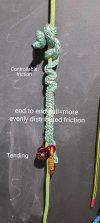
Taking some of the load off the wraps so that it will easily release is one problem with a SRT hitch, the other is to stop the binding up of the wraps, which happens with use. The Tenex constrictor hitch shown above will do the same, the braids tighten at the top until they bind up.
 
Right on. That is exactly why the Sticht works I guess? I'm keen to hear your thought.
Yes, I would agree. As in my example, if we can use some means to help distribute the major portion of our load/friction, over the length of cord, the remaining friction left on that hitch cord will be controllable and manageable. So, adding rings and such throughout the hitch will do this.
Remember, we are talking about climber loads, typically in the 100-300+ pound range. If a climber weighs 70 pounds or less, done! That climber is already in the realm of what a hitch can handle and distribute without damage or seizing. Also, when using a lanyard, if a climber is standing on spikes or on a limb, there too, a portion of the load is already removed from the system, not to mention the 50% or more, if it is used in a doubled moving rope configuration.
A friction hitch is a beautiful thing as most climbers can appreciate, just remember we are dealing with rope on rope friction. If the hitch is asked to carry too much load, or the friction becomes focused on a single bend, the results could be disastrous.
 
... The Tenex constrictor hitch shown above will do the same, the braids tighten at the top until they bind up.
No, it does not actually lock up and remains quite smooth due to the proportion of friction that is widely and evenly distributed throughout the strands in the finger trap. It is also not midline attachable.
My main concern with even posting this it that someone unknowingly will bail out of a tree putting heat on the Tenex. As Tenex is made of Polyester one would expect it to be the same as Poly hitch cord but perhaps due to the coating or manufacturing process for abrasion resistance, it performs differently. At any rate, once a layer of melted fiber starts to build it is like having your brakes glaze over creating an environment that is difficult to control. It just made me think of those truck pull off ramps on long downhills but we don't have those in a tree. A purely mechanical can also get too hot and cause problems as well. One will notice in some user manuals a maximum descent rate is specified.
Perhaps if a similar braid of some Aramide fiber was used this could be overcome but I suspect the Aramide will not be a smooth.
 
Yes, I would agree. As in my example, if we can use some means to help distribute the major portion of our load/friction, over the length of cord, the remaining friction left on that hitch cord will be controllable and manageable. So, adding rings and such throughout the hitch will do this.
Remember, we are talking about climber loads, typically in the 100-300+ pound range. If a climber weighs 70 pounds or less, done! That climber is already in the realm of what a hitch can handle and distribute without damage or seizing. Also, when using a lanyard, if a climber is standing on spikes or on a limb, there too, a portion of the load is already removed from the system, not to mention the 50% or more, if it is used in a doubled moving rope configuration.
A friction hitch is a beautiful thing as most climbers can appreciate, just remember we are dealing with rope on rope friction. If the hitch is asked to carry too much load, or the friction becomes focused on a single bend, the results could be disastrous.
Thank you. Good to hear that. In my use case, the rings, especially the back ring, become pretty hot after a long descent, so I assume they're absorbing a certain amount of heat/friction. There's no way for me to know what percentage they're bearing, though. I'll keep inspecting the wear and damage every climb.
 
As I have skimmed over this thread a couple of things come to mind, I mention them in the spirit of awareness, nothing more. If a climber is aware and chooses these actions it is completely up to the climber, but others who don't find it obvious, should be aware.
I see many putting a donut shaped ring above their hitch cords in an effort to make the hitch easier to operate. We may be treating the symptom and not the illness. There may be good reason that hitch is difficult to operate and just overpowering it may put excess heat on the hitch. I don't think anyone wants to see the hitch or climbing line glaze over, become slippery or even fail from heat. Also, we have discussed the "spring" or tension function of a hitch that should be there to provide automatic engagement of the hitch if we trip or slip from our perch. Be sure your "spring" tension will not be suppressed by this weighted ring. It also takes one of the great features of a hitch away, that small footprint on top if something were to slide down your line, (think cambium saver or deadwood). Next if you slip or trip, it becomes much easier to grab it in a panic or have a chest harness lay on it, again, preventing engagement.
Just food for thought and again, I hope taken in the interest of awareness.

There are some interesting requirements for ITCC rules on hitch cord size. I have quoted them below, again, just for awareness. I certainly won't be competing in the ITCC. ;)

2.2.22 Climbing hitch cords for moving rope applications and those which support the entire system load (stationary rope applications) shall be of a doubled configurationꢀifꢀlessꢀthanꢀ10ꢀmmꢀandꢀaꢀminimumꢀdiameterꢀofꢀ 8 mm. They shall also meet the requirements of Rule 2.2.1. Climbing hitch cords for stationary applications, where the load applied to the hitch is approximately half the system load, shall be of a doubled configuration if less than 8mm and a minimum diameter of 6 mm. Climbing hitch cords shall be manufactured from material(s) suitably resistant to the abrasion and temperatures experienced during work and rescue scenarios. Competitors shall perform an “on-rope test” to demonstrate theꢀeffectivenessꢀandꢀadjustmentꢀofꢀallꢀclimbing hitches.
 
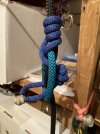
74B1662F-46A9-4EE1-A297-B4CADD9F7736.jpegThe Tenex will start binding if used enough to wear all the coating off. I thought a work around would be to have an eye at each end when the binding occurred. Wasn’t long until it would bind on the first climb after switching ends. 8mm Beeline cover works on on 9mm htp, the two sections were to be able to keep the distance between hitch and carabiner close, I think, been a few years since I tried this. A couple of companies make rope clutches for sailboats using this principle using Technora.

Light weight climber would need extra strength to overcome 70 lbs of grabbing of hitch, as everybody does. A heavier climber would have more weight pulling down on the hitch while it is also grabbing. Seems to be more proportional than a cut off point.

Right, your safety and life are your own personal responsibility, do your homework, don’t blame the dog.
 
No need for video, my hitches bound up, yours didn’t.
You can take this anyway you want and I'll leave your thread alone.
If anyone can find that "holy grail hitch" you will. Keep it up.
So this Tenex hitch was the closest I was able to come to building a system out of a textile hitch. I have used it to demonstrate the required components in a system.
It is important to distinguish between the two, a hitch as part of a system or a hitch being the system.
A hitch is generally the controllable friction of a system.
A system, IMO must contain, one, controllable friction, two, proportional friction and three, the "spring" action to initiate it all. If the ratios of those components are not correct it will not perform well, lock up, slip, fail to engage etc. Even if it is a full mechanical, those components need to be there and in the correct ratio. If say an Akimbo is adjusted so that the upper and lower friction points are doing the same job, or if the upper is adjusted to take too much friction, it will be grabby and even lock up. When the upper friction point is adjusted to be in the controllable range, and the lower friction point takes the greater proportion of friction, it will function well.
When rings are added, or as was discovered 20 years ago, a ring and a carabiner above the hitch, a "system" is being built.
Good luck.
 
I only used a single drag above the sleeve, a brummel in the picture above, a single overhand before that. The sleeve had to deal with more of the load making it stretch out and eventually bind. I was only using the single drag to help start the grabbing, but obviously there is a benefit to using more.
 
Yes please do. @Brocky got rightly run out of your thread for not discussing the hhx. Coming in here and mucking the thread up no matter how carefully you try to conceal it is quite frankly poor form for your part. Maybe you two can keep your little tiff in a PM?
Thanks for the support, but I hope he comes back, this is a place to discuss, sometimes disagree, but not in favor of censorship.
 

New threads New posts

Kask Stihl NORTHEASTERN Arborists Wesspur TreeStuff.com Teufelberger Westminster X-Rigging Teufelberger
Back
Top Bottom