
I'm a second season climber and am curious about using a steel cord lanyard. Right now i am using a run of the mill rope lanyard running through a Petzl adjuster. I like the simple set-up. I was on a job this week with a climber that ranted and raved about his steel cord lanyard and the benefits he felt he gained from it such as flipping it up when climbing large diameter trees. i didnt get a chance to try his lanyard out but would love to hear some other climbers opinions on steel cord layards. I'm going to replace may lanyard shortly and might try something new.

Navigation
Install the app
How to install the app on iOS
Follow along with the video below to see how to install our site as a web app on your home screen.
Note: This feature may not be available in some browsers.
More options
You are using an out of date browser. It may not display this or other websites correctly.
You should upgrade or use an alternative browser.
You should upgrade or use an alternative browser.
Steel core lanyard or no?
- Thread starter Tucker943
- Start date

- Location
- Hawaii
masterblaster, do you use the tail of your softcore flipline to clove hitch small limbs to gain control??

- Location
- urbana, il.
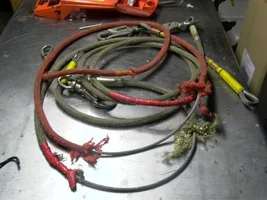
hey trees and surf there's nothing better for spiking up trunks (removals only of course) be sure to constantly inspect cable for wear and try to find that the rope spliced through the eye of the snap. STAY away from ELECTRIC conductors!

- Location
- NJ
Bought one about 5 months ago and it works great on removals. But when it is not in use it stays in an open circle and catches on branches and the like. Set mine up with a VT and micro-pulley for easy adjustment. Also it seems to stand up better to alot of wear and tear unlike rope lanyards.

- Location
- Ontario, Canada
I do most of my work with a steel core but I have both.
I only use a steel cored lanyard when I need one - spiking up large diameter trees. Which is what they were designed for.
They are unmanageable and heavy for a general flipline.
The real issue is energy absorption - there isn't any, so if you gaff out and slip while ascending or working that 'S' bend trunk, your really going to hurt when you come to a stop. The kidneys will absorb that because of the hip D attachment. I jarred my back a few years ago just rigging down a big lump on a pole. That was enough for me /forum/images/graemlins/crazy.gif.
There is limited merit to chainsaw cut protection; you may get away with a glancing blow, but a pressure cut from a small saw is enough to cut it through. I also don't like the fact that I can't inspect for any flex fatigue and rust.
I always use a soft lanyard for topping down, but then I always choke my lifeline 8" lower so its protected by the rigging sling to worry about cutting my lanyard. My lanyard is dynamic too. By choking the lifeline, there is less risk of it being struck by a saw, and you have an easy descent to the ground. Mark wrote an article on that technique a long time ago - is it on this site?
When I do use a flipline for ascent, i install a soft link between D ring and flipline. This can be a prusik or sling for mechanical grabs. This way I can easily be cut free in a rescue scenario.
Don't forget that effectively your wired up to a giant and very effective 'jump lead' - having been surprised by hidden LV supply lines in the past, I prefer low conductivity materials for tools such as a lanyard and polesaw and ladders.
Each to their own, but there are a few considerations above that some tend not to think about.
/forum/images/graemlins/cool.gif
They are unmanageable and heavy for a general flipline.
The real issue is energy absorption - there isn't any, so if you gaff out and slip while ascending or working that 'S' bend trunk, your really going to hurt when you come to a stop. The kidneys will absorb that because of the hip D attachment. I jarred my back a few years ago just rigging down a big lump on a pole. That was enough for me /forum/images/graemlins/crazy.gif.
There is limited merit to chainsaw cut protection; you may get away with a glancing blow, but a pressure cut from a small saw is enough to cut it through. I also don't like the fact that I can't inspect for any flex fatigue and rust.
I always use a soft lanyard for topping down, but then I always choke my lifeline 8" lower so its protected by the rigging sling to worry about cutting my lanyard. My lanyard is dynamic too. By choking the lifeline, there is less risk of it being struck by a saw, and you have an easy descent to the ground. Mark wrote an article on that technique a long time ago - is it on this site?
When I do use a flipline for ascent, i install a soft link between D ring and flipline. This can be a prusik or sling for mechanical grabs. This way I can easily be cut free in a rescue scenario.
Don't forget that effectively your wired up to a giant and very effective 'jump lead' - having been surprised by hidden LV supply lines in the past, I prefer low conductivity materials for tools such as a lanyard and polesaw and ladders.
Each to their own, but there are a few considerations above that some tend not to think about.
/forum/images/graemlins/cool.gif
- Location
- Hawaii
yeah, whether using steel core or not, I think choking your lifeline is the most important. I've seen guys do it with a running bowline but I worked with guys that did it by just clipping their biner over the lifeline and choking that way, works great.
jp
jp
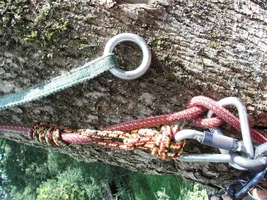
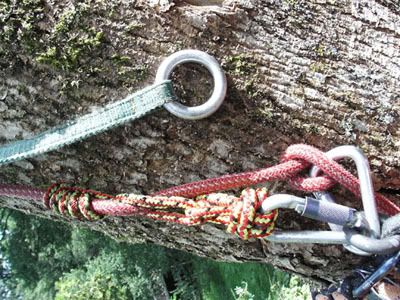
Thats how I do it T&S - just make sure the gate of the biner faces UP so the line loads the spine of the krab opposite the gate. I clip in my friction saver to retrieve for each piece (I rarely take bigger than 6' lumps for good reasons). If I do need to rap down further, I'll pull up enough rope and slip hitch it over the large friction saver ring that dangles down. I then take the micro pulley off my VT and clip a meunter below - slick and effective. Picture attached, if some kind soul would mind resizing?
You can walk down the pole one handed - just pull down on the VT, then put weight into the muenter.
You can walk down the pole one handed - just pull down on the VT, then put weight into the muenter.
Attachments
- Location
- Hawaii
good on yah lazarus2. here's the resize. nice pic

- Location
- Bloomington, Indiana
[ QUOTE ]
By choking the lifeline, there is less risk of it being struck by a saw, and you have an easy descent to the ground. Mark wrote an article on that technique a long time ago - is it on this site?
[/ QUOTE ]
Yes it is in the articles section. The title is something like "Tie-in Technique Too Difficult to Name".
[ QUOTE ]
I clip in my friction saver to retrieve for each piece
[/ QUOTE ]
So your climbing line is choked to the stem with the krab that is in the eye of you climbing line, the small ring of the friction saver is clipped into the same krab, and the big ring of the FS hangs down so that you can retrieve the choked line? And that big ring is the one that we see in your photo?
By choking the lifeline, there is less risk of it being struck by a saw, and you have an easy descent to the ground. Mark wrote an article on that technique a long time ago - is it on this site?
[/ QUOTE ]
Yes it is in the articles section. The title is something like "Tie-in Technique Too Difficult to Name".
[ QUOTE ]
I clip in my friction saver to retrieve for each piece
[/ QUOTE ]
So your climbing line is choked to the stem with the krab that is in the eye of you climbing line, the small ring of the friction saver is clipped into the same krab, and the big ring of the FS hangs down so that you can retrieve the choked line? And that big ring is the one that we see in your photo?
Thats right Mahk!
After tying the rigging sling, my lanyard sits above it, and I choke my line below the rigging sling. Just make sure there is a short tail from the rigging block, so the line can sit under without the risk of getting chopped or burnt through. I used to put both above, but its too easy to cut through both at the same time. This way my lifeline is protected by a big sling. I've only occasionally had a sling slippage incident, because I usually tie a cow hitch and take short sections. Even when it has happened, its no big deal - just back off on the hitch or unclip, as you are still on the lanyard.
After the section has gone and is released, flip the lanyard down over the sling, loosen the knot and pop the sling off the top. I clip it through the eye with a large smooth nose HMS to a sling over my shoulder. I then spike down on the lanyard until my weight comes onto the choked lifeline. Descend and repeat.
You can lean into the choked line for support when cutting.
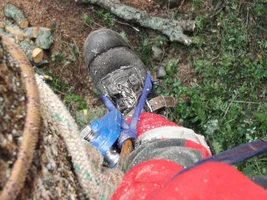
The tree I took the photos on had a 60 degree lean over a roof. These are tricky when placing a face cut, so leaning into the choked lifeline set the opposit side helps. Then i doubled a sling through the pulley block for a foot hold (use the spur or foot). Big photo attached.
After tying the rigging sling, my lanyard sits above it, and I choke my line below the rigging sling. Just make sure there is a short tail from the rigging block, so the line can sit under without the risk of getting chopped or burnt through. I used to put both above, but its too easy to cut through both at the same time. This way my lifeline is protected by a big sling. I've only occasionally had a sling slippage incident, because I usually tie a cow hitch and take short sections. Even when it has happened, its no big deal - just back off on the hitch or unclip, as you are still on the lanyard.
After the section has gone and is released, flip the lanyard down over the sling, loosen the knot and pop the sling off the top. I clip it through the eye with a large smooth nose HMS to a sling over my shoulder. I then spike down on the lanyard until my weight comes onto the choked lifeline. Descend and repeat.
You can lean into the choked line for support when cutting.
The tree I took the photos on had a 60 degree lean over a roof. These are tricky when placing a face cut, so leaning into the choked lifeline set the opposit side helps. Then i doubled a sling through the pulley block for a foot hold (use the spur or foot). Big photo attached.
Attachments

Steve Connally
Been here much more than a while
- Location
- Suffolk, Virginia
I still don't get it. I use the friction saver but just use the VT on my lifeline. Lifeline below block and flip line above. What point does the muenter make?

- Location
- Home of the New Jersey Devils
The muenter will absorb heat for descending.
[ QUOTE ]
I still don't get it. I use the friction saver but just use the VT on my lifeline. Lifeline below block and flip line above. What point does the muenter make?
[/ QUOTE ]
Never descend on a single line by a prusik alone - same principle as footlocking with a prusik; when it starts to slide it'll keep going to the ground or jam. All the weight is on the prusik.
You can get away with it with a VT by sharing weight through standing on spurs. Not considered good practice though.
As Mark says, the meunter ensures a smooth descent by taking the heat. its easy on and off too.
I still don't get it. I use the friction saver but just use the VT on my lifeline. Lifeline below block and flip line above. What point does the muenter make?
[/ QUOTE ]
Never descend on a single line by a prusik alone - same principle as footlocking with a prusik; when it starts to slide it'll keep going to the ground or jam. All the weight is on the prusik.
You can get away with it with a VT by sharing weight through standing on spurs. Not considered good practice though.
As Mark says, the meunter ensures a smooth descent by taking the heat. its easy on and off too.
New threads New posts
-
test
-

-
-
 Fruit tree holding on by a thread, client wants to get another year out of it. Thoughts?
- Started by climbingmonkey24
- Replies: 41
-
-

-


