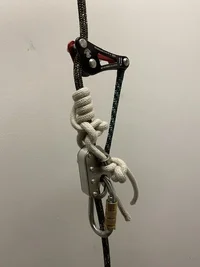
SRS rope and hitch

This is more what I was getting at. When I tried the KMIII the distel I usually use, was slippery. 8mm cord grabbed better than my 10mm. I’ve mostly figured out how to keep my RW from seizing when weighted on my 24 strand Samson ropes. I’ve seen a few posts about static ropes are for mechanicals only…but, that’s probably someone’s opinion. I just wanted a static/kernmantle to help with SRS and hitch cord. I’m on the fence if/when I try mechanicals.

I think the construction of the static’s core matters for rope wrench/hitch functionality. 10mm Sterling HTP is wild stuff with a wrench. An 8mm hitch cord works but things get weird, the parallel(?) core seems to get twisted and “bunchy”. Even if it didn’t the core fibers become so rigid during a climb that I think the rope bend through the wrench is not supple enough.

Any static line that becomes progressively less supple during a climb would be problematic for wrench/hitch performance.
-AJ
 
This is more what I was getting at. When I tried the KMIII the distel I usually use, was slippery. 8mm cord grabbed better than my 10mm. I’ve mostly figured out how to keep my RW from seizing when weighted on my 24 strand Samson ropes. I’ve seen a few posts about static ropes are for mechanicals only…but, that’s probably someone’s opinion. I just wanted a static/kernmantle to help with SRS and hitch cord. I’m on the fence if/when I try mechanicals.

Screenshot 2025-09-07 at 5.57.17 AM.webp

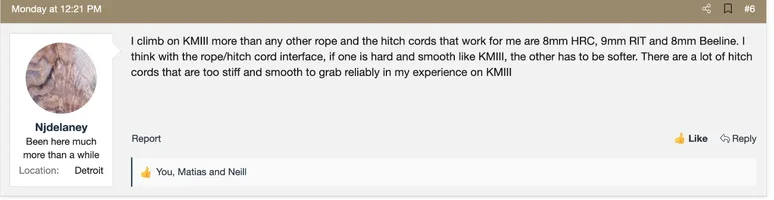
There is wisdom in Noah's post #6. Hard greasy/slippery ropes and hitch cordage with similar properties is a recipe for failure. I am a light climber and have had great success with 8mm HRC and 8mm beeline on kernmantle.
 
The climber’s weight makes the hitch grab and it is also trying to force it downward at the same time.
 
I've done head to head hitch/RW tests on the same rope which is part of the basis for my opinion. Knowing the load distribution RW/hitch drives my comment about trying a kid 1/2 your weight on your rig w/out your RW. Not on a kid's rig, but on a 140 lb guy's rig (best estimate recollection sorry if off base). I could surmise that the size of hand force to break the hitch/initiate descent could represent the degree of binding. I measured that too.

Without digging out my notes IIRC forces distribution is between 1:1 and 1:2 . I premised on 1:1. If the RW is running harder you'll have to derate the kid size to maybe 50 lbs.

IIRC Oceans is to blame for the moniker


For a very heavy climber you just have to tweak the RW geometry like the Italian(?) guy's RW meant for two people at once (rescue).
 
I've done head to head hitch/RW tests on the same rope which is part of the basis for my opinion. Knowing the load distribution RW/hitch drives my comment about trying a kid 1/2 your weight on your rig w/out your RW. Not on a kid's rig, but on a 140 lb guy's rig (best estimate recollection sorry if off base). I could surmise that the size of hand force to break the hitch/initiate descent could represent the degree of binding. I measured that too.

Without digging out my notes IIRC forces distribution is between 1:1 and 1:2 . I premised on 1:1. If the RW is running harder you'll have to derate the kid size to maybe 50 lbs.

IIRC Oceans is to blame for the moniker


For a very heavy climber you just have to tweak the RW geometry like the Italian(?) guy's RW meant for two people at once (rescue).
As mentioned I’m coming from at it from the other end, if you put a typical well dressed arborist hitch on a line and weight it, doesn’t matter how much a person weighs, It may slide at first but with 2 or 3 sequential loadings it will bind up tight. Introduce a bend above the hitch (rope wrench) and load is distributed 50/50 through hitch and tether. The hitch works. Principle is the same no matter what the climber’s weight is. That’s theory. I think an adjustable bollard rope wrench like the Apex can deal with whatever climber weight differences change the hitch performance variables. Which I think is what you’re saying ;-)
-AJ
 
Are we confused yet? Another way of saying it is: I believe a hitch/length/climbing line combo that works for a light climber like myself will work very well for a heavy climber. I think focusing on hitch cordage and configuration is mostly barking up the wrong tree for heavy climbers. Assuming the climber is already well versed in hitches, cordage types and e2e lengths try an adjustable bollard wrench to perfect your system for low drag ascent and “like butter” release and descent.
-AJ
 
50:50 to 33:66 depending on he RW. 1:1.4 over bark DRT (rope legs). edit - there's two splits: hitch:RW and up leg to down leg, DRT legs or basal side to climber side. too much data to keep straight.! Another experiment. If you go 140 lbs, put on a 70 lb backpack so you're 210 lbs and try out your SRT setup. Might bind more than usual. :) do let us know if it feels awkward!!! maybe use diving weights:)

During my testing I found quite a variation in hitch/cord performance and RW performance. Sweetest hitch/cord combo had a bit extra ascent drag but grabbed 100% and released like butter! Also very little sitback. It was a bit springier cord construction I think RIT.
 
Last edited:
I'm just thinking out loud. I have never tried mating the HH with the RW, but it would be nice if it could handle up to a two person load.
 
I tried the Wrench, HH, Sticht combo before, didn’t see any great improvement. The Sticht helps when paired with just the Wrench, it releases easily before the Wrench rotates and engages with the rope.
 
Brocky was that with a silver zk-1 or shorter red ISC RW? Your observation illustrates the engagement actiion of the RW, kind of progressive.
 
50:50 to 33:66 depending on he RW. 1:1.4 over bark DRT (rope legs). edit - there's two splits: hitch:RW and up leg to down leg, DRT legs or basal side to climber side. too much data to keep straight.! Another experiment. If you go 140 lbs, put on a 70 lb backpack so you're 210 lbs and try out your SRT setup. Might bind more than usual. :) do let us know if it feels awkward!!! maybe use diving weights:)

During my testing I found quite a variation in hitch/cord performance and RW performance. Sweetest hitch/cord combo had a bit extra ascent drag but grabbed 100% and released like butter! Also very little sitback. It was a bit springier cord construction I think RIT.
I can barely lift myself out of bed some mornings! 70 backpack would destroy me ;-)

I could hang additional weight on my climbing system without carrying it on my back. On the other hand it would be easier for one my friends up in the 200 lb. Range to test my Rope Wrench setup.
-AJ
 
Derail anecdote. Back in my dirtbiking days I was on a ride with a 150 lb young lad who was kicking butt climbing a sand hill. I went 210 or 220 so when discussing technique etc I said to throw on 70 lb backpack and see if your riding results change - then you understand the fat guy dirtbiking handicap. hp can only compensate so much as you turn into a trenching machine. Many years back I struggled to bulk up/bodybuild to 150 lbs! Also the difference between an mx bike and a street legal dual sport was basicly the weight of a medium passenger sitting on the seat behind you - rule of thumb. I used to feel I could sufficiently kill myself on a 125, no need for bigger - till I expanded! One day I thought something was wrong with the 125 engine - then I realised it was a payload problem :)

I was in the local arborist store last year and came across this young big guy estimate 300 lb, helped him hang/move for his first time SRT on a zigzag and thought - I don't care how big your biceps are that's gotta be rough climbing. He was so big he couldn't even get close to body vertical. Wouldn't want to piss him off, he could fold me up like an oregami.

ramblings :)
 

New threads New posts

Kask Stihl NORTHEASTERN Arborists Wesspur TreeStuff.com Teufelberger Westminster X-Rigging Teufelberger
Back
Top Bottom