Speedline w/ short distance to work with

Jamin, what's the tarp for? All the logs getting cut up into firewood lengths and the tarp catches the sawdust so it doesn't go into the driveway? clean opperation.

To those that are planning on doing their first speedline: speedline, zipline and sometimes load transfer line could pull excessively on your anchor point in the top of the tree, causing failure to the top. So be careful out there. When a load is out in the middle of a speedline span, it's amazing how much force is put on the anchor points. Take the stuff light and small the first time you do one.
 
Zak, thanks a lot for the picture of the load transfer line, also known as a drift-line you say.

I was aware of "load transfer system" but didn't know that the term "drift line" was also used for that.

diagrams like that help people undertand a lot, thanks.
 
[ QUOTE ]
Jamin, what's the tarp for? All the logs getting cut up into firewood lengths and the tarp catches the sawdust so it doesn't go into the driveway? clean opperation.


[/ QUOTE ]

Yeah. The customer wanted it that way.
shakinghead.gif


I would have rather cut it where it was and then used the leaf blower to get rid of the saw dust...
 
Nice drawing Zac.

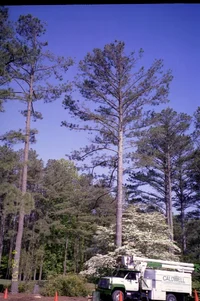
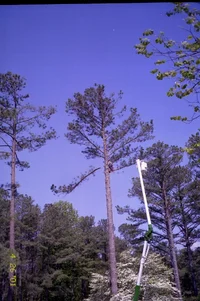
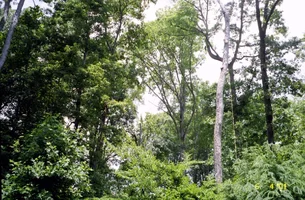
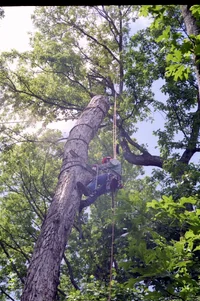
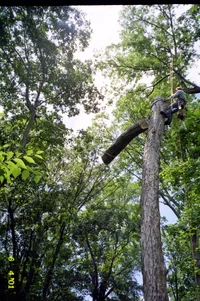
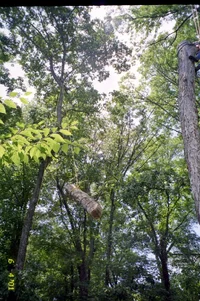
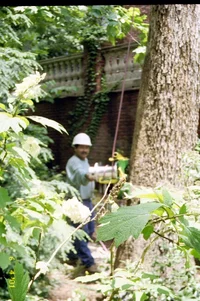
Here are some photos.

Pine in the middle of the photo was to be removed without damaging the dogwood below it. A drift line was set in the pine on the left.
 

Attachments

  • 147762-001_0A.webp
    147762-001_0A.webp
    272.3 KB · Views: 208
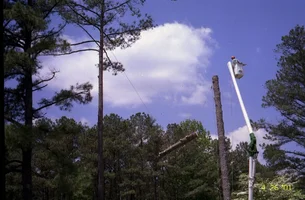
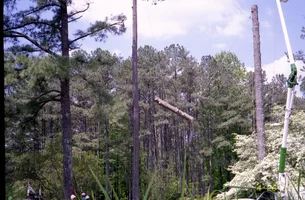
...its important that the lowering line (the line on the tree that is being removed) be allowed to run and the drift line be held so that the piece 'drifts' away from the climber.

Once the ground crew is familiar with the setup both lines can be allowed to run at the same time, but its critical for the lowering line to move at the same rate as or faster than the drift line. If the lowering line is held fast, the piece will move back towards the climber.
 

Attachments

  • 147770-122_21A.webp
    147770-122_21A.webp
    398.9 KB · Views: 157
Nice work, Mark.

I'm curious, though. That looks to be a wooded site, with a bit of a drop zone..err, maybe.

Was it not possible to drop small stuff, or were you doing the way cool rigging for training or demo purposes?
 
Thanks Roger.

This is the worksite for that tree. The driftline tree is on the right (with the rope in it). The removal tree is on the very far left in the background (behind the leftside, foreground tree).

The stream is manmade. The rocks were brought from offsite. All of the understory--hydrangeas, hemlocks, ferns, astilbe, grasses, magnolia, etc--is planted.

There is a pool deck just out of the photo on the left side.
 

Attachments

  • 147846-014_13A.webp
    147846-014_13A.webp
    265.2 KB · Views: 155
'Workzone' under the removal tree. Pool deck in the background.

We had to dig up plants so that the groundworker would have a place to stand and a place to lay the rope.
 

Attachments

  • 147847-119_18A.webp
    147847-119_18A.webp
    209.6 KB · Views: 146
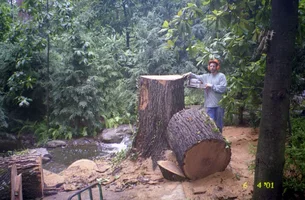
Different tree, same property, same manmade stream with imported rocks.

All of the plants in the background--hemlocks, magnolias, ferns, etc--are planted. The area that is covered in sawdust was just as thickly planted. We removed the plants, took down the tree, ground the stump, and replaced the plants.

This tree was 120-130+ feet tall. You can just make out another large oak in the upper left of the photo. That too was later removed, and over the last six or seven years many other mature trees. Wonder why they died...
 

Attachments

  • 147848-016_15A.webp
    147848-016_15A.webp
    252.7 KB · Views: 152
Sorry for the confusion. At one time 'lowering device' was synonomous with 'Hobbs' (a Hobbs Lowering Device) which is what we were using. Now 'lowering device' is a generic term that is used to refer to any one of the several pieces of equipment (Hobbs, Port-a-Wrap, Good Rigging Control System) that can be used to contriol the fall of a piece.

And yes, I was refering to the drift line. My point was that if there is only one Hobbs or GRCS available it should be used for the drift line so that tension can be applied easily to help tip the piece. When working the brush, tension can be applied to help swing a piece or keep the tip up. In either case (brush or wood) tension on the drift line can be used to lift a piece if that is necessary.

A PAW will work fine for the lowering line because that line is allowed to run or is held fast--it usually doesn't have to be tensioned.

Another point is that as the climber works their way down the pole the pieces become harder to tip because the driftline is pulling at a steeper angle.

Finally, and pedantically, a driftline and a speedline could both be considered different types of load transfer lines. But, the terms load transfer line and drift line are used synonymously. Sharon Lilly and I debated this when we were working on the Glossary of Arboricultural Terms.

To keep it simple its best to just use 'speedline' and 'driftline'.

Wow, way too much info...
 
Very nice work, Mahk. I seldom use a speedline but seeing the different ways to rig one up will be helpful in the future. I am sure of that.

Thanks for sharing

Larry
 

New threads New posts

Back
Top Bottom