speed line rope question

I use the same as you Josh. The mini porty is awesome for this as well. I have to admit, I dont put enough time into figuring out breaking strengths of rope or all the other complicated math that goes along with rigging. I just make sure to keep the loads small and keep friction out of the system anywhere I can.

Heres a little bit of plam tree zipline vid.
http://www.youtube.com/watch?v=exJNvXbm2Y4

not the best but safe enough I hope.
As for the root system of a Mexican Fan...no problemo so long as there is NO decay in the stem. Used a wooden hammer on the way up and felt these were sound.
Yours truly
Stanley Simplton
 
[ QUOTE ]
haha i think we all do a little one handed use from time to time.

[/ QUOTE ]


LOL....I like to joke, and say that I two handed a climb saw once, back in '87.....

Right or wrong, but I one hand all the time, especially when doing easy conifer removals.
 
Josh...not a 'must' though...easy enough to tagline them or carry a wedge and hammer for bigger stuff just like you would on the ground. Tim Walsh showed me a clever set of wedges he had made with tethers so that they didn't drop to the ground. I followed his lead and copied the leashes that were on my ice axes and made the same for my hammer. All had a break away fuse in them just in case they were grabbed.
 
I've never climbed palms, but I imagine that you can use a deep face cut with a dutchman, and then release with a lower than the dutchman backcut. Also, has been called a sniped snap cut. Gord posted a thread calling it the Magic Cut. SUPER USEFUL! Search for that. I also reposted the idea at one point to show friend as I couldn't find Gord's thread at that time.

You basically are undermining the center of gravity by cutting a narrow face cut more than 1/2 the depth. If you continue to cut a full width horizontal dutchman, then finish with a low backcut, the piece's gravity pulls the chunk off. The dutchman defeats the "hinge" (effectively a snap cut).


I couldn't find a picture of that.


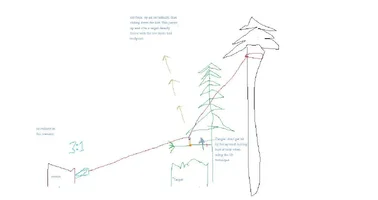
Another speedline variation.
Here is a attached drawing of a "speedline with lift" that you can use to "pop" low, long branches up from over landscaping, using a 3:1 and a strong pull. Beware lateral forces, as always.
 

Attachments

  • 242577-ziplinewithlift.webp
    242577-ziplinewithlift.webp
    24.8 KB · Views: 132
Nice picture Sean
grin.gif
 
I might retire from full time trees to pursuit my career as an artist.

Note that the tree being removed seems not to have any buttress roots on the side opposite the speedline. Beware lateral forces!

I think that it is being removed due to construction damage and grade change.
 
[ QUOTE ]
Joshua,

rigging speedlines is one of the most complicated systems that is used. Until you sit down and run the numbers to understand the loads you shouldn't take on a heavy rigging setup.

Have you read the ISA publication: The Art and Science of Practical Rigging? One of the 'must-reads'.

[/ QUOTE ]

Truer words couldn't have been spoken.

Speedlining or 'slidelining' puts unknown forces on both anchors. It depends on many factors; the angle of the slideline, the rope construction and fiber(s), the weight of the piece of wood, the type of carriage (is it a carabiner, a screw link, a rigging plate, a pulley or a slideline carriage).

Purchasing "The Art and Science of Practical Rigging" is truly an investment that will be valuable for many years.
http://secure.isa-arbor.com/webstore/The-Art-and-Science-of-Practical-Rigging-Book-P152.aspx
 
The Art and Science is a very good book that is easy to read and understand, relative to the amount of info. It will be very useful for training your crew.

How did the palm go? Done it yet?
 
I like the A&SofPR as well; it functions as a kind of prophylactic. You may not need it today, but it could save you from something nasty tomorrow, and the whole thing fits inside your wallet.

Of course, there is a lot more "science" for rigging available, but it does cover a good solid introduction. But as far as "art" goes, it is sadly lacking. There is no mention of Goya anywhere in the book . . . and what is better than using Saturn as a metaphor to illustrate the nature of tree work in relation to the arborist . . . yada, yada, yada . . .
 

Attachments

  • 246051-goya_saturn.webp
    246051-goya_saturn.webp
    72.8 KB · Views: 86

New threads New posts

Back
Top Bottom