sliding bridge question

Which is the better arborist

  • UK

    Votes: 0 0.0%
  • USA

    Votes: 0 0.0%

  • Total voters
    0
[ QUOTE ]
I have a captured eye biner and a shackle on my bridge. Sometimes I clip a biner directly to the bridge. It all depends on how I want the biners in my climbing set to nest together.

[/ QUOTE ]

Someone is going to pay one day for riding the removable part of a shackle on a saddle bridge!
 
[ QUOTE ]
[ QUOTE ]
I have a captured eye biner and a shackle on my bridge. Sometimes I clip a biner directly to the bridge. It all depends on how I want the biners in my climbing set to nest together.

[/ QUOTE ]

Someone is going to pay one day for riding the removable part of a shackle on a saddle bridge!

[/ QUOTE ]

I gotta admit, that bothers me too. I think I'll try the biners straight to the bridge thing though. I get potential side loading problems using the ring sometimes, I have to watch it every time I weight my harness.
 
[ QUOTE ]
[ QUOTE ]
I have a captured eye biner and a shackle on my bridge. Sometimes I clip a biner directly to the bridge. It all depends on how I want the biners in my climbing set to nest together.

[/ QUOTE ]

Someone is going to pay one day for riding the removable part of a shackle on a saddle bridge!

[/ QUOTE ]

Dan, How much experience do you have with stainless steel shackles? Are you aware that a properly tightened shackle is considerd a locked configuration even without "Lock-tite" applied to the threads? Do you understand that besides multiple turns and the simple mechanical interface of threads that the shackles are designed so that the last 1.5 -2 turns in closure are springing the bow of the shackle creating a high tension load on the threads that precludes vibrational opening and twisting open the pin without the application of a tool to provide significant torque? I check my shackles on every climb. They have NEVER opened the slightest amount. Opening of a shackle is actually harder to achieve than opening a tri-acting 'biner.
 
[quoteDan, How much experience do you have with stainless steel shackles?

[/ QUOTE ]

I have a few stainless steel shackles on my sail boat. I've seen enough bolts loosen up to know you are talking out of your hat!

It's not a smart move to have moving rope contacting the removable pin.

Hang your life on them all you want Stumper! I see it as a an unnecessary risk.
 
Silly me. Sailor Dan knows so much more about shackles on climbing harnesses that those idiot engineers at Komet.
egg.gif
 
[ QUOTE ]
Silly me. Sailor Dan knows so much more about shackles on climbing harnesses that those idiot engineers at Komet.
egg.gif


[/ QUOTE ]

Stumper apparently Komet and I agree.

I've been saying I believe it is dangerous to use a shackle as a moving attachment point between the climbing rope and the bridge on the saddle. Komet doesn't do it, I bet for good reason. Do you?

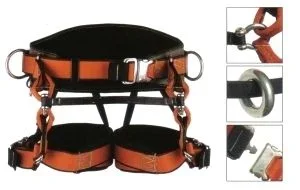
Komet uses a non-opening alloy ring as the moving attachment for the climbing rope to bridge connection as shown in the attached picture.

101727-KometButterflyIISmall.jpg
 

Attachments

  • 101727-KometButterflyIISmall.webp
    101727-KometButterflyIISmall.webp
    9.1 KB · Views: 22
Dan. You are the only one talking about using shackles on moving rope, The rest of us are talking about utilizing shackles as attachments to rope or webbing. In Komet's application and mine webbing and rope are connected by a shackle. These are flexible connections that alloy the textile components to rotate around the shackle pin. Such action does not come anywhere close to achieving sufficient friction to loosen a properly tighten pin.
Tom's application is slighty different. He is connecting a textile component and a hardware component utilizing a shackle.Smooth metal on smooth metal under approximately 100 lbs of load apparently doesn't possess enough grab to loosen a tightened 5/16ths shackle pin either. The inability of textiles to do so was already apparent. All of these applications apply fractional rotational forces to the smooth pin...and don't loosen it because there is insufficient friction to overcome the locking action of the tensioned thread interface. Play with a shackle some. When the pin torqued fully closed, pliers, a wrench or a marlinespike(if you have a traditional peforated flat head on the pin) can loosen it but tying to do so via friction on the pin shaft seems futile. Pinch it as tightly as you can with fingers,rope,webbing-it won't budge.
 
[ QUOTE ]
Dan. You are the only one talking about using shackles on moving rope, The rest of us are talking about utilizing shackles as attachments to rope or webbing.

[/ QUOTE ]


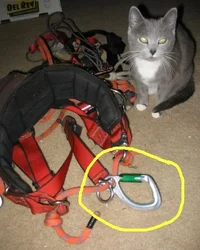
Look real close at the use of the shackle in this attached photo. It is being use as a climbing rope attachment point to the bridge. If you want to defend that use go for it. I'm against it. Tom has defended this use before but still I insist....it isn't right.

"When I climb DdRT the spliced eye of my rope goes onto the biner. then I clip a Petzl Williams into the shackle for my hitch termination."


101731-Shackle.jpg
 

Attachments

  • 101731-Shackle.webp
    101731-Shackle.webp
    45.5 KB · Views: 30
Dan, There doesn't appear to be any "moving rope" in the picture, I do grasp that your concern is the ability of the shackle to travel a few inches along a fixed bit of rope. What you seem to fail to recognize is that the loading of the shackle while subjecting it to rotation also happens at the ends of the bridge.-If such loading could unscrew the pin doing so 1/16 of a turn at a time is not significantly safer than spinning it out 4 turns in a single body rotation while limbwalking-both could result in death. My point is that the pin does NOT loosen under these loadings either in small increments or large ones. A tightened shackle pin is a secured closure. Check it often ...and take comfort in its intransigence.
 
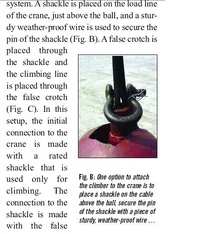
Here is a photo and some text from Mark Adams' PDF on crane use in the 'articles' section of the Buzz. Any guesses as to why wiring the pin is suggested? ANSI maybe?

101733-PDFonpropercraneusebyMarkAdams.JPG
 

Attachments

  • 101733-PDFonpropercraneusebyMarkAdams.webp
    101733-PDFonpropercraneusebyMarkAdams.webp
    43.4 KB · Views: 23
[ QUOTE ]
My point is that the pin does NOT loosen under these loadings either in small increments or large ones. A tightened shackle pin is a secured closure.

[/ QUOTE ]

We have a number of climbers who use the BFII and have had several instances of the shackle that holds the bridge coming loose.

We use rings on the bridge itself and now have a second bridge that goes through the ring and attaches to the saddle as a backup. The second bridge is slightly longer than the original, so it bears no weight, but is there in case the shackle comes undone.
 
I will now stop mouthing off about my personal experience and arguing with Dan and go crawl back into my hole. I am curious however-How is the back-up bridge attached? Did anyone get hurt or was loosening noted during preclimb inspections?
Is there any chance Dan has been sneaking in and sabotaging shackles just to prove his point?
drowninga.gif
 
Just did some checking and found that my previous post may not have been entirely accurate. The shackles that became loose were probably direct from the factory and may not have had Loc-tite. But, at least three shackles (on three separate saddles) were found to be loose.

Sorry for the slipup.

The secondary bridge is simply a piece of cord (Sta-Set or Beeline) that lies parallel with the bridge, and each end of the secondary bridge is tied to the same attachments as the shackle.

Again, sorry for not checking before I posted.
 
If I was so inclined, which I'm not this afternoon, I would find out what the specified torque setting is for a stainless steel screw that is the same size as the ones "I" use on MY harness. I would place my ususal dollars to donuts bet that it is measured in high inch-pounds or very low foot-pounds of torque. When I use the allen wrench which is about 3.5" long I know that I can develop MORE than enough torque to keep the screw tight. In low grade steel, below Grade 8, it is likely that the same torque applied to the same screw would pull the threads out. How do I know this? From experience over the years.

The allen wrench that is in the pouch of my harness ALL of the time is handy so I go over the shackles at least every 7 days of climbing. Like I have said many times...I have NEVER had to tighten any of the screws on MY harnesses and I 've been using them for years.

There have been LOTS of ropes and soft gear DQ'd but we still use soft gear without backups. The routine is to do regular and thorough gear inspections.

I will agree with Nick, a SS ring would be a better choice. I'm going to source one next week.

If someone does get injured because a shackle's screw opens I would bet that it is because they weren't ever inspected and tightened.

When was the last time anyone checked the lugnuts on their car? Heck, check the inflation of the tires...ha haha...it is getting close to the time to change the Summer Air over to Winter Air.

 

New threads New posts

Back
Top Bottom