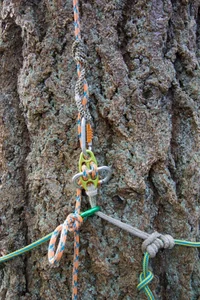
Simple but effective.

Here is another SRT lowerable basal anchor that is simple and really cheap. The Kong GiGi costs about $12 from Karst Sports, or you can use a Camp OVO, which costs $9.50. The amount of friction can be varied by taking one or two wraps on the GiGi. The picture illustrates two wraps.

GiGi basal anchor.webp
 
Here is another SRT lowerable basal anchor that is simple and really cheap.

Please don't take this as rude, but most of these don't look simple. And there is a lot of pieces and parts to keep track of as inventory and deployment.

For a lower-able basil I use this...
I use two or three wraps around the tree, tie an alpine butterfly and capture the climbing line with a quickie. I point the u-shape of the quickie up so the slick pin can be extracted as it isn't under pressure (the butterfly and climb line are on the sides of the U and not on the slick pin).

To lower, you hold the standing end, remove the quickie which due to the wraps has minimal pressure on it then I simply unwrap slowly until the stranded climber descends using the remaining wraps as controlled friction.

Am I missing something or misusing gear? I think I am in spec (the minor axis is 15 kN rating) and it is fast, cheap (non machined quickie is like $30) minimal parts, and even I can deploy easily.
 
I love the trunk wrap supreme. The only thing is that your rescuer must know what to do and most importantly what NOT to do. If the guy lowering you hasn't been trained on your lowerable base anchor, could he figure it out without dropping you?
 
Please don't take this as rude, but most of these don't look simple. And there is a lot of pieces and parts to keep track of as inventory and deployment.

For a lower-able basil I use this...
I use two or three wraps around the tree, tie an alpine butterfly and capture the climbing line with a quickie. I point the u-shape of the quickie up so the slick pin can be extracted as it isn't under pressure (the butterfly and climb line are on the sides of the U and not on the slick pin).

To lower, you hold the standing end, remove the quickie which due to the wraps has minimal pressure on it then I simply unwrap slowly until the stranded climber descends using the remaining wraps as controlled friction.

Am I missing something or misusing gear? I think I am in spec (the minor axis is 15 kN rating) and it is fast, cheap (non machined quickie is like $30) minimal parts, and even I can deploy easily.

I don't take it as rude at all. In fact, I like to get challenged regarding stuff like this because it makes me think about ways to improve on existing methods. I used to use the "wraps around the trunk" method a lot, but never really liked it because I thought it was kind of a pain, especially in cases where I was dealing with very long ropes on very big trees on steep slopes, which is what I deal with a lot. Getting multiple wraps around the trunk and adjusting the friction in such cases was not easy. Plus, the wraps tended to want to travel up the trunk and hang up on rough bark, which made the lower a bit jerky, at least for me. So, I gradually quit using the wraps method and transitioned entirely to basal anchors that use some kind of friction device for lowering. I have tried a bunch of these, including a gearless lowering system that uses a Blake's hitch (posted elsewhere on the buzz), as well as mechanical devices like the RIG, GriGri, micro rappel rack, HUB, Rescue 8, and GiGi. So, in posting stuff like this I am just trying to give people ideas about things they might try if they are looking for alternatives to the old ways of doing things. If you want to stick with the wraps method that is fine by me!

Although I am not an expert with use of Quickies your system sounds reasonable to me. However, one thing that is not clear to me about your method is whether you have an auto-locking mechanism such as a VT attached to your saddle and the lowering rope while you are lowering the climber? If not, what is to keep the climber from falling if you have a heart attack and let go of the rope? Just a suggestion if you are not already doing something like that.
 
I'll stick with the Petzl I D. For lowering, that way anyone on the crew knows what to do!

I agree that the ID and RIG are both great tools for rescue systems and are simple to use. And if you are climbing with crew people who don't know how to tie a VT, then I agree that a device that requires no knots is better. But if all you have is a $12 GiGi and an e&e prusik, it does give you another option.
 
I love the trunk wrap supreme. The only thing is that your rescuer must know what to do and most importantly what NOT to do. If the guy lowering you hasn't been trained on your lowerable base anchor, could he figure it out without dropping you?

I would not want anybody lowering me on ANY system if they had not had some basic training in how to do it!
 
Yes! Training is a must! But even experts can make mistakes! Or slip and fall!
Its nice there's no gear involved, but there's also nothing to catch you once those half hitches are undone, besides the shaky hands of a sweaty, stumbling ground man cursing at all the rope he has to manage around that mountainside stump you anchored to.
 
Sell, I used the totem and the GriGri for a long time, I've even had to use the rock climbing belays, until I purchased the Petzl I'D. It's just making sure that as you grow you upgrade your gear, bit by bit! So, to go from just a climbing rope, all the way to high quality gear. It's all about the bottom line. Personal Safety! As well as, the guys/gals working below you. But I do understand, use what you have!
 
[QUOTE="
If not, what is to keep the climber from falling if you have a heart attack and let go of the rope? Just a suggestion if you are not already doing something like that.[/QUOTE]

Arlo, I very much appreciate the conversation...makes this site a great learning environment to talk with people a lot smarter than me on this.

Regard a "whistle stop" like backup always seem kinda useless to me. I mean I get it, but it seems like one of those good ideas, that maybe isn't scientifically vetted. Let me explain... Sure I could have a heart attack lowering someone and yes that is not good, BUT the reason I find it kind of overkill is the ambulance driver could also have a heart attack taking the victim in - no whistle stop there. Plus the odds of either of us having a physically incapacitating problem during the rescue is very very minimal. So I would posit that building in a whistle stop may even be a problem as it creates a higher level of confusion due to unfamiliarity (also a very serious problem in an emergency or any situation that seldom happens) to be worth protecting the very slight risk. I offer just one example, but there are many non-whistle stop pieces going on during an emergency. Why all the effort for only one piece of the execution especially if it could be more of a problem than a solution?

Frankly if a secure lowering device was needed and practiced very often, I would not be of the same mind as everyone would be familiar on its use, function, and deployment.

Just my 2 cents which is likely all that is worth :-)
 
Good lord, is this what its come too. Now I gotta worry about a heart attack, on top of everything else. I think all this fear might be contagious cause I'm starting to loose sleep worrying about whether I'm gonna live through my next job. I have never been around so many guys who are fearful/afraid of what they do for living. You gotta learn how to embrace that fear and move on. This work can be beautifully simple and enjoyable if you let it. Learn to cut from great timber fallers. Check. Learn to climb and rig from great, highly skilled climbers. Check. Keep your systems and methods as simple as possible to minimize the chances of failure or fuck ups. Check. See how easy that was. Now go out there and get er' done son!!! I was just hoping to learn some cool new method/techniques here, but I'm starting to think this might not be the right forum for this grumpy old fucker, and this might not be the right gig for some of ya!

As someone who has had coronary bypass surgery I can tell you that I would at least think about it, even if it does not worry you too much. But really, I just picked that as an extreme example. The standard for rope rescue training in my world is that you have to be able to let go of the rope at any time without any danger of the climber falling to the ground (the so-called "whistle rule"). It may sound like over-kill, but I would never teach new climbers any other way. There are times in a real rescue where you may need to let go of the rope and deal with some other issue such as the climber getting hung up on a branch or you needing to stop and send gear up to a rescuer in the tree, etc. It is really easy to prepare for those situations, so why not do it?
 
I was just hoping to learn some cool new method/techniques here, but I'm starting to think this might not be the right forum for this grumpy old fucker, and this might not be the right gig for some of ya!

Nah, keep on being grumpy. It keeps the rest of us busy thinking up witty comebacks. But seriously, it does make all of us think about why and how we do things the way we do, even if we don't all do things the same way.
 

New threads New posts

Kask Stihl NORTHEASTERN Arborists Wesspur TreeStuff.com Teufelberger Westminster X-Rigging Teufelberger
Back
Top Bottom