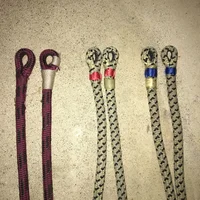
Show off them splices

Plus, the eye to eye would end up close to 38" in length to have the proper buries in place. That's a silly unusable length. Lastly, I can tell they're Class I by looking at them @Brocky


Reed Wortley
CA# SO-6953A
CTSP# 01739
 
I have always liked to cover the eyes on hitch cords, modded classII included. If that is what ARLO does also, perhaps he wanted to test them as he uses them.
 
You were testing class I splices on a class II rope? Why?


Reed Wortley
CA# SO-6953A
CTSP# 01739

I normally splice 8 and 10 mm Bee Line with Brummel splices but I like the idea of a covered eye, so I decided to experiment and see how class 1 double-braid splices would hold up. My layout for the splice was with a 5/16" tubular fid and a long fid bury above the eye. For the cover taper I used the 5-5 Samson double-braid pattern. I spliced and whiplocked the first eye before doing the second eye. To get a 28" prusik cord I cut the rope 39" long as measured from the end of the first eye (41" for a 30" prusik). The test results for the two prusiks that I sent to Treestuff were both nearly identical (10,400 lbs), and the rope broke between the splices, not in the splice.

So, all I can say is that I was favorably impressed by the performance, even though the splices did not meet the specs for class 2 rope. I am not necessarily recommending it to others, and I definitely am not selling to others, but I feel safe climbing on them. If you decide to give this a shot, I would really like to see if you get similar results.

 
I normally splice 8 and 10 mm Bee Line with Brummel splices but I like the idea of a covered eye, so I decided to experiment and see how class 1 double-braid splices would hold up. My layout for the splice was with a 5/16" tubular fid and a long fid bury above the eye. For the cover taper I used the 5-5 Samson double-braid pattern. I spliced and whiplocked the first eye before doing the second eye. To get a 28" prusik cord I cut the rope 39" long as measured from the end of the first eye (41" for a 30" prusik). The test results for the two prusiks that I sent to Treestuff were both nearly identical (10,400 lbs), and the rope broke between the splices, not in the splice.

So, all I can say is that I was favorably impressed by the performance, even though the splices did not meet the specs for class 2 rope. I am not necessarily recommending it to others, and I definitely am not selling to others, but I feel safe climbing on them. If you decide to give this a shot, I would really like to see if you get similar results.

Just don't forget how badly Vectran self-abrades...


Reed Wortley
CA# SO-6953A
CTSP# 01739
 
Just don't forget how badly Vectran self-abrades...


Reed Wortley
CA# SO-6953A
CTSP# 01739
Good point regarding Vectran in general. But it seems to me that the same concern is present with covered eyes in sewn Bee-Line prusiks. For me that is not a big concern because my climbing activity is pretty light compared to climbers who are in the trees every day. And I tend to replace my prusiks after a year or two of use because that gives me an excuse to splice more.
 
Thanks for the info @ARLO, here are some covered eye splices I did when first starting to learn. The Ultra tech is the earliest with buried tails only, didn't know about brummels at the time. The Bee Lines are locked brummels on one end and three pass regular brummels on the other.
IMG_1114.webp
The better looking eye of the pairs is the second one spliced naturally.
 
Good point regarding Vectran in general. But it seems to me that the same concern is present with covered eyes in sewn Bee-Line prusiks. For me that is not a big concern because my climbing activity is pretty light compared to climbers who are in the trees every day. And I tend to replace my prusiks after a year or two of use because that gives me an excuse to splice more.
The core does not touch itself in a sewn eye to eye @ARLO


Reed Wortley
CA# SO-6953A
CTSP# 01739
 
I thought you were talking about abrasion of the strands inside the cover in the sharp bend of the eye. Just for grins I may have a couple of them tested after they have been used for a year or two.
Self-abrading. The fibers in the rope that touch each, abrade each other...

CTF, cycles to failure are greatly reduced. Yes use one for a year then get it broken. [emoji4]


Reed Wortley
CA# SO-6953A
CTSP# 01739
 
I thought you were talking about abrasion of the strands inside the cover in the sharp bend of the eye. Just for grins I may have a couple of them tested after they have been used for a year or two.
It would be interesting to know where they break, along with the load required. This would also be an opportunity to document as much as possible about the use of the product before destructive testing. What a great way to learn more and share with others.

My thinking is the self abrasion will show up mostly where fibers move in opposite directions against each other, under any load, low or high. Perhaps the crossover can make a huge difference in your case.
 
It would be interesting to know where they break, along with the load required. This would also be an opportunity to document as much as possible about the use of the product before destructive testing. What a great way to learn more and share with others.

My thinking is the self abrasion will show up mostly where fibers move in opposite directions against each other, under any load, low or high. Perhaps the crossover can make a huge difference in your case.


I will try to keep a record of use on a couple of them for a year or two and then break them.
 
Hmm... I thought it was just another color variation of BlueStreak/BRW/Hawkeye... if so, it should be a very good 16-strand. Not sure what you mean by it being flat. These ropes often have a rather hexagon/octagon kind of shape when they're new, because of how they're tensioned during braiding, and the strand count. They don't normally flatten out much through mechanical devices.

Maybe it's a different construction.
 

New threads New posts

Kask Stihl NORTHEASTERN Arborists Wesspur TreeStuff.com Teufelberger Westminster X-Rigging Teufelberger
Back
Top Bottom