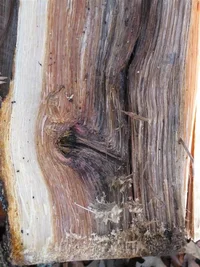
Shigo Wrong?

[ QUOTE ]


Excellent photos; could we see more to get a sense of the 3-dimensional context?

And, does anyone have a idea of how that union would be cleaved to reveal its internal secret? I'm asking if there's a method.


bob w

[/ QUOTE ]

Thanks Bob. I don't have other photos of that piece, all I have is the original photo in a larger file size. Wish I'd saved that piece now. I have a few hundred photos of this type and would be glad to post a few more in this thread if there is interest. I'd also email the full sized file to anyone interested if PM'd an email address.

267390-Deadstubclosed.JPG
 

Attachments

  • 267390-Deadstubclosed.webp
    267390-Deadstubclosed.webp
    89.4 KB · Views: 43
The shape of the branch stub with pith, and the reddish woundwood sealinbg around it, looks like "safe" tree growth.

For method of cleaving, I prefer the splitting maul, but the hydraulic one is good for the gnarly suckers.

Nice detail in the image; purple in the heartwood. Quercus falcata, or alba, or?
 
If I remember correctly it was Quercus rubra...but it could be Quercus falcata. It looks like this naturally shed limb closed over 15 or more years ago. There was a small amount of 'compost' where the tip of this branch had decayed away and was completely enclosed with healthy wood. I'll be splitting wood and look down and see these photo ops....not realizing what is going to be revealed beforehand. Of course there are often surface clues, too. Watching as the wood pulls apart is a lesson itself in tree anatomy.
 
"We loosely use the word branch for tree parts that have different patterns of tissues as they form unions with the other parts. What this means is that branches have different tissue arrangements from codominant stems, and both are different from epicormic branches- dormant buds, adventitious buds- and to make matters more complex, we must also add the tissue patterns associated with included bark. Once these different tissue arrangements and their outer bark signs are recognized and understood, we will return to clarity and simplicity."

Alex Shigo
<u>A New Tree Biology</u>
pg. 445 (bold text mine)
 
So in short, Slater has misunderstood Shigo's model?

Guy, interesting info about the about the cambium.

Thanks for posting KTSmith.
 
[ QUOTE ]
" Once these different tissue arrangements and their outer bark signs are recognized and understood, we will return to clarity and simplicity."

[/ QUOTE ]

25 years later i am still trying to understand these arrangements.

every time i dig into ANTB i pull out a nugget and try to fathom its facets.


grover, thanks--and it's cambial parenchyma ;) see the case of the Suspicious Specks.
 
I'm still surprised at how relevant and "new" much of ANTB is!

Guy, What are your referring to as "cambial parenchyma"? That is not a common term, at least not to me! Maybe I wasn't paying attention those days in those pesky plant anatomy courses!

I do know "procambial parenchyma" located just back from the seedling hypocotyl and epicotyl. Those cells are produced by the apical meristem. After maturing as parenchyma, they de-differentiate to form the new vascular cambium. They are a transient tissue, keeping pace with the apices.

In a strict sense, the vascular cambium (VC) are the undifferentiated cambial initials that have not committed to differentation as either xylem or phloem. In my sense of the vascular cambial zone, I include the derivatives of the VC that although committed, have not yet shown signs of differentiation. I might even include the very juvenile xylem or phloem that show signs of differentiation but are not yet functioning as differentiated elements.

But I still don't know what you mean by "cambial parenchyma". I'm not being critical, just curious!
 

New threads New posts

Back
Top Bottom