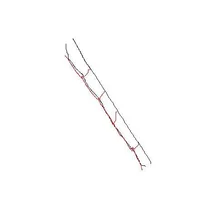
Setting a line to pull trees over.

Maybe,

either way, your putting alot of force into compression, basically wasting pull force. that downward energy is totally for nothing as far as getting the tree over is concerned.

i would think if the above math is correct, than you would have to pull 1000 pounds to get 710 of pull. which basically means your losing leverage. you might as well lower the line. likewise if you stand closer to the tree your wasting energy in pulling the tree down. you gain an advantage by getting your angle as close to 90 as possible.

i believe that the best thing to do is to lower the line to a confidently sound section of the trunk. then set a pulley as high up the tree your pulling off of as you safely can and pull down. The closer to 90 degrees the better, as long as you dont risk loading it when the tree falls. this way, you gain back some of the leverage you lost by lowering the line.
 
"Tom, did you compare the bending of the twigs to the line being tied lower down the trunk? how does that arch compare? "

No, I didn't.

The reason is that would have been a whole new scenario with more combinations and permutations. Too much time to show something that I had figured out before I even did the first go around.

What I did was pick stems with proportions that would translate to real trees. I know...not scientific but it answered enough of the question for me.

So...what do I do when I have to pull a tree over? Use the best and easiest method. Set the pull over as high as possible without worrying about pulling the top off. Since I have a 4:1/8:1 handybilly it don't need a long lever to initiate tipping. Using the two speed HB I can put nice even pull on the stem and still have a nice tactile feel for the hinging.
 
My guys do both, set lines with bowline or tie above the cut. I will check to see their selection criteria is and why they do it. We tie off plenty of trees and we have to tie anything that can hit our utility lines.
 
So let's take this into a normal rigging scenario. If tying off above the cut does not reduce the likelihood of the top, or rigging point busting out then what is the advantage of using the fishing pole technique in a regular rigging situation.

Does the fishing pole technique only lower the forces on the rigging line? Or does it reduce the forces at any given point on the spar that is so rigged?

If the latter, then that distribution of forces would almost by definition reduce the likelihood of the tip/top breaking out.

In any case, though, it does seem correct that you would have to put more force on the pulling end of the rope to induce the tree to come over.
 
[ QUOTE ]
If tying off above the cut does not reduce the likelihood of the top, or rigging point busting out then what is the advantage of using the fishing pole technique in a regular rigging situation.


Does the fishing pole technique only lower the forces on the rigging line? Or does it reduce the forces at any given point on the spar that is so rigged?


[/ QUOTE ]

I don't think the scenario you laid out in your first post qualifies as the 'fishing pole' technique. The fishing pole technique as I understand it is used in case the piece being rigged or the piece catching the load were to fail......that the half hitchs or marls would catch the broken pieces.

139682-fishingpole.JPG
 

Attachments

  • 139682-fishingpole.webp
    139682-fishingpole.webp
    4.5 KB · Views: 76
Just like a standard rigging system the rope runs through a crotch to a brake at the base of the tree with the load on the other end of the line.

What makes it the Fishing pole technique is that the rope running to the brake is routed along under the stem through clevises or pullies secured to the stem and then to the brake with while the other end is secured to the load.

Granted what i described has the rope running down the back of the stem but it still "routed" to run through several points along the stem.

Think of a fishing pole with the eyes on the top of the pole and how the line runs from the reel (brake) over the lenght of the pole and out to the fish (z-rig)
 
[ QUOTE ]
Just a curiosity question...

When pulling over a dead tree will there be any advantage to running the line over a crotch, down the back of the tree (maybe even woven through other crotches) and tying it off near the butt of the tree as opposed to using a running bowline to the top of the tree?

[/ QUOTE ]

No difference. This problem can be solved through introductory statics. Using tigonometry will show the x-component of force is equal using a running bowline or running it down the length of the stem. The x-component of force from tension in a pull line creates the torque converted to the stem when the stem is being influenced by pulling on the rope.

Joe
 
I always thought that if you run a rope over a branch union The force is increased by 1.6x.

Pull 1000lbs. and it becomes 1600lbs. pull at the brach union.

Simple as that.
 
[ QUOTE ]
I always thought that if you run a rope over a branch union The force is increased by 1.6x.

[/ QUOTE ]

The 1.6x's is the resultant force at the crotch(neglecting friction). You may want to google resultant force to get a better explanation of that idea.

Joe
 
Thanks for the terminology Joe...

I'm pretty sure I covered That (resultant force) in the second part of my response.

I tend to break things down to a simple form, my bad.

Thanks again...
 
IMLHO (disclaimer), in these things we are dealing with a dance of raw forces in a given situation, and the strings of multipliers that are involved. Each variation in the setup, varies a handful of multipliers, that can change everything. Even if the raw forces are fairly matched in separate situations, it is the multiplying forces that dictate if the raw forces are then conducted at nominal or full potentials. Thus, different experiences and comfort levels from different peoples.

The angle of the line gives a multiplier above 1 here usually(multipliers less than 1 reduce forces, less than 0 reverse their directions). But, then we also lose the perpendicular/ more leveraged angle of the line to the tree, in the formed direction mediated between the 2 legs of the angle, and not just along a single leg pull line. Which is better, will then depend partially on the leveraged increase from the rope angle multiplier less the leveraged loss of the pull angle change multiplier(how it is more down than across now).

But then also, the amount of friction at the angle of line, will reduce that angle's potential force by decreasing the tension on the far/anchored leg. But, then, this will give more of a direction of pull perpendicular, more along the pull line than less. But, then by sweating more purchase(elusive, invisible quantity that can be very important) out of that leg b4 the main pull, we can reduce that reduction. Perhaps even reverse it, by stashing tensioned line back there behind the friction buffer??

But, then that brings up another factor, elastic deformations. We now have more rope to store tension in elastically to later release, and perhaps can flex/spring our prey/target; to let it give same re-leseable force characteristic like the stretched rope too. It all adds up... Which would then include moving the tree's CG more leveraged towards target(if we flexxed tree), all in the pre-start. Hear especially, you could even have a contest ready to go, side by side(let alone across the map), and 1 setup has so much more potential captured. This shows paint prep (and experience) that 1 man might do most meticulously(and another not) polishing each point to smooth perfection of focussed, unfettered force. Or at least knowing what alterations where needed , and which yielded the most for your time and trouble.

Noting that even if the direction of pull across the spar was now less, the force from the bend would be increased, and the more loaded forces would move more surely to target, even if not a lot easier force wise on every occasion. This alone can be a big thing, especially with the inertia of that now moving force.

i also think that if the spar is straight (not the Dano version; whereby that is a different machine, with an extra bend), the line down the back spine (and compression) can be fortifying, also kind of push/brace forward as the line cradles the load with even a more of a 'rolling forward' motion. Especially more noticeable with a more closed angle, across pull, and serving forward with everything else against ye, of a back leaner. And then in reciprocal, less noticeable as we have a straight, then even less in a forward leaner (where friction reduces, but angled force does too, and direction is more straight down than across). Sometimes each strategy will be best, by what effect is needed.

Notice even if we hung tree upside down by this bend, the bend would have increase force over that of the tree!

Also, the knot is easier to find tied low back, and is not buried, is closer to a team member, and employs that member that might be closest to taking a break, leading, caring for lines - the sawyer.

The line doesn't have to come straight down on this rig. We can even tie low, centered-back to go high right, then low left in front, to offset to the left as we also serve forward, with our direction factor. This can be more of a closed angle and sometimes solicit more elasticity/spring from the top too.

A lot going on hear, i recommend everyone get fluent with the feel of this orchestrations of forces in felling, rigging, pulling tops out etc. Play as with a new toy in open wonder, harvesting occasions to do so, as they offer themselves. L-earn them, polish their deploymeant, then finally, holster them when confident you can draw them out quickly and sharp shoot cleanly when called for/equitable.

This, all then too, depends on the mechanics of the hinge/pivot itself, to once again; make 2 totally seemingly same situations, much different by their orchestration, sometimes fairly invisibly. but, giving higher, safer, more confident, less effort success rate.

 
[ QUOTE ]
[ QUOTE ]
If tying off above the cut does not reduce the likelihood of the top, or rigging point busting out then what is the advantage of using the fishing pole technique in a regular rigging situation.


Does the fishing pole technique only lower the forces on the rigging line? Or does it reduce the forces at any given point on the spar that is so rigged?


[/ QUOTE ]

I don't think the scenario you laid out in your first post qualifies as the 'fishing pole' technique. The fishing pole technique as I understand it is used in case the piece being rigged or the piece catching the load were to fail......that the half hitchs or marls would catch the broken pieces.

139682-fishingpole.JPG


[/ QUOTE ]

correctomundo, Dan...except....ya gotta use marls, half hitches won't hold a broken load together....

also, I haven't seen it called fishing pole tech when the objective is to tie a suspect limb/log so as to be safe if it breaks. I think the term was first used to describe a method for tying multiple blocks at and below a rigging point, in case the rigging spar breaks....

But I s'pose you could use the term for both. Typically, marling a load is used if it is going to be tip tied...but I imagine it would help to keep a butt hitched section together as well...!
 

New threads New posts

Back
Top Bottom