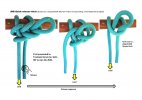
Regarding background and comparison with other quick release hitches... I am familiar with the tumble hitch and many (likely most) other quick release hitches. I understand that this hitch will be compared with them for reference. This is all fine. I'm also aware of the reputation that the highwayman's hitch has for insecurity. However, let's probe a bit deeper: highwayman's reputation for insecurity increases with the diameter of the object it is tied to. In the circumstance of the JRB hitch, it's wrapped around two strands of rope with a different set of loading forces effectively embracing the "inner highwayman's". It is not comparable to the highwayman's any more than we could compare the OVERHAND KNOT to any of the bends which are constructed from two overhand knots, including: Zeppelin Bend, Hunters Bend, Water Knot, Overhand Bend, Alpine Butterfly Bend, Fishermans Knot and False Zeppelin bend. (Pardon the lack of ABOK references as I'm typing with my thumbs while I eat dinner at 10.30pm). Of course, we can compare those bends to each other, but not very well to the overhand knot which is their common foundation. And so I will simply let the testing and results thereof ensure that this hitch is not going to receive a reputation for one of its inner components. I have achieved incredible test results with an "inner highwaymen's variant" instead of the classic highwayman's, however, I do believe this published version is more secure by my crude analysis. Nevertheless, if I had a day and a test laboratory, I would test all these variations.
Now on testing, if I could do only three sets of tests, these would be the tests:
1. Lengthwise pull test, ideally using a standard diameter climbing rope, tied on a tree trunk of 12in diameter, exactly how I tied it in the introductory video.
2. Using 8mm or equivalent cordage, perpendicular pull test, tied on a one inch (or similar) smooth metal bar. Ideally, I would perform this test with both one and again with three wraps, creating 3 and 6 visible turns around the bar, respectively, exactly as tied in the introductory video. 1 it is my expectation that the strength of the hitch will increase with the additional turns.
3. Perpendicular pull test, using 8mm or similar cordage tied onto a carabiner of average diameter. Only one wrap, forming 2 visible turns. And for bonus points, let me try to describe a variation: after passing the initial bite around the object, when we reach through the bight and grab the release line, creating a Bight to begin the inner highwayman's... pause there, lengthen that Bight, and pass it up and over the double strand to which is is pressed, then down the back and up around the bottom, effectively adding a full 360 degree turn around the double strand. Then complete the rest of the hitch as per the original. In my testing, this variant is easier to disengage under moderate loads. I have not yet Tested this under extreme Loads.
And although it is much too early in the journey to make any predictions about whether this hitch COULD be used for Life Safety, I do not want it to be dismissed based on the properties of the release mechanism. I do have an unpublished "finish" detail, which does not affect the Integrity of the knot, because it is tied the same way, but which adds significant additional resistance to the possibility of accidental release while under load. However, when load is removed, it spills easily. I simply did not want to complicate matters at this early stage by introducing variants. My logic is simple: let's just test the basic hitch, then decide if next steps are warranted.
Lastly, I simply want to thank agent Smith for his time and attention. I hope I get an opportunity to return the favor.