Screamer's!

Re: Screamer\'s!

Ice climbers make mistakes, your best rope man gets sick and takes the day off, etc.

Seems to me this tool was developed specifically to try and keep mistakes from ending in fatalities and disaster.

Definitely a tool going in my toolbox for a host of reasons.

Using screamers on a SRT base tie makes lots of sense to me as well.

Just my opinion of course.

Jomoco
 
Re: Screamer\'s!

So I am not going to use it because it seems useless tryiing to employ a new tool when there are so many other options to do this safely and controlled. But...do you all think Wesspur is giving misinformation advertising the screamer as a rigging "safety net"? I thought it looked like agreat idea when I first saw it and just assumed other guys were using it. I don't want to do an unsafe job with a band-aid but to sefely reduce 2 or 3 KN of dynamic force seemed like it was worth $17 in certain situations.

-BEN
 
Re: Screamer\'s!

Come on BWK, tree climbers are some of the most opinionated stubborn people in the world!

Getting consensus on just about anything is a tall order!

I like a little stretch in my rigging catching big wood with my Hobbs. The combination of bull line stretch and nylon strap anchoring gives me that when I can't let a load run.

The problem I've run into on real fat conifers is that even a very short section of spar can weigh in excess of 700 lbs. Shock load that and you're really pushing your luck without going to bigger bull ropes, hardware, straps etc.

My solution? Carve those shorties into an hourglass shape all around, cinch them and duct take the cinch so it can't possibly loosen, and bombs away!

Time consuming meticulous PITA, but better than having a shortie slip out of your rigging!

Staying within your rigging's capacity is an absolute must my friend.

I may be crazy, but I like to think I'm not stupid. But rest assured I have been accused of being just that by other climbers!

Jomoco
 
Re: Screamer\'s!

It would be very unlikely that a ground anchor for SRT would ever be subjected to enough of a load to cause a Screamer to deploy. Even using a rope like Snakebite.

It isn't about making mistakes. Its about reducing loads on rigging points. Two very different concepts.

In ice climbing there is no option to set a different TIP or take smaller pieces. Don't Fall...repeat. In treework there are other options.
 
Re: Screamer\'s!

[ QUOTE ]
It would be very unlikely that a ground anchor for SRT would ever be subjected to enough of a load to cause a Screamer to deploy. Even using a rope like Snakebite.


[/ QUOTE ]

From TC3's screamer link.

We have determined that the most effective activation for a standard screamer to be >2kN(550lbf.) for climbing related situations.


So a 250lb climber falling say 10 feet or so?

http://www.myoan.net/climbart/climbforcecal.html

Jomoco
 
Re: Screamer\'s!

J,

Why do you stretch so far to try to make a point? :)

How many 250# climbers do you know?
Why would a climber fall ten feet?

I'm very familiar with Screamers. Until I worked through the math on impact loading I had one in my SRT setup. Right at my harness. After doing the math I realized I was better protected by my rope itself...Tachyon or Fly.

Climbing rope should have some stretch in it...there is flexibility in the tree too. If anything...DdRT climbers should be more concerned about this issue since there is half the stretch in a DdRT system. When ropes are paired the result is twice the strength and half the stretch.

You're not going to convince me that a Screamer is needed.
 
Re: Screamer\'s!

A known weakest link?

You should KNOW or at least be able to make a good guess as to what you are getting into. Though I must say at a training class for I can't remember what, the "good guesses" of the experienced arborists were all over the map.

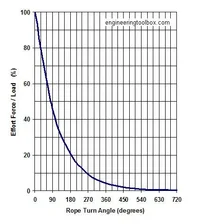
Attached is a chart I came across about wraps. Tell me what you see. I see you better not take more than 2 1/2 wraps.
 

Attachments

  • 322915-bollard-force-chart.webp
    322915-bollard-force-chart.webp
    17.5 KB · Views: 91
Re: Screamer\'s!

[ QUOTE ]
J,

Why do you stretch so far to try to make a point? :)

How many 250# climbers do you know?
Why would a climber fall ten feet?

I'm very familiar with Screamers. Until I worked through the math on impact loading I had one in my SRT setup. Right at my harness. After doing the math I realized I was better protected by my rope itself...Tachyon or Fly.

Climbing rope should have some stretch in it...there is flexibility in the tree too. If anything...DdRT climbers should be more concerned about this issue since there is half the stretch in a DdRT system. When ropes are paired the result is twice the strength and half the stretch.

You're not going to convince me that a Screamer is needed.

[/ QUOTE ]

Considering that I weigh 165 lbs, but by the time I'm booted, braced, saddled and gaffed with a chainsaw in my hand, I weigh over 200 lbs, combined with the fact that I'm considered a small guy in this biz, leads me to suspect that bigger guys than little ole me might just be quite common?

It's quite common for demolition climbers to run up a leader 10 feet or more before lanyarding in and taking the slack out of their line. What if they gaff out before they get their lanyard around that leader?

I could swear I've seen vids of demolition climbers like Reg and X-Man using SRT setups.

Seems like there's threads on overweight climbers sharing methods and training tips on how to lose weight floating around here somewhere? I wonder how much they weigh when harnessed up for work with chainsaws in their hands?

Funny how when I punched in the numbers on that fall force calculator, it exceeded the 2 kilonewton screamer activation trigger by a pretty hefty margin.

Please excuse me for even contemplating that anyone could be wrong, make mistakes, be overweight, or not be my intended audience when posting.

Jomoco

 
Re: Screamer\'s!

The idea of incorporating a 'screamer' or whatever the hell you want to call it into a rigging system is one of the most pathetic things I've heard in treework.

In fact...if you were to have a scale of patheticness ranging from 1 to 10 with 10 being the most pathetic, a screamer used in tree rigging would be an 11.
 
Re: Screamer\'s!

Bro, if you have 40 lbs of gear on you are carrying to much...

A 200T is like 12 or 13 lbs with fuel and a bar/chain.... saddle weighs 7 or 8 lbs (or much less).... boots and spurs 10 lbs max... so unless you have 10 lbs of loop runners or something....

And that fall calculator is totally off.... I put in a 10' fall on 10' of rope and it calculated a factor 2 fall which is a 20' fall on 10' of rope (10/10=1 while 20/10=2)

Besides, your example shows a complete misunderstanding of fall factors. If you were at 30' with your rope anchored at 60' and you traveled to the 40' mark without tending your rope and fell you would take a 10' fall... BUT its on 60' of rope (in a DRT setup; in srt it would be on 30' of rope.) a 10' fall on 60' of rope is .165 fall factor, nothing (on SRT its a .33 fall factor, still very minor.)

Fall factor is a result of total distance fallen divided by the entire amount of rope in the system. That calculator you are using is coded incorrectly or rooted in bad math, either way it is incorrect.
 
Re: Screamer\'s!

Is that how you really feel Grover?

That tears it!

Farewell cruel world!

Cue the anguished screamer!

Jomoco
 
Re: Screamer\'s!

A base tied SRT redirected from 60 feet up, with the climber at 40 feet with 10 feet of slack in his line, has a total of 90 feet of rope in his system unless I'm sorely mistaken my friend.

Do you really think I haven't ever weighed myself fully equipped for removals? Just my braces and Wesco Highliners alone weigh over 10 lbs.

http://m.youtube.com/watch?v=QBDC08ZuuqY

Jomoco
 
Re: Screamer\'s!

[ QUOTE ]
Bro, if you have 40 lbs of gear on you are carrying to much...

A 200T is like 12 or 13 lbs with fuel and a bar/chain.... saddle weighs 7 or 8 lbs (or much less).... boots and spurs 10 lbs max... so unless you have 10 lbs of loop runners or something....

And that fall calculator is totally off.... I put in a 10' fall on 10' of rope and it calculated a factor 2 fall which is a 20' fall on 10' of rope (10/10=1 while 20/10=2)

Besides, your example shows a complete misunderstanding of fall factors. If you were at 30' with your rope anchored at 60' and you traveled to the 40' mark without tending your rope and fell you would take a 10' fall... BUT its on 60' of rope (in a DRT setup; in srt it would be on 30' of rope.) a 10' fall on 60' of rope is .165 fall factor, nothing (on SRT its a .33 fall factor, still very minor.)

Fall factor is a result of total distance fallen divided by the entire amount of rope in the system. That calculator you are using is coded incorrectly or rooted in bad math, either way it is incorrect.

[/ QUOTE ]

Those fall factors only work on DYNAMIC line... not static ... huge difference.
 
Re: Screamer\'s!

Ever climb on a rock climbing line? Might as well hook up to a piece of rubber.

Calculator isn't specific enough.
 
Re: Screamer\'s!

[ QUOTE ]
Ever climb on a rock climbing line? Might as well hook up to a piece of rubber.

Calculator isn't specific enough.

[/ QUOTE ]

Exactly...the fall factor rating system was made based on Dynamic line (allowance for 25-40% elongation).

Static line allows for 3-4% elongation. Every fall on a static line is pretty much a factor 1 fall.

We only use static line in tree work.

It's comparing apples to oranges.
 
Re: Screamer\'s!

ACTUALLY... the fall factor is the same whether tied to Bluewater Dominator (dynamic), Sterling HTP (Static), Poison Ivy (Arbo), home depot twine, steel cable, chain, or dental floss.....

How the rope/cable/etc reacts to the weight and fall factor is another story. Of all the types listed, rock ropes (extremely dynamic) are the only ones that can survive high factor falls.

The elongation has nothing to do with the factor.

http://www.camp4.com/rock/index.php?newsid=231
http://www.southeastclimbing.com/faq/faq_fall_factor.htm#whatis
"Dynamic Ropes and Fall Factors

The shock load resulting from a fall in a climbing system is the result of three factors; the energy absorbing (stretch) characteristics of the rope, the fall factor, and the weight of the falling climber. The amount of stretch designed into in dynamic climbing ropes varies from about 6 - 10 percent. The climbing industry (U.I.A.A.) has set standards of the amount of force a climbing rope must absorb."
 
Re: Screamer\'s!

25-40% ???

so my 70 meter rope, 229 feet; will actually be 320' long after I rappel down it? thats 40% stretch


or 286' @ 25%

nope.
 
Re: Screamer\'s!

[ QUOTE ]
ACTUALLY... the fall factor is the same whether tied to Bluewater Dominator (dynamic), Sterling HTP (Static), Poison Ivy (Arbo), home depot twine, steel cable, chain, or dental floss.....

How the rope/cable/etc reacts to the weight and fall factor is another story. Of all the types listed, rock ropes (extremely dynamic) are the only ones that can survive high factor falls.

The elongation has nothing to do with the factor.

http://www.camp4.com/rock/index.php?newsid=231
http://www.southeastclimbing.com/faq/faq_fall_factor.htm#whatis
"Dynamic Ropes and Fall Factors

The shock load resulting from a fall in a climbing system is the result of three factors; the energy absorbing (stretch) characteristics of the rope, the fall factor, and the weight of the falling climber. The amount of stretch designed into in dynamic climbing ropes varies from about 6 - 10 percent. The climbing industry (U.I.A.A.) has set standards of the amount of force a climbing rope must absorb."

[/ QUOTE ]

Reread both articles...they both state...the fall factor is not in regard to static rope
 
Re: Screamer\'s!

[ QUOTE ]
25-40% ???

so my 70 meter rope, 229 feet; will actually be 320' long after I rappel down it? thats 40% stretch


or 286' @ 25%

nope.

[/ QUOTE ]

Sorry i didn't state the difference between working elongation and fall elongation. Since we were talking fall factors i assumed fall elongation was understood.
 

New threads New posts

Back
Top Bottom