Rubbing branches...any decay?

Tom Dunlap

Here from the beginning
Administrator
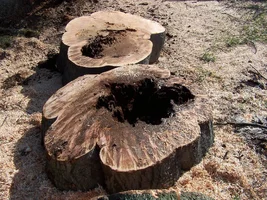
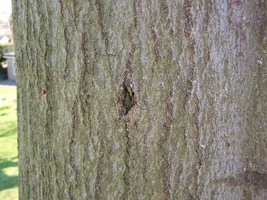
This picture was posted in another thread.

http://tinyurl.com/kdoyz

The question was raised...was there any decay?

When I've had to take out rubbing branches I would have them put aside instead of going through the chipper. Then I would slice them and rip them down the middle with my bandsaw. After doing this on a lot of branches I came to the conclusion that there is very little decay or discolored wood from rubbing branches. There is wounding, that's evident.

Since I saw little discoloration I started to rethink the "dead, diseased, dieing and crossing" mantra that we're taught. Now, crossing limbs are a much lower priority for removal. there has to be other compelling reasons for the limb to go before it gets cut. In many cases I have looked a the offending limb as a candidate for reduction. Keeping the smaller limb from moving a lot seems like it would reduce the increasing size of the rubbed wound. This is one of those experiments that I've undertaken but have little hope of following through on.

Does anyone else have any experiences with rubbing limbs?
 
I have collection of wound wood over the years with a small library of rubbing branches, id say its ver species dependent, cottonwood and silver maple tend to develop decay and dicoloration quite readily from crossing where as something like green ash, tends not too. I'll see if i cant get some pictures, and ill take a look in my shed at work
 
i don't blindly remove in stronger breeds of trees that can handle a lil'rubbing. i think in terms of removing any touching, potentially touching branches at loading as decreasing support of 1 or both members. So, even if there is small 'tarnishing' or even wounding i think the total effects have to be weighed on the decision. Furthermore, if the branchin question blocks wind for the other branch, then potentially loading is increased on other branch at the same time that potential support is removed; making this a compounding/ pivotal decision.
 
Good point by spyder re biodynamics.

"I have looked a the offending limb as a candidate for reduction. Keeping the smaller limb from moving a lot seems like it would reduce the increasing size of the rubbed wound.'

That's my philosophy too. Where there is no research to guide us, a little common sense can go a long way.
 
I love how we keep on finding proof that the less we do the better. The vast majority of our work probably shouldn't be done at all. I have always wondered about that issue. It seems the trees do it on purpose much of the time. A lower limb will dynamically support a higher limb for example. Like a good cableing system.
 
Although little decay may exist, the wound destroys the phloem and over time as the rub gets larger, may force one or both of the limbs into death. Also, insects and pathogens often need exposed sapwood to enter a tree, or at least do so with much greater success. The larger the wound, the better the chance of infection.

The concept of our work even needing to be done was brought up and i have thought about this as well. In the natural world...no, our services are not needed. Tress have been here longer than we have and are not designed to last forever. They grow, reproduce and die, some sooner than others....It is the way of life. Enter man and the urban environment...now arborists are needed and customer/homeowner opinions are thrown into the mix. Do we really know what trees "need" when it comes to pruning? Or do we just do what we think (based on education, research, and experience) will help the tree to live longer? If we put the right tree in the right spot on the right site in a land scape i would say we could reduce the amount of tree work needed (ignoring storm damage and acts of God). This rarely happens and so the field of arboriculture has grown into what it is today. All in all though...there will never be a shortage of tree work. Makes me happy cus I have a purpose in life.
 
[ QUOTE ]
there will never be a shortage of tree work. Makes me happy cus I have a purpose in life.

[/ QUOTE ]

Me too. /forum/images/graemlins/laugh.gif

Phil you make a good case for reduction not removal of large rubbing limbs.
 
Year ago the late John Britton convinced me that "tree pruning is for people, not for trees".

He said at the time that Alex Shigo had got him thinking this way. If you think about it you can't find a pruning action that doesn't fit this generalization.

I use this quote often with clients. And always tell them that this does not mean don't prune trees or that its bad to do so. It simply gets them to thinking about why!

That said, we all know that a ton of unecessary pruning is done and that some of it is definately a negative for the trees. Out here thinning of native conifers is commonly done for no good reason and if repeated, it reduces the options for managing big trees as they get bigger.

I'm in the less is more camp. Scott
 
Tom I collect rubbing branches, peel all the bark of them rub them down and make ornaments out of them, to be honest I have hardly ever found any decay in them. Well maybe if we make it down to Augsburg I´ll bring you down an example. Today got a really cool peice of rubbing beech branch that had been growing against the stem for many years was about the size of a dinner plate, was the combination of dead wood and new wood from reaction growth was a strange mixture. Willow is the best example for rubbing or splitting branches that I have found so easy to peel.


Scotty
 
[ QUOTE ]
Year ago the late John Britton convinced me that "tree pruning is for people, not for trees".

He said at the time that Alex Shigo had got him thinking this way. If you think about it you can't find a pruning action that doesn't fit this generalization.

I use this quote often with clients. And always tell them that this does not mean don't prune trees or that its bad to do so. It simply gets them to thinking about why!

That said, we all know that a ton of unecessary pruning is done and that some of it is definately a negative for the trees. Out here thinning of native conifers is commonly done for no good reason and if repeated, it reduces the options for managing big trees as they get bigger.

I'm in the less is more camp. Scott

[/ QUOTE ]

i totally agree; but think some things we do is right; like removing mistletoe; diseased trees/ brances etc.

That is why i think that the first thing to be trimmed; should properly be the customer's perception of beauty in a tree. Propose a tree as the proud king of inanimate beasts and to respect that; to glorify that not abuse it!

i think the advent of the chainsaw; especially the 1 man chainsaw A) is not old in tree time (60years?) and B) enabled the great hunters that have maid almost all other great beasts extinct; a new prey to hunt and take power over (at least more so than previously). Being that a 1 man chainsaw has only been birthed to us in the 50's; like all the other life we have preyed on just to mount on the wall; we really don't know what all the implications and outcomes of our meddling has done/ can do to the balance of the system.

Tree's part in the system is not a small one, so therefore the (d)effects of our meddling is not small; especially in the volume that we do. For like the great elephants and the smallest of bees; trees are a keystone species. Insamuch as hunting this breed to extinction (or near) would throw many things off.

So i go to werk as a friendly guard at the concentration camp; maintaining my position to save what i can from the death & torture chambers! Sure i have to do some things i don't like but it is to be kept around; to save more; for what other guard would?


Orrrrrrrrr something like that!
 
Well

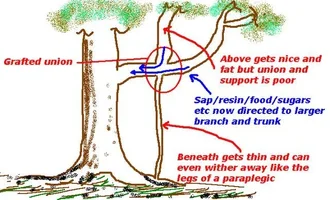
Have a look at the attached diagram. Problem can occur where grafting takes place.

I recently looked at a tree where the rubbing was now grafting together. The sucker was growing out of the root flare and cutting there would certainly introduce decay at a place you do not want.

The problem is that the grafted union wouldn't offer the strength required as the tree grew. The join would be near verticle and not a colar or anything just a "tack weld". The sucker was achieving apical dominance and the major part of the tree. The lower part beneath the graft was already markedly smaller than above ... usual reaction as little resources now go there.

Cutting the section off below the graft would be bad to not only the root flare but the branch it was attached too. This was bit of a no win situation.

If the horizontal branch was removed the sucker would not be able to support itself either. So this would become a long term management issue. It also didn't help that the graft was not dead vertical ... the angle was about 10 degrees off vertical putting a lot of weight and stress on the grafted union and lateral branch.

The only offer of assistance was reducing the apical dominance of that sucka! And over many years the sucka would be subdued and the tree would gain it's proper form and strength.

So, consider the consequences of the rubbing grafting too and what the impact of that would be to the tree. Sometimes dealing with that early will help. In this instance that sucka should have been cut off at birth!

Sometimes in multileadered trees I have considered encourageing grafting as a way of strengthening the stems ... I wonder, and this was an idea, if you used a growth hormone or rooting hormone on the area and bound it for a while. I thought maybe carefully removing the bark, adding the treatment then binding them with hession etc just like grafting fruit trees etc... this might take and the system works in unison rather than conflict.
 

Attachments

  • 45534-example1.webp
    45534-example1.webp
    60.4 KB · Views: 76
Neat concept on grafting Ekka. I've installed bolts to hold rubbing magnolia branches together in thees with defects; maybe I shoulda sprinkled in some Root-Tone before doing it.

On second thought, I'd rather let the tree move its oen hormones around, unless I have a better feel for the process...
 
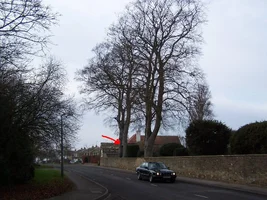
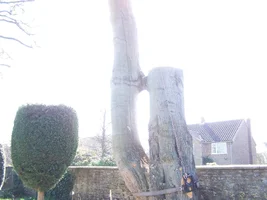
yesturday we finished taking down this old Beech. Low in the tree is an old rubbing branch that has become grafted. Only just visible in this shot.
 

Attachments

  • 45556-a.webp
    45556-a.webp
    504.4 KB · Views: 71
Eventually we had to cut the graft to continue to take down the stems. The cut below my feet was the graft.
 

Attachments

  • 45558-d.webp
    45558-d.webp
    179.7 KB · Views: 65
There was no decay due to the graft, and its not possible to tell how the transport system may have been affected as ekka suggests above.

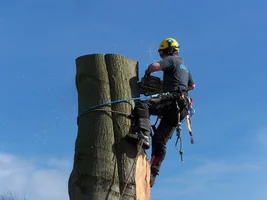
further up above the graft the right hand stem, (main stem) looked like this.
 

Attachments

  • 45559-e.webp
    45559-e.webp
    782.1 KB · Views: 60
Yeah, great shots and what a great example of a good grafting ... that one most likely strengthened the stems.

Now, if some-one in their wisdom (not) had cut that graft apart a few years ago it would have weakened the stems and potential decay into the stems.

Also, notice how thin the dia of the branch in the centre of the graft area was compared to attachment points.

Well, atleast half the stump grind was done el-naturale.
 
I've only climbed a few beecha nd never donoe any work in them. They seem to be the most graftable trees on the planet. Having all of the grafts seems like a really healthy arrangement. The mechanical 'cabling' system that develops is my envy. Having a vascular web connecting other branches seems like a good way to exchange starches and other nutrients too.

Take some time to read all of Bob Wulkowicz's articles.

Rupe,

Were you able to rip open any of the old spike wounds and get a picture of the decay?
Thanks for the pics inside the graft area.
 
I apologize for the juvenile nature of the attachment, but couldn't escape the mental correlation to the thread.

Grafting isn't the only thing that can happen when sticks rub :)

I'd have rather posted a link to the animated GIF but couldn't determine where I'd gotten it back in Dec. '99.
 

Attachments

  • 45619-rubbing_sticks.gif
    45619-rubbing_sticks.gif
    92.5 KB · Views: 68
Back
Top Bottom