Rope Sleeves are save?

Howie65

Participating member
Now I also own two rope sleeve from TreeStuff and was just thinking about if they could slip from a limb and come down to release my hitch or ZigZag. It this scenario possible in your opinion?
 
Assuming you are talking about the Dan House Rope Sleeves, I've been hit in the hand with one coming down while I was removing the rope and it hit fairly hard (60' slide).

Disclaimer...I have limited experience and have not tested this scenario.

I haven't used a zig zag but I wouldn't worry about the sleeve hitting a hitch or other device for two reasons. 1) I've never had the sleeve move out of position to where it would fall while I was climbing. 2) (and this is the important one) If the sleeve did come down and hit the hitch hard enough to release it, it should immediately grab again as the sleeve (without the momentum of the fall) wouldn't have sufficient weight to keep the hitch released.

I'm interested to see what those with more experience have to say.
 
I use plain basic tubular webbing, it works just the same and would not do a thing to a hitch or mechanical device.

For a Positioning Lanyard I agree. Have a Petzl Grillon that comes with a tube made of nylon (maybe Cordura). Tried this one times on DdRT and wasn’t very happy with the durability of the nylon - I moved only slow on it but could see its got glazing a lot. But for occasional usage (second anchor; friction saver forgotten at home) it’s not bad to have such a lightweight webbing in the bag (a recreational climber has been spoken).
 
Assuming you are talking about the Dan House Rope Sleeves ...

Yes you are on the right track - I am talking about conduit sleeves used as a friction saver. I thank you for your assessment and agree to your 1st point. If there would be a problem in principle in holding the position then we had have already read posts about it.

But nevertheless after I have read your answer yesterday evening I put my ¾” x 30” sleeve on the kitchen scale and it showed me about 340 g (0,75 lbs). Not much on one side but on the other side maybe enough to bring some trouble.

My idea is now just to test it if I find the time. Whereas I don’t want that the sleeve bounces with high speed to my gear of course but it should be enough to release the HC or ZZ with the sleeve in contact above it and check if it grabs again after let it sliding down. To be continued…
 
Last edited:
Nah, it's cool. That's the first thing I thought of too, but with some experimenting found it to be a non-issue. Firstly, the sleeve really won't come out of the union once installed properly until you retrieve it with w stopper knot, Secondly, it retains a bit of that U shape which creates friction on the rope slowing or stopping a rapid slide. Thirdly, if it did somehow contact your kit then the impact would be minimal - not enough to cause you to plummet.

In fact at times when it's too stubborn to go inti the union from the ground I've just let it ride above my hitch until I can get there and force the issue - you've got to watch your hitch of course to make sure it's setting but then you watch all your gear all the time anyway right?

Enjoy the sleeve and proceed with confidence.

 
My test results:
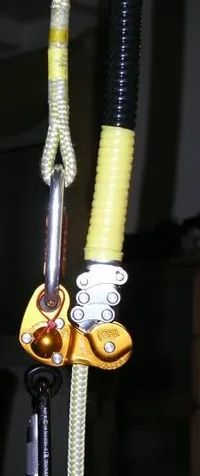
Indeed I couldn't detect any issue with the HC. The hitch grabbed well with the sleeve on top of it and I could lower myself very controlled by pressing the sleeve downwards to release the hitch. If I stopped pressing the sleeve downwards then the system stopped sliding down also.

So even if the sleeve would hit the hitch with high speed there is a good chance that a therefore completely squeezed hitch does its job well and stops the downwards movement immediate.

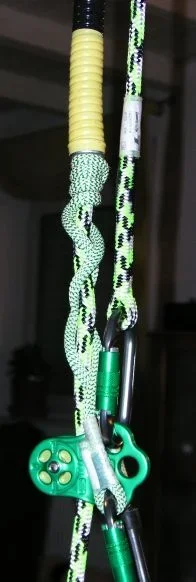
My test with the ZigZag looks different. With my 210 lbs on it it was able to hold the weight of the sleeve above it (remember 0,75 lbs). But immediately after I started to release it carefully by adding slightly more pressure then the ticket for going down was booked. There was no time to react in any way.

For me the lesson learned is:
Rope Sleeve + ZigZag = dangerous

P1290739_smal.webp P1290742_smal.webp
 
A conduit sleeve will not come off a limb once your weight is on the system. If the sleeve is not fully over the limb it can theoretically come out while you're climbing but it's very easy to verify that the sleeve is over the limb before you get on rope, whether you can see the sleeve or not. Grab both legs of the rope and pull it back and forth, if the sleeve is correctly installed you will feel smooth motion of the rope. If it is not completely over the limb you will feel the resistance from rope/bark friction.
-AJ
 
Last edited:
On my long lanyards I have started to use tubular webbing, (orchafe sleeve) it is easy to get over spices and sewn eyes. Put a little dimensional fabric paint over it to help it grip. It is cheap, light, coils easily and pulls thru crotches better than the electrical conduit sleeves. I don't use that on the climb line as the heat generated there is greater and may harm the bark/tree or webbing.

One thing you can do to prevent the tubes from sliding down and hitting your fingers is to put shrink tubing over the center portion, heat shrink it, then cut the back side a little to open it up. This will give it a slight permanent bend. Also helps in setting the cambium saver.
As far as things sliding down and hitting your hitch, I'm not concerned about the cambium saver but more about dead wood sliding down my ascent line. If I am suspicious of this I will put a hand ascender above my multicender, it also helps the grip on long ascents.
 
Thank you Andrew & Richard. I always appreciate your tips.

Richard one question about the trick with the shrink tube. Does it influence the smallest possible bending diameter? I ask because both of my ¾" DHRS have been delivered with some orange tape in the center. At my first bending tests I saw that this part is a bit stiff and I decided to remove this tape. Since then the bending behavior is better. What is your experience with the shrink tubing here?
 
Nice tip Richard on putting a slight bend in the conduit sleeve with shrink tubing, that solves that problem of getting fingers stung when you're taking a sleeve out. My ear is so attuned now to the sound of a conduit sleeve flying down the rope that I quickly react to get my hand off the rope or lift the tail of the rope to create a "U" and catch the sleeve, pain is an excellent teacher.
 
Thank you Andrew & Richard. I always appreciate your tips.

Richard one question about the trick with the shrink tube. Does it influence the smallest possible bending diameter? I ask because both of my ¾" DHRS have been delivered with some orange tape in the center. At my first bending tests I saw that this part is a bit stiff and I decided to remove this tape. Since then the bending behavior is better. What is your experience with the shrink tubing here?

Your weight on rope will overcome any bend resistance caused by the middle wrap of orange tape. I find that bit of tape useless anyway, no point in keeping it on the sleeve.
 
When I first started using a rope sleeve FS I managed to get one to slide down my rope a time or two too many while changing positions in a tree. I ended up going with longest lengths available to hang over tie in point more.

Also somewhere along the way kinked one and when I went to replace it noticed the term, "Original Dan House", on the TreeStuff site. Oh man, what a difference. Those knock offs are junk, I love quality tools.

 
Never used a Dan House Rope Sleeve yet - I want to; but I wonder could the identical rubber/plastic conduit be used on its own without the metal ferrules at the end?

Could the conduit really damage the rope if the metal ferrules weren't there?

Would the conduit begin to 'fray' at the ends over time? - Would it be a problem?

You might think I'm just trying to save money by just getting the conduit - but it's not just that; I don't want to carry any more than I have to up a tree (including metal). I've also heard that on certain occasions the metal has damaged the rope. I'd also like to make the rope sleeve to the exact lengths perfect for my use. Plus - if I'm going to get hit in the face with something - I'd prefer it to be just rubber tube, rather than rubber tube with metal.
 
The DHRS is metal conduit with a rubberized coating. The ends are there to prevent damage from the metal conduit to the rope. From what I understand, people were having issues with the rope wearing through the conduit but these were found to be knock-offs. The DHRS is very inexpensive (around $20 or so at Treestuff) and IMO are worth buying (instead of trying to make) just for the peace of mind
 
Sorry for the delay in getting back to you N.e. Tree. Thanks for letting me know there is actually metal within the conduit itself (and not just the ends) - I did not know this. It certainly is on my shopping list.

I will still consider shortening the length (I'll order the 30") after trying it out - does anyone have any experience of this? - Is it relatively easy to do?

Thank you.
 

New threads New posts

Kask Stihl NORTHEASTERN Arborists Wesspur TreeStuff.com Teufelberger Westminster X-Rigging Teufelberger
Back
Top Bottom