












Navigation
Install the app
How to install the app on iOS
Follow along with the video below to see how to install our site as a web app on your home screen.
Note: This feature may not be available in some browsers.
More options
You are using an out of date browser. It may not display this or other websites correctly.
You should upgrade or use an alternative browser.
You should upgrade or use an alternative browser.
rope placement while blocking down a trunk
- Thread starter Phil
- Start date

TC
Participating member
Re: Dangerous Technique Alert!!! *DELETED*
Post deleted by Tom Dunlap
Post deleted by Tom Dunlap

- Location
- Louisville, KY
Re: Dangerous Technique Alert!!! *DELETED*
Post deleted by Tom Dunlap
Post deleted by Tom Dunlap

- Location
- Hawaii
Re: Dangerous Technique Alert!!!
SPAM
SPAM

- Location
- Retired in Minneapolis
Re: Dangerous Technique Alert!!!
Most of the last posts in this thread have nothing to do with the discussion. If you guys want to beat up on each other, take it off-line and out of Treebuzz. This isn't a grade school playground.
Most of the last posts in this thread have nothing to do with the discussion. If you guys want to beat up on each other, take it off-line and out of Treebuzz. This isn't a grade school playground.

- Location
- St. Paul, MN
Re: Dangerous Technique Alert!!!
Not having a laugh, Contract.
I quoted Ekka because safety is top priority. All risk cannot be completely removed but it can be mitigated.
I quoted you because nothing is absolute and it takes skill, experience, and judgment to know when a technique can safely be applied to a given situation.
Not having a laugh, Contract.
I quoted Ekka because safety is top priority. All risk cannot be completely removed but it can be mitigated.
I quoted you because nothing is absolute and it takes skill, experience, and judgment to know when a technique can safely be applied to a given situation.
Re: Dangerous Technique Alert!!!
Found it. I knew I had it somewhere.
Oct/Nov 2006 edition Australian Arbor Age, pages 42 to 49, Aerial Rescue Avoidance Concepts by Donald F Blair.
[ QUOTE ]
Climber catapult:
A pine tree is being limbed for removal. Tied-in for ease and safety, the climber drops down 30 feet and puts in a face-cut to dump out the top. Putting in the back cut is no time to discover that the climbing line has not been removed from the high crotch. At this point, the climber gains the experience of being catapulted out of the tree and into an emergency room or choroner's slab.
[/ QUOTE ]
Found it. I knew I had it somewhere.
Oct/Nov 2006 edition Australian Arbor Age, pages 42 to 49, Aerial Rescue Avoidance Concepts by Donald F Blair.
[ QUOTE ]
Climber catapult:
A pine tree is being limbed for removal. Tied-in for ease and safety, the climber drops down 30 feet and puts in a face-cut to dump out the top. Putting in the back cut is no time to discover that the climbing line has not been removed from the high crotch. At this point, the climber gains the experience of being catapulted out of the tree and into an emergency room or choroner's slab.
[/ QUOTE ]

Re: Dangerous Technique Alert!!!
that was the climber at fault not the technique
that was the climber at fault not the technique

Treespotter
New member
- Location
- Houten, The Netherlands
Re: Dangerous Technique Alert!!!
Aren't most accidents "climbers errors" whilst using some kind of technique? And shouldn't those techniques than be abandoned or at least put on the list of NOT TO ADVOCATE...
It's the same with the one handed chainsaw use. Do you want to use this technique? Yes? Well by all means do so if it makes you feel good. But don't tell a rookie climber it's THE proper technique to work by, because it's not.
No one cuts the stem where his over head TIP is in on purpose. If that happens it's called an accident. But this is one scenario where an accident could have been prevented by not using the mentioned technique.
Aren't most accidents "climbers errors" whilst using some kind of technique? And shouldn't those techniques than be abandoned or at least put on the list of NOT TO ADVOCATE...
It's the same with the one handed chainsaw use. Do you want to use this technique? Yes? Well by all means do so if it makes you feel good. But don't tell a rookie climber it's THE proper technique to work by, because it's not.
No one cuts the stem where his over head TIP is in on purpose. If that happens it's called an accident. But this is one scenario where an accident could have been prevented by not using the mentioned technique.

Roger_Barnett
Participating member
- Location
- Seattle, in the PNWet
Re: Dangerous Technique Alert!!!
[ QUOTE ]
I've used this technique lots of times and it is a real energy saver. When you're blocking down large trunk sections it really helps. The area where Riggs is from has lots and lots of really, really big trees. I believe that he does know what he's talking about but I only have 32 years of experience.
P.S. Seems like a lot of bickering over one simple question, doesnt it?
[/ QUOTE ]
I prolly started climbing trees 54 years ago...when I was 3...hehe. but I, too, have been a tree worker for 32 years...
Man, this thread has really been a barn burner!!
I have to say I agree with both sides of this argument/discussion.....as I use the technique sometimes. But, close to 30 years ago, I DID forget to pull my lifeline....I was about 30 feet up with about that much line out in a 40 foot alder top. As it was going over, I realized what had happened. Didn't think to cut the lifeline....which thankfully just came snug as it hit the ground.
Grover, your points would come across better if you were less dogmatic, amd more tactful and polite.
As far as risking weakening a spar while being tied to it, that is worth thinking about. I'd never do it if there was any doubt...which there is little or none in big wood that is sound and vertical.
re the other subject of where to place tie-ins when blocking wood, I agree that the optimum spot is above the block sling---as long as the choked lifeline is secure and can't work up and off....I have often attached my steel core lanyard just below the sling and above the block, but it is possible for the sling to be forced down and pinch the lanyard, as others have pointed out. Question is, if an accident occured, would there be too much weight on the lanyard to disconnect both ends of it from the climber?
[ QUOTE ]
I've used this technique lots of times and it is a real energy saver. When you're blocking down large trunk sections it really helps. The area where Riggs is from has lots and lots of really, really big trees. I believe that he does know what he's talking about but I only have 32 years of experience.
P.S. Seems like a lot of bickering over one simple question, doesnt it?
[/ QUOTE ]
I prolly started climbing trees 54 years ago...when I was 3...hehe. but I, too, have been a tree worker for 32 years...
Man, this thread has really been a barn burner!!
I have to say I agree with both sides of this argument/discussion.....as I use the technique sometimes. But, close to 30 years ago, I DID forget to pull my lifeline....I was about 30 feet up with about that much line out in a 40 foot alder top. As it was going over, I realized what had happened. Didn't think to cut the lifeline....which thankfully just came snug as it hit the ground.
Grover, your points would come across better if you were less dogmatic, amd more tactful and polite.
As far as risking weakening a spar while being tied to it, that is worth thinking about. I'd never do it if there was any doubt...which there is little or none in big wood that is sound and vertical.
re the other subject of where to place tie-ins when blocking wood, I agree that the optimum spot is above the block sling---as long as the choked lifeline is secure and can't work up and off....I have often attached my steel core lanyard just below the sling and above the block, but it is possible for the sling to be forced down and pinch the lanyard, as others have pointed out. Question is, if an accident occured, would there be too much weight on the lanyard to disconnect both ends of it from the climber?
Re: Dangerous Technique Alert!!!
[ QUOTE ]
I prolly started climbing trees 54 years ago...when I was 3...hehe. but I, too, have been a tree worker for 32 years...
Man, this thread has really been a barn burner!!
I have to say I agree with both sides of this argument/discussion.....as I use the technique sometimes. But, close to 30 years ago, I DID forget to pull my lifeline....I was about 30 feet up with about that much line out in a 40 foot alder top. As it was going over, I realized what had happened. Didn't think to cut the lifeline....which thankfully just came snug as it hit the ground.
[/ QUOTE ]
Good to read you Roger, you are a well experienced guy, know all about the job and the wobbly poles etc. What I like is the way you see both sides and say it the way it is, and openly discuss your experiences, and the way you accept exploring discussion. I like that.
I'm also glad to hear nothing happened.
[ QUOTE ]
I prolly started climbing trees 54 years ago...when I was 3...hehe. but I, too, have been a tree worker for 32 years...
Man, this thread has really been a barn burner!!
I have to say I agree with both sides of this argument/discussion.....as I use the technique sometimes. But, close to 30 years ago, I DID forget to pull my lifeline....I was about 30 feet up with about that much line out in a 40 foot alder top. As it was going over, I realized what had happened. Didn't think to cut the lifeline....which thankfully just came snug as it hit the ground.
[/ QUOTE ]
Good to read you Roger, you are a well experienced guy, know all about the job and the wobbly poles etc. What I like is the way you see both sides and say it the way it is, and openly discuss your experiences, and the way you accept exploring discussion. I like that.
I'm also glad to hear nothing happened.

Riggs
Participating member
- Location
- Bryn Mawr , Pa.


- Location
- Chapel Hill, NC
Re: Dangerous Technique Alert!!!
[ QUOTE ]
[...]
Grover, your points would come across better if you were less dogmatic, amd more tactful and polite.
[/ QUOTE ]
True words!
[ QUOTE ]
As far as risking weakening a spar while being tied to it, that is worth thinking about. I'd never do it if there was any doubt...which there is little or none in big wood that is sound and vertical.
[...]
[/ QUOTE ]
Last week, while this thread was raging, I witnessed a perfect example of when NOT to use the this technique...
I held the rope while I watched a climber setup to take a large top section, probably 1/3 of a 50' spar. He lowered from his last cut at the top and faced it while tied in above, no big deal. The wind was blowing a bit, not hard, but enough to make the spar sway some. The climber pulled his rope and was setting up to lower the piece when we heard wood fiber breaking... the section fell without a backcut.
The notch, a humboldt if I remember right, was fairly deep but shallow angled so when this large section snapped the hinge the spar went into overdrive. I've seen videos of guys being yanked off their spikes and getting whipped around violently but this was by far the most spectacular ride I ever expect to witness... he was majorly rag-dolled. He whipped like a bull rider from one side of the spar to the other four times before he could begin to regain control. Really an amazing thing to watch.
Had that spar snapped while his rope was still tied in above it's hard to say what the outcome would've been... but it would not have been good.
So to me, a major factor in deciding whether to use this technique would be the size of the piece being taken and how much of a moment it could produce by swaying. If it's moving, a long piece can create a huge amount stress on the holding wood and snap it.
[ QUOTE ]
[...]
Grover, your points would come across better if you were less dogmatic, amd more tactful and polite.
[/ QUOTE ]
True words!
[ QUOTE ]
As far as risking weakening a spar while being tied to it, that is worth thinking about. I'd never do it if there was any doubt...which there is little or none in big wood that is sound and vertical.
[...]
[/ QUOTE ]
Last week, while this thread was raging, I witnessed a perfect example of when NOT to use the this technique...
I held the rope while I watched a climber setup to take a large top section, probably 1/3 of a 50' spar. He lowered from his last cut at the top and faced it while tied in above, no big deal. The wind was blowing a bit, not hard, but enough to make the spar sway some. The climber pulled his rope and was setting up to lower the piece when we heard wood fiber breaking... the section fell without a backcut.
The notch, a humboldt if I remember right, was fairly deep but shallow angled so when this large section snapped the hinge the spar went into overdrive. I've seen videos of guys being yanked off their spikes and getting whipped around violently but this was by far the most spectacular ride I ever expect to witness... he was majorly rag-dolled. He whipped like a bull rider from one side of the spar to the other four times before he could begin to regain control. Really an amazing thing to watch.
Had that spar snapped while his rope was still tied in above it's hard to say what the outcome would've been... but it would not have been good.
So to me, a major factor in deciding whether to use this technique would be the size of the piece being taken and how much of a moment it could produce by swaying. If it's moving, a long piece can create a huge amount stress on the holding wood and snap it.
Re: Dangerous Technique Alert!!!
I've seen that happen, and experienced it Blinky (Poplars).
I have used the technique described here, and it was included inthe top handled chainsaw research report.
However, I can't remember the last time I used it. I do remember using it on large diameter trunk sections, because it enables a big saw to be held more efficiently when making the snipe.
I always make a point of telling a groundie to hold my rope and watch; if I look like I'm going to put in the back cut, they must pull. This puts so much pressure on the groundie (cause I only employ responsible people), that they are yanking my chain before I've barely completed the face!
I have observed a friend of mine cut out his anchor point - luckily he was topping a small tree, and it hit the ground as it tugged his waist. We saw what was happening, but he was in a bad mood and ignored our shouts. And we couldn't get over to yank his chain in time. Incidentally, he broke his back a few years later descending a notched spar.
I have also nearly proceeded with the back cut using this technique before I was stopped by an observant groundie. It was a very long time ago, getting lost in the need for speed before I realised how working flat out was a good way to hurt myself and others.
It isn't a technique to be used IMHO as a standard procedure. At least it isn't on my work sites. It should never be used at all with a top heavy section, or weak wooded or compromised trees. It should never be undertaken lightly, without explaining to the ground crew and holding their attention to the sequence of cutting.
Having said that, I can think of times when I might use it in the future. The sort of sections where, even if I continued with the back cut, I'd be cutting for a while before anything could possibly happen.
I don't condone it as a technique to use for every section of every dismantled tree.
I feel it is best kept as the exception not the rule. Along with extra controls listed above, to counter the increased risks.
After all, we all need to make it safely back to the bar

I've seen that happen, and experienced it Blinky (Poplars).
I have used the technique described here, and it was included inthe top handled chainsaw research report.
However, I can't remember the last time I used it. I do remember using it on large diameter trunk sections, because it enables a big saw to be held more efficiently when making the snipe.
I always make a point of telling a groundie to hold my rope and watch; if I look like I'm going to put in the back cut, they must pull. This puts so much pressure on the groundie (cause I only employ responsible people), that they are yanking my chain before I've barely completed the face!
I have observed a friend of mine cut out his anchor point - luckily he was topping a small tree, and it hit the ground as it tugged his waist. We saw what was happening, but he was in a bad mood and ignored our shouts. And we couldn't get over to yank his chain in time. Incidentally, he broke his back a few years later descending a notched spar.
I have also nearly proceeded with the back cut using this technique before I was stopped by an observant groundie. It was a very long time ago, getting lost in the need for speed before I realised how working flat out was a good way to hurt myself and others.
It isn't a technique to be used IMHO as a standard procedure. At least it isn't on my work sites. It should never be used at all with a top heavy section, or weak wooded or compromised trees. It should never be undertaken lightly, without explaining to the ground crew and holding their attention to the sequence of cutting.
Having said that, I can think of times when I might use it in the future. The sort of sections where, even if I continued with the back cut, I'd be cutting for a while before anything could possibly happen.
I don't condone it as a technique to use for every section of every dismantled tree.
I feel it is best kept as the exception not the rule. Along with extra controls listed above, to counter the increased risks.
After all, we all need to make it safely back to the bar

- Location
- Gibsons BC
Re: Dangerous Technique Alert!!!
Reading through this thread I think I have learned just two things. Actually no, only reminded of them.
-You can't make enough rules to substitute for 'common' sense.
-Some people simply should not climb trees.


Reading through this thread I think I have learned just two things. Actually no, only reminded of them.
-You can't make enough rules to substitute for 'common' sense.
-Some people simply should not climb trees.
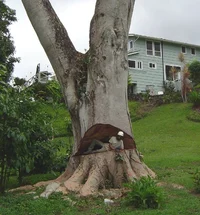
TC
Participating member
Re: Dangerous Technique Alert!!!
[ QUOTE ]
Hmmm....I wonder if the technique being practiced in this picture would be considered unsafe.
[/ QUOTE ]
Only if you heard a LOUD crack(!)
[ QUOTE ]
Hmmm....I wonder if the technique being practiced in this picture would be considered unsafe.
[/ QUOTE ]
Only if you heard a LOUD crack(!)
Treespotter
New member
- Location
- Houten, The Netherlands
Re: Dangerous Technique Alert!!!
It would only be unsafe to you if you stood to close to the tree whilst taking the picture.

It would only be unsafe to you if you stood to close to the tree whilst taking the picture.












New threads New posts
-
test
-
-

-
-
 Free CEUs: February 05 & March 05 - 'Urban Forestry Today' Webcasts @ Noon (Eastern)
- Started by UFT
- Replies: 0
-

-








