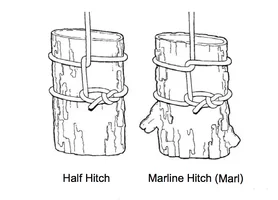
A marl is almost the same as a half-hitch to accompany your RB. I use a half-hitch. When you slip the marl off the end of the piece, it turns into an overhand knot. When you slip a HH off, it falls out cleanly.
They both take the strain of the RB.
With a hh/ rb, you can slip it off the end of the piece, and the RB will be your stopper knot, keeping the end from going through your block and falling to the ground. You can flip a HH onto the top of the spar, then slip on your RB. No need to untie/ retie the RB.
Some simple tips you might already know...
If you have a big spliced eye on the rigging line, you can replace the RB by forming a girth hitch by passing a bight of rope through the eye and "rolling" the eye "inside out" until it is TDS neatly.
As you are getting lower on the stem, you end up rigging thicker pieces with less rope in the system to absorb the shock through stretch, along with "running" it at the Lowering Device. If you re-direct your rope at the ground to another tree for your LD anchor, you can keep more rope in the system.
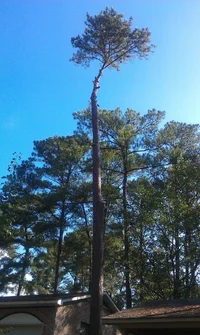
Looks like you had a tight drop zone there for a good sized tree. If you need to crash-land, or just cut and drop pieces, some tires tied together will absorb the impact and "catch the piece". I've had this work well, even on a bit of a slope with free-falling pieces. You can go to a tire store and get free junk tires. I've tied four together with the treads touching. You could layer two sets of three or four tires.
We had a 5'x 4' drop zone on a paver sidewalk for a tall fir tree, and bombed firewood rounds from 80-100' on down, with no broken pavers. We also had a rubber horse stall mat ($40) on top of the tires, making it easier to roll the round off the crash pad.