









Roof job - FA Rope questions

Woodwork

Participating member
Location
Tidewater
Hey, all,

I may try to reroof my house. 2nd story is 12 pitch (45°) and has required a rope to get up to clean chimney in past. Have roof jacks, scaffolding, ladders, etc., but I'm thinking I'll also want a fall-arrest harness and rope.

Questions:

- Given a choice, would you use a static rope or a stretchy rope in case you did fall on this? (I bought dynamic rope when I first did chimney and didn't know about other ropes. Since then I've also gotten tree rope and bull rope.) I'm thinking of using the stretchy rope since I won't be climbing or pulling myself up with it -- it's just for FA.

- What anti-chafing gear would you use where rope goes over roof ridge and down to truck / tree? It'll be sliding across abrasive asphalt shingles. Somewhere I saw someone talking about old fire hose, which sounds like it'd be good.
ETA: I could just use some old garden hose for chafing gear -- just thought of it.

Thanks,

Jeff
 
Last edited:
This summer I did a bunch of brick repointing and caulking on a 5/12 pitch using an 11 mm kern rope (Edelrid Preformance) and ISC's D4 in a RADS pulley setup.
http://www.wesspur.com/items/asc225.html
I think ISC gear is a cut above in compared to other stuff I have - it was flawless, smooth and gave me micro adjustment up and down, even while lying down on my side, feet out over roof overhangs (that was a different feeling). It gets my vote for roof work. Zero chance of fall or slip or even a skidder if you use roof clips for directionals.
Regulatory requirements for commercial work may be different where you live though, requiring full body harnesses, etc. etc.
Stay safe out there.
 
Thanks for your reply Ghostice. Not a commercial job and it's a one-off, I hope (my house), unless I live to be 100, so I was planning just to use what I've got.

When I cleaned chimney, I just used a rock climbing harness (I would substitue a FA harness for this) and prusik loops to pull myself up. With this roof job, I'll be using roof jacks so I won't need to pull myself up on the rope much, so I was just going to use a rope and 3/8" prusik loop and clip that to FA harness.

My main question is which rope to use – my rock climbing dynamic kernmantle rope (I forget the brand/product name), or my static tree rope (Yale XTC Fire). Stretchy or non-stretchy rope?

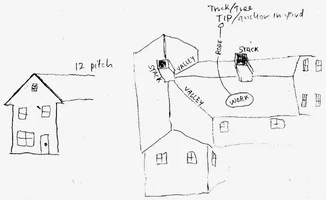
Depending on what part of the roof I'm working on, I figured on using the chimneys for some degree of lateral control -- could also nail down some redirects on the ridge for working at the gable ends -- and using the truck as a moveable anchor. Also will have some scaffolding. (See below)

House is shaped like a "T" with 2 valleys and 2 chimneys:

roof.webp
 
If you are going to keep the slack tended at all times, the static rope, or 16 strand, would be better with a burlier cover. Your regular harnesses would be okay for this, also. A fall arrest harness might leave you hanging from the back, and in midair if you slid off.

The dynamic rope would be better if slack is anticipated.
 
Thank you, Brocky. Hadn't considered the slack issue, but I guess that's the key to the whole question.

Good point on the FA harness hanging you from your back, too. For some reason I was thinking my rock harness wasn't strong enough if I fell, but it should be more than sufficient for any height fall I might experience on 2nd story, now that I think about it. And with that, at least I could get myself down where with FA harness, I'd have to have help, I guess.

I'm sure I'll be working with slack, so dynamic rope it is.

I appreciate the help, guys. Thanks.

Jeff
 
I’ve done roofing and snow/ice removal. Since I keep my slack tended I use my tree climbing setup

Rope protection isn’t complicated. Any tube thing works. Fire hose if you have accesss. Garden hose works fine too. A half hitch on a bite works well as a jam to keep the protector from sliding off the ridge.

Bagging the tail of your rope keeps things tidy
 
Thanks, Tom.

Another question: When I rig the rock climbing rope over the house, I should have both ends anchored at the ground, like with trucks parked on each side of the house -- so that if I fell and was hanging in mid-air, I could go down the rope instead of having to go back up and climb over the eave ... right?

This is the way I do it on the chimney cleaning, but for some reason I was thinking all I needed was one ground anchor on this. Now I'm thinking better use two, to avoid having to climb over the eave if injured. Or at least have enough tail to get to the ground. There will be scaffolding, but not full coverage, so depending on where I was, I might not be able to get to ladder or scaffolding...

Or maybe I'll just make sure I have enough rope to get to the ground, and bag it. It's not like I'll ever need the anchor on the downhill side, since I'll only be working on one side of the roof at a time.

Sorry for these real basic questions. I appreciate the help thinking it through.

Jeff
 
Last edited:
Probably just urban legends, like two guys lifting a running lawnmower to trim hedges, and they cut all their fingers off. But still a good idea!

If you're just working on one side, having enough rope to reach the ground is all you need. You just need to descend to ground if you slid off the roof.
 
Probably just urban legends, like two guys lifting a running lawnmower to trim hedges, and they cut all their fingers off. But still a good idea!

If you're just working on one side, having enough rope to reach the ground is all you need. You just need to descend to ground if you slid off the roof.

I know of one instance that is not an urban legend. The wife drove off while the husband was roofing. The husband won a Darwin award. I would not recommend using a vehicle as an anchor unless it is an emergency.
 
Actually, make sure rope is tight all the time and no falls is the best advice. If you're planning on arresting if you go over the eves, maybe better plan on how to deal with going into or through a plate glass window (building code doesn't require safety glass on second story windows) - actual incident about 30 yrs ago - guy went off a building but his swing took him thru a window - extensive lacerations to lower body and lucky EMT's got an IV in him quickly due to blood loss. Lots of stitches and some tendon damage as I remember. What you potentially stand to hit or go thru is a concern not always addressed in the fall proection plans for going over an eves. Pendulum swing into a brick chimney, no problem - just smashed up or some busted ankles. Some of the other stuff though - permanent ouch. My 2 centz
We always used the rule; If it can happen, it will.
 
A roof peak reusable anchor is what I use. Like THIS one. You need a caulk gun and a tube of high quality caulk (polyurethane or tri-polymer) to caulk up the screws if you're going to leave it installed on the roof, or remove it and caulk up the holes in the shingles. If you reinstall it after the tearoff, you can permanently install it by caulking it all up with plastic roofing cement and shingling over it. You'll have to pay attention when you do the ridge cap, to keep it waterproof. Good caulk is your friend.

Use the 16-strand and keep your slack tended, as others have noted. It's work positioning.. fall arrest gets complicated on a roof, because the rope is usually at an angle to a fixed anchor and the point where you actually go over the edge is hard to predict.

One of our houses has a 12/12 pitch and I installed three of them on the house and one on the garage permanently, because I'm up there when I do any work on the ham radio antenna installations. Most people won't want to bother with that.
 
Thanks, JeffGu, that roof anchor is pretty slick. Had not seen them before (and was planning to fabricate something to accomplish the same thing)...
 
Thanks again for these replies. I plan to do this job this spring.

Was going to use old fire hose for anti-chafing gear on the rope over the ridge of the roof.

Question: Will I be able to get a 1/2" rope through about 10' or 15' of 1-3/4" diameter fire hose to use as anti-chafing? I figured I'd use a fishing weight and braided fishing line to get through the fire hose initially (like a throw line) and then use that to pull my 1/2" rope through the hose...
 
Thanks again for these replies. I plan to do this job this spring.

Was going to use old fire hose for anti-chafing gear on the rope over the ridge of the roof.

Question: Will I be able to get a 1/2" rope through about 10' or 15' of 1-3/4" diameter fire hose to use as anti-chafing? I figured I'd use a fishing weight and braided fishing line to get through the fire hose initially (like a throw line) and then use that to pull my 1/2" rope through the hose...

It should work. I think it would be easier to get through the hose with a fish tape or fiberglass rods. You can push it from one end.
 
@JeffGu and others: anyone have experience with the “permanent” stainless roof anchors? I want to install a few and leave em in case the suns out and the mrs. asks me to take her somewhere special to eat lunch.
 

New threads New posts

Kask Stihl NORTHEASTERN Arborists Wesspur TreeStuff.com Teufelberger Westminster X-Rigging Teufelberger
Back
Top Bottom












