Risk assessing a tree

Location
PA
What type of insect activity do you consider normal vs cause for concern ? Is seeing a single termite or carpenter ant enough for you?

In some cases it's been blatantly obvious to me (dying white oak with a super highway of carpenter ants). Other times I'll see a few termites on the trunk and wonder.

I haven't been bitten by the trees that have minimal insect activity. Just trying to gauge the general consensus. I love climbing, but also like doing a risk assessment prior, so I'm as informed as can be.
 
Even an army of ants may mean very little - they could all be concentrated in one limb or a relatively small hollow spot on the trunk. They certainly should say "figure out what is going on with decay" - but it is important to recognize decay pockets even if the ants aren't there. Look for mis-shapen wood. That says "rot" but it doesn't say how extensive. The first tool to use when estimating extent of decay is a mallet. Learn to hear what the different tones mean. Tap on down logs so you can see how much decay makes each sound. A probe is also very useful if there are openings you can reach.
 
There was a large White oak I worked on recently that the clients had a lot of love for, they built their house on piers as far away from the tree as they can, and a company I was working with at the time had been out several times to evaluate and deadwood. It had a large defect at the base of the tree and had a lot of panic sprouts. There was also an extensive ant population emerging from the hole at one visit. I thought we were going to be doing an aggressive tip weight reduction on the whole tree, trying to reduce the likelihood of striking a neighbors house, and coming back a few years later for a removal.

Good news! We had a tomograph done and it revealed the decay really wasn't as advanced as we had guessed. So much better than expected that we decided not to prune the tree at all, and just do vertical mulching.

As far as the ants, my understanding is that ants will not further the demise of a tree, just eat the soft rotten wood as it decays. All it really indicates is, yes, there is a cavity and yes there is some rotten wood inside of it. I do not believe I have ever climbed a large (over 36" diameter, say) tree of any species that did not have some cavities and insect activity present.
 
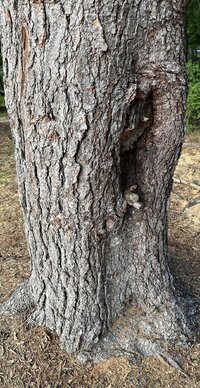
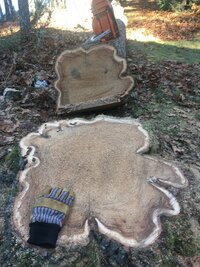
Thanks for the replies. I am taking a 24" dbh white pine down later this week. Not due to its health, but the customer is putting in a water feature.

The pine has what appears to be an old wound from a flush cut. I noticed some carpenter ant activity, but the wound looks very old. If you look closely at the base, you can see wood shavings from termites or the ants

Have used this tree as an access tree in the past. Was solid about 8 months ago. These replies are encouraging
 

Attachments

  • IMG_3601.jpeg
    IMG_3601.jpeg
    988.8 KB · Views: 11
My gaffs seem to find every rotten tree within 50 miles of me. Been up stuff that I wouldn't do any heavy rigging from but still climbed it. To the tree, I'm just another ant. There is some stuff I wouldn't climb and found alternatives for removal. Did some with 50ton crane that I wouldn't rig anything from but knew it was safe for crane picks.

From your pic, I'd gaff that all day.
 
A thorough inspection is still required. Tap on it like ATH mentioned, probe it with a long screwdriver or something, take notice of how much dead wood is in the tree.

If you're not comfortable with it, don't climb it. You'll get a sense of what's ok and what's not with experience. Take note of stuff that's rotten and it's structure. Standing or just put on the ground. You'll learn the woods structure and what it can tolerate. All species are different too.
 
Climb fast and don't think about it. Jk.

I don't look for insect activity in general. Rot (especially soft rot) cankers, fruiting bodies, cavities without significant compartmentalization, obvious inclusion failures, etc. I'm pretty conservative on tree risk. Species plays a big part too. I climbed a terrible Siberian Elm this week that, if it were a different species, I probably wouldn't have climbed. I knew it would hold up to the rigging needed.
 

New threads New posts

Back
Top Bottom