RigGuy cabling wire stops

Just installed my first RigGuy system today. I really enjoy it. It is the only EHS system that I know of that is single-climber possible. I used a microcender in lieu of a chicago-grip.

Thanks Guy for the pic. I'll surround the cone next-time. I see your point.
 
The baby is still in the bath water...don't make the toss!!!

There is a place for steel cables I know. Low in the tree where a split has formed. The tree will move very little but needs a super strong support that doesn't move very much. Hybrid support systems where through bolts in the woody trunk, steel cable above that and dynamic cable way up in the moving crown. The best of all worlds.

Don't get so strident about poking holes in trees. Like
Alex said, 'It's all about dose.' compare the does of damage by installing a steel cable to support a crack to the dosage of failure from not supporting the structural defect. A small wound is less significant than a tree failure.

Mattheck isn't the ONLY source for understanding the physics of trees. A more complete vision will be gained by understanding statics. Do a search for Erk Brudi's work. combine both to get a more complex understanding of how trees survive and what we can do to reduce their failures.
 
Brudi's work is interesting Tom, but everyone of these guys is of the consensus that invasive steel cabling will be obselete in less than 30 years. I agree with them. Steel cabling, drilling holes in trees is finished, its a throwback to the 40s and 50s, time and technology have moved on, it is folly to pretend that drilling holes in trees is advanced tree care.

What is your guy's issue with Mattheck anyway?! just because he's not American is that it? At this moment in time Claus mattheck is in the vanguard of arboricultural research, leave your petty xenophobia behind and listen to the man, its not about academic egos, its about learning from the most intelligent and thought provoking source and right tnow that is Mattheck.
 
[ QUOTE ]
At this moment in time Claus mattheck is in the vanguard of arboricultural research

[/ QUOTE ]

Hmmm specifically what area of Arboricultural research are you alluding to?

[ QUOTE ]
its about learning from the most intelligent and thought provoking source and right tnow that is Mattheck

[/ QUOTE ]

I didn't realise that Arboriculture had descended globally to a competition between cheer squads....I know thats the case in the UK, but perhaps you should take your own advice and look beyond the merchandise...there's a great deal of excellent research (without magic numbers and core bending devices) out there from a great many sources.
 
guy wrote:


[ QUOTE ]
Steel when movement tends to destroy the union, synthetic when movement tends to build the union.

[/ QUOTE ]

That is a very good synopsis.


grover wrote:

[ QUOTE ]
By installing steel cables you are destroying the trees ability to create secondary thickening around structural weaknesses at branch unions.


[/ QUOTE ]


This, I think, is vastly overstated. It stems from the concept that steel does not stretch (and it doesn't) and sythetic material does stretch (and it does).

But how much stretch does the synthetic material have? 5%? 10%? I have asked this quetion before but have not received any replies.

And although steel does not stretch that does not mean that the system (and the tree) is static and immovable.

For the sake of discussion lets suppose (and this number is just a guess on my part, so please don't use it elsewhere) that a synthetic material stretches 10%. That means that a 10 foot long cable will allow, at a maximum, an extra 1 foot of movement, but only when the force is strong enough to move the stems to the limit of the stretch of the material and only when the stems are moving exactly in line with the cable. That is, if the cable is installed so that it is alinged in exactly a north/south orientation and the wind blows from the north to the south, the southern stem will move ten inches further with a sythetic system than it would with a steel system. If Guy's advice

[ QUOTE ]
"Steel when movement tends to destroy the union, synthetic when movement tends to build the union"


[/ QUOTE ]

has been followed then all should be well.

And note that if the steel system allows only ten feet of separation at any time between the two stems, a synthetic system allows only eleven feet of separation at any time between the two stems (and this only when the force is strong enough to stretch the synthetic material). Both systems restrict the completely natural movement of the tree.

For an idea of the oscillation of trees in a wind see the article by Ken James in February's Arborist News magazine.

My point is that steel systems are not completely static and synthetic systems do not allow the same unencumbered movement that a tree would have without a system. I don't think that the difference in a tree's movement when using a steel versus a static system is as significant as has been portrayed.
 
Mattheck has been referenced as one of the leading researchers of the day with inferences that he feels that invasive drilling is damaging to trees. If you have read his study "The Effects of Excessive Drilling on Wood Decay in Trees" (co-authored by K. Weber) which dealt with several species over a 10 year period, both decayed and healthy, you will see that his conclusions in that study supported the practice of drilling in diagnostic circumstances as opposed to whole tree removal or failure. His findings show that the drilling itself was fairly insignicant with a reminder that discoloration is not (and should not be confused with) decay.

Cabling should be a last resort. Not as a prophylactic which might inhibit the tree's ability to grow naturally.

Back on topic, I too am adopting a "wait and see the field results" on the rig guy because of my concern of cable failure at the inner junction of the cable and trunk. Cable failures I have removed from old trees failed when movement between the cable and eye stopped. But because all of those failures occurred in old cables, 20 years plus, it may be irrelevant. So, here I sit and wait the results....

D Mc
 
[ QUOTE ]
Just installed my first RigGuy system today. I really enjoy it. It is the only EHS system that I know of that is single-climber possible.

[/ QUOTE ]


I have installed scores of EHS systems using deadends without another climber.
 
You may already know this from the literature, but the RIGGUY manufacturer recommends a hole 1/16" larger than the cable. They also sell bits if you can't find them, but only up to the 18" range. If you need longer than that, you may be pushing the limits of 5/16" cable. You can buy extensions to those auger bits, but the end of the extension is larger than the bits you are using. As a compromise, you might drill a 2"-deep hole large enough for the extension (on the inside of the crotch, presumably), then the rest of the way through with the appropriate ship auger.

As for the silicone, my personal opinion (no research to back it up) is not to use it. As with wound dressing, you might just as easily caulk some bad spores inside the hole as keep them out, and you'd have created a nice, warm, moist place for them to germinate.

I'm still on the fence about the rigguy, for the same reason as Mahk. We did one installation recently and plan to watch it while we use up our stock of eye lags and amon eyes. NOt sure if we'll switch, give up on rigguy, or go for some combination.

We do try to use dynamics when possible, but there are times when steel still seems to be the best choice.

k
 
Good observation about the "amount of stretch" in dynamic vs static systems Mahk, indeed it can be perceived as fractional in regards to overall length. Now imagine falling from a bunk bed in your sleep. What would you rather land upon, the concrete floor or a dense foam pad? Ever tried to break a Coke bottle against a tree? Heck, think about the distance the crumple zone of a car collapses in a catastrophic collision, or what an airbag can do for your little pea-bob in a crash? Certainly the long leg of branch above a cable installation absorbs some energy from static cable but it seems hardly arguable that additional energy absorbed by dynamic restraint material can ad significant difference in high winds.

If I didn't confess it in a previous catalog, I should this year. I was of your train of thought initially about Rigguy wire stops; that the cable span supporting tree parts would be under significant flex fatigue at contact points due to oscillating movement of the limbs. Two years ago we added the product after pretty convincing reassurance from a renowned scientist for one of North America's premier biology-based tree service companies. I'm still awaiting their results on dynamic cable.

If it were my trees? There'd have to be pretty significant reason to use any kind of cable, much less static/invasive. I just think this practice should be very last resort.

cheers all
 
[ QUOTE ]
[ QUOTE ]
Just installed my first RigGuy system today. I really enjoy it. It is the only EHS system that I know of that is single-climber possible.

[/ QUOTE ]


I have installed scores of EHS systems using deadends without another climber.

[/ QUOTE ]

Me too!
 
Hi neighbor!
[ QUOTE ]
Certainly the long leg of branch above a cable installation absorbs some energy from static cable but it seems hardly arguable that additional energy absorbed by dynamic restraint material can ad significant difference in high winds.

[/ QUOTE ]True, but isn't the idea of the 2/3 guideline and regular inspections to have a *short* leg of branch above the cable?[ QUOTE ]

If it were my trees? There'd have to be pretty significant reason to use any kind of cable, much less static/invasive. I just think this practice should be very last resort.

[/ QUOTE ]I'd put cabling at 3rd-to last. Removal is last, and a disfiguring/devaluing amount of reduction would be 2nd to last. Both those options are much more expensive, in terms of cost and tree damage, than cabling.

I expect the wirestop designer to weigh in tomorrow--we are hearing from all over, great comments!
 
[ QUOTE ]


Quote:
--------------------------------------------------------------------------------


Quote:
--------------------------------------------------------------------------------

Just installed my first RigGuy system today. I really enjoy it. It is the only EHS system that I know of that is single-climber possible.


--------------------------------------------------------------------------------


I have installed scores of EHS systems using deadends without another climber.


--------------------------------------------------------------------------------


Me too!

[/ QUOTE ]

Me three. It's just that on long spans, I prefer another climber.

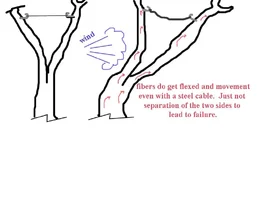
I'm glad Mahk mentioned that trees with steel hardware do still flex and move. There was so much talk (and still is) about steel cables not allowing a tree to flex and move, that I started to almost believe it a few years back. Until huricane Isabell came through years ago. When she came through I drove to my parents house just to see how their big multiple stem silver maple was moving with steel cables in it. It moved tremendously. So much that I rushed to get a video camera to record it. The only movement that didn't happen was the seperation of the stems to where the tight V crotches would have failed. (see my very poor drawling in the attachment)

What I don't like about steel is that if a gust of wind blows in a way to produce a big amount of slack in the cable, when the limb or leader bounces back to the original position, a tremendous jolt must happen to the steel hardware, with no give, a lag could be ripped out, broken, or break a cable or something else. That's why I'd like to see a steel system with a spring inline in the system.

What customer really will have an arborist climb and inspect a dynamic system every 2 to 3 years? About, NONE. I like the longevity of a steel system.

But this thread was supposed to be about the rig guy wire stops, not dynamic vs. static cabling. But some people always have to turn it into that. grover.

I do worry about the fatigue of the cable entering the wood. Yes, just as someone else mentioned, we've only seen this on 15-20 year old cables with lags or rods though. So maybe EHS cable won't fatigue anyway, until it is much older.

One of the wire stop guys at a TCIA trade show said the same old reply to me, "yeah, but the tree is constantly growing and the entry point of the cable is constantly changing to a new location". My thoughts are yeah, very, very slowly and ever so little.

Time will tell, I guess about 10 years of time with the cable stops will be adequate; in a tree with a lot of movement. But I'm not going to test them out on any of my customers trees. Maybe I should put them in some trees in my woods.

I do think they are a clever idea.

 

Attachments

  • 121176-cableflex.webp
    121176-cableflex.webp
    28.7 KB · Views: 43
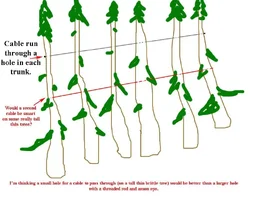
This is something I've wondered about for a while. (see attachment)

This would involve using the wire stops and running the cable through the stems.

I have wondered about doing this: Say you have a long line of white pine trees. They were planted very close and are very tall and thin. Say they are next to a parking lot and you are afraid one might break now and then and cause damage to a car. Removal is not an option, nor is thinning. What if you drilled a small hole through each trunk 2/3rds way to the top and ran a single cable through all the trunks down the row. This way, if one tried to break from the row, the cable would stop it or at least keep it from falling. Or, would there be the possibility of one or two initially breaking, and then pulling all the rest down with them? Would multiple cables be better?
 

Attachments

  • 121181-cabletallwhitepinescopy.webp
    121181-cabletallwhitepinescopy.webp
    44.8 KB · Views: 67
[ QUOTE ]
[ QUOTE ]


Quote:
--------------------------------------------------------------------------------


Quote:
--------------------------------------------------------------------------------

Just installed my first RigGuy system today. I really enjoy it. It is the only EHS system that I know of that is single-climber possible.


--------------------------------------------------------------------------------


I have installed scores of EHS systems using deadends without another climber.


--------------------------------------------------------------------------------


Me too!

[/ QUOTE ]

Me three. It's just that on long spans, I prefer another climber.


[/ QUOTE ]

Me four
mad.gif
. Dang it, you guys showing me up. Well, if I'm going to learn a thing or two, I couldn't pick three better guys
grin.gif
 
Five
wink.gif


The karate effect has been overplayed I think. If a wind moves a tree inline with the cable the upwind side will displace some distance along with the downwind side. I doubt that a lot of slack is developed in the cable. A properly designed, installed and inspected cabling system would account for this type of loading.

If a web of cables needs to be installed in the pines it is the perfect place for dynamic. Erk Brudi shared pictures of a system that was installed in an allee of large trees.

Think of how the rigging on old sailing ships was designed. As the parts that were supported got smaller so did the rigging. The tree has taper and so should our systems.
 

Attachments

  • 121197-web2UTRMMVictory.webp
    121197-web2UTRMMVictory.webp
    29.5 KB · Views: 60
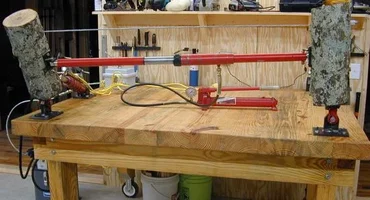
I have done a number of wind simulation test using hydraulic cylinders. The strand will hold longer than eye bolts in these test. I will download a picture. Also, each year the place where the strand is subject to fatigue will change slightly because of the growth of the tree. So, I think there is not much possibility of strand failure. I practice, there has not been any reported fatigue failures in the past six years.

Steve Tillitski
Rigguy, Inc
 

Attachments

  • 122251-Windtest.webp
    122251-Windtest.webp
    40.3 KB · Views: 53
The failures that I have seen have always occured in the terminal hardware. I have never actually seen the strand itself break. The failure is always in the neck of the lag where the threads start or in the apex of the pre-formed wrap. I am not sure the breakage is because of lack of movement or because of fatigue or wear. When I have done tests using hydraulic cylinders, when there is pressure of over 750 pounds of so the thimble does not move but rather the whole eye bolt moves.


Steve Tillitski
Rigguy, Inc
 

New threads New posts

Back
Top Bottom